

152
Z. Tang et al.
Determination of Thermodynamic Conditions
Temperature
The temperature has a great influence on the standard equilibrium constant of the
chemical reaction. Although the temperature of the lower part of the blast furnace
varies with the blast furnace object, most of the temperature is between 1373.15 and
1673.15 K. The temperature for this calculation is 1523.15 K.
System Pressure
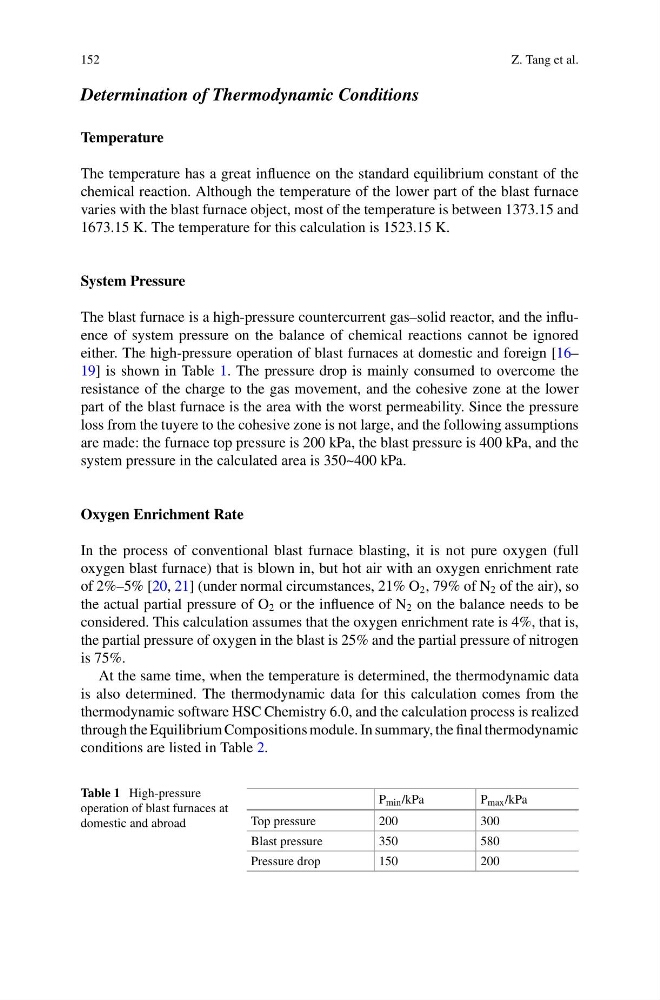
The blast furnace is a high-pressure countercurrent gas–solid reactor, and the influence of system pressure on the balance of chemical reactions cannot be ignored
either. The high-pressure operation of blast furnaces at domestic and foreign [16–
19] is shown in Table 1. The pressure drop is mainly consumed to overcome the
resistance of the charge to the gas movement, and the cohesive zone at the lower
part of the blast furnace is the area with the worst permeability. Since the pressure
loss from the tuyere to the cohesive zone is not large, and the following assumptions
are made: the furnace top pressure is 200 kPa, the blast pressure is 400 kPa, and the
system pressure in the calculated area is 350~400 kPa.
Oxygen Enrichment Rate
In the process of conventional blast furnace blasting, it is not pure oxygen (full
oxygen blast furnace) that is blown in, but hot air with an oxygen enrichment rate
of 2%–5% [20, 21] (under normal circumstances, 21% O 2 , 79% of N 2 of the air), so
the actual partial pressure of O 2 or the influence of N 2 on the balance needs to be
considered. This calculation assumes that the oxygen enrichment rate is 4%, that is,
the partial pressure of oxygen in the blast is 25% and the partial pressure of nitrogen
is 75%.
At the same time, when the temperature is determined, the thermodynamic data
is also determined. The thermodynamic data for this calculation comes from the
thermodynamic software HSC Chemistry 6.0, and the calculation process is realized
through the Equilibrium Compositions module. In summary, the final thermodynamic
conditions are listed in Table 2.
Table 1 High-pressure
operation of blast furnaces at
domestic and abroad
P min /kPa
P max /kPa
Top pressure
200
300
Blast pressure
350
580
Pressure drop
150
200
Z. Tang et al.
Determination of Thermodynamic Conditions
Temperature
The temperature has a great influence on the standard equilibrium constant of the
chemical reaction. Although the temperature of the lower part of the blast furnace
varies with the blast furnace object, most of the temperature is between 1373.15 and
1673.15 K. The temperature for this calculation is 1523.15 K.
System Pressure
The blast furnace is a high-pressure countercurrent gas–solid reactor, and the influence of system pressure on the balance of chemical reactions cannot be ignored
either. The high-pressure operation of blast furnaces at domestic and foreign [16–
19] is shown in Table 1. The pressure drop is mainly consumed to overcome the
resistance of the charge to the gas movement, and the cohesive zone at the lower
part of the blast furnace is the area with the worst permeability. Since the pressure
loss from the tuyere to the cohesive zone is not large, and the following assumptions
are made: the furnace top pressure is 200 kPa, the blast pressure is 400 kPa, and the
system pressure in the calculated area is 350~400 kPa.
Oxygen Enrichment Rate
In the process of conventional blast furnace blasting, it is not pure oxygen (full
oxygen blast furnace) that is blown in, but hot air with an oxygen enrichment rate
of 2%–5% [20, 21] (under normal circumstances, 21% O 2 , 79% of N 2 of the air), so
the actual partial pressure of O 2 or the influence of N 2 on the balance needs to be
considered. This calculation assumes that the oxygen enrichment rate is 4%, that is,
the partial pressure of oxygen in the blast is 25% and the partial pressure of nitrogen
is 75%.
At the same time, when the temperature is determined, the thermodynamic data
is also determined. The thermodynamic data for this calculation comes from the
thermodynamic software HSC Chemistry 6.0, and the calculation process is realized
through the Equilibrium Compositions module. In summary, the final thermodynamic
conditions are listed in Table 2.
Table 1 High-pressure
operation of blast furnaces at
domestic and abroad
P min /kPa
P max /kPa
Top pressure
200
300
Blast pressure
350
580
Pressure drop
150
200