

142
B.-W. Liu et al.
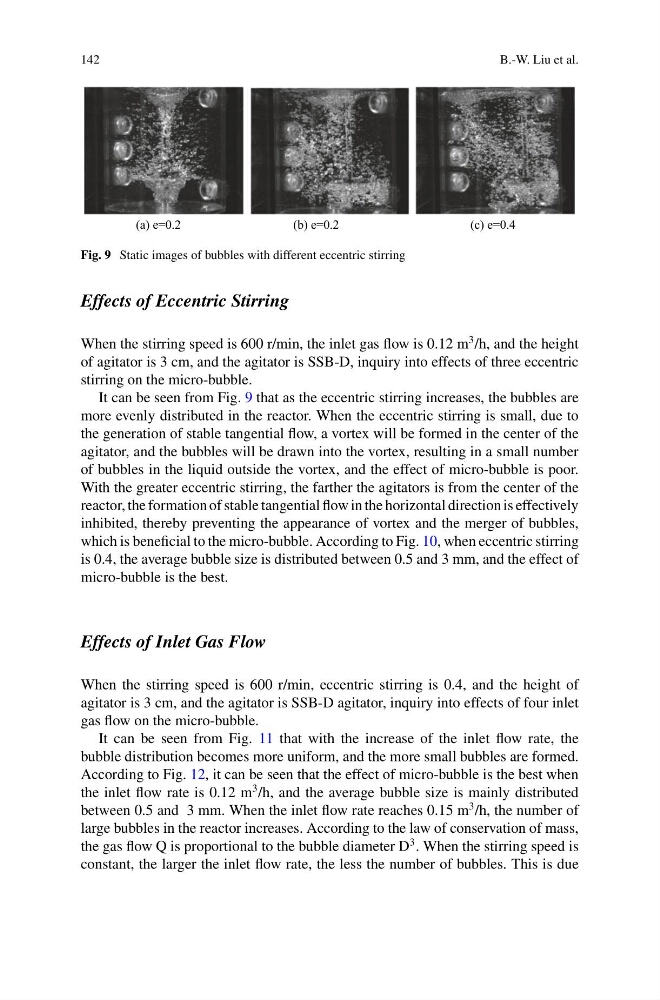
(a) e=0.2
(b) e=0.2
(c) e=0.4
Fig. 9 Static images of bubbles with different eccentric stirring
Effects of Eccentric Stirring
When the stirring speed is 600 r/min, the inlet gas flow is 0.12 m
3 /h, and the height
of agitator is 3 cm, and the agitator is SSB-D, inquiry into effects of three eccentric
stirring on the micro-bubble.
It can be seen from Fig. 9 that as the eccentric stirring increases, the bubbles are
more evenly distributed in the reactor. When the eccentric stirring is small, due to
the generation of stable tangential flow, a vortex will be formed in the center of the
agitator, and the bubbles will be drawn into the vortex, resulting in a small number
of bubbles in the liquid outside the vortex, and the effect of micro-bubble is poor.
With the greater eccentric stirring, the farther the agitators is from the center of the
reactor, the formation of stable tangential flow in the horizontal direction is effectively
inhibited, thereby preventing the appearance of vortex and the merger of bubbles,
which is beneficial to the micro-bubble. According to Fig. 10, when eccentric stirring
is 0.4, the average bubble size is distributed between 0.5 and 3 mm, and the effect of
micro-bubble is the best.
Effects of Inlet Gas Flow
When the stirring speed is 600 r/min, eccentric stirring is 0.4, and the height of
agitator is 3 cm, and the agitator is SSB-D agitator, inquiry into effects of four inlet
gas flow on the micro-bubble.
It can be seen from Fig. 11 that with the increase of the inlet flow rate, the
bubble distribution becomes more uniform, and the more small bubbles are formed.
According to Fig. 12, it can be seen that the effect of micro-bubble is the best when
the inlet flow rate is 0.12 m
3 /h, and the average bubble size is mainly distributed
between 0.5 and 3 mm. When the inlet flow rate reaches 0.15 m
3 /h, the number of
large bubbles in the reactor increases. According to the law of conservation of mass,
the gas flow Q is proportional to the bubble diameter D
3 . When the stirring speed is
constant, the larger the inlet flow rate, the less the number of bubbles. This is due
B.-W. Liu et al.
(a) e=0.2
(b) e=0.2
(c) e=0.4
Fig. 9 Static images of bubbles with different eccentric stirring
Effects of Eccentric Stirring
When the stirring speed is 600 r/min, the inlet gas flow is 0.12 m
3 /h, and the height
of agitator is 3 cm, and the agitator is SSB-D, inquiry into effects of three eccentric
stirring on the micro-bubble.
It can be seen from Fig. 9 that as the eccentric stirring increases, the bubbles are
more evenly distributed in the reactor. When the eccentric stirring is small, due to
the generation of stable tangential flow, a vortex will be formed in the center of the
agitator, and the bubbles will be drawn into the vortex, resulting in a small number
of bubbles in the liquid outside the vortex, and the effect of micro-bubble is poor.
With the greater eccentric stirring, the farther the agitators is from the center of the
reactor, the formation of stable tangential flow in the horizontal direction is effectively
inhibited, thereby preventing the appearance of vortex and the merger of bubbles,
which is beneficial to the micro-bubble. According to Fig. 10, when eccentric stirring
is 0.4, the average bubble size is distributed between 0.5 and 3 mm, and the effect of
micro-bubble is the best.
Effects of Inlet Gas Flow
When the stirring speed is 600 r/min, eccentric stirring is 0.4, and the height of
agitator is 3 cm, and the agitator is SSB-D agitator, inquiry into effects of four inlet
gas flow on the micro-bubble.
It can be seen from Fig. 11 that with the increase of the inlet flow rate, the
bubble distribution becomes more uniform, and the more small bubbles are formed.
According to Fig. 12, it can be seen that the effect of micro-bubble is the best when
the inlet flow rate is 0.12 m
3 /h, and the average bubble size is mainly distributed
between 0.5 and 3 mm. When the inlet flow rate reaches 0.15 m
3 /h, the number of
large bubbles in the reactor increases. According to the law of conservation of mass,
the gas flow Q is proportional to the bubble diameter D
3 . When the stirring speed is
constant, the larger the inlet flow rate, the less the number of bubbles. This is due