

120
K. He et al.
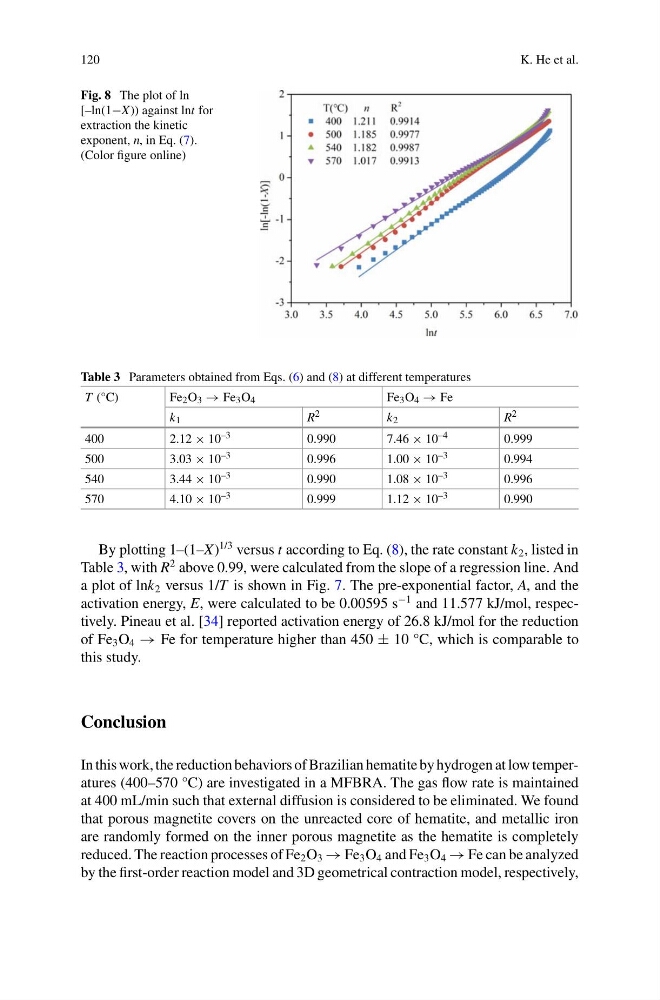
Fig. 8 The plot of ln
[–ln(1−X)) against lnt for
extraction the kinetic
exponent, n, in Eq. (7).
(Color figure online)
Table 3 Parameters obtained from Eqs. (6) and (8) at different temperatures
T (°C)
Fe 2 O 3 → Fe 3 O 4
Fe 3 O 4 → Fe
k 1
R 2
k 2
R 2
400
2.12 × 10 –3
0.990
7.46 × 10 –4
0.999
500
3.03 × 10 –3
0.996
1.00 × 10 –3
0.994
540
3.44 × 10 –3
0.990
1.08 × 10 –3
0.996
570
4.10 × 10 –3
0.999
1.12 × 10 –3
0.990
By plotting 1–(1–X)
1/3 versus t according to Eq. (8), the rate constant k 2 , listed in
Table 3, with R
2 above 0.99, were calculated from the slope of a regression line. And
a plot of lnk 2 versus 1/T is shown in Fig. 7. The pre-exponential factor, A, and the
activation energy, E, were calculated to be 0.00595 s
−1 and 11.577 kJ/mol, respectively. Pineau et al. [34] reported activation energy of 26.8 kJ/mol for the reduction
of Fe 3 O 4 → Fe for temperature higher than 450 ± 10 °C, which is comparable to
this study.
Conclusion
In this work, the reduction behaviors of Brazilian hematite by hydrogen at low temperatures (400–570 °C) are investigated in a MFBRA. The gas flow rate is maintained
at 400 mL/min such that external diffusion is considered to be eliminated. We found
that porous magnetite covers on the unreacted core of hematite, and metallic iron
are randomly formed on the inner porous magnetite as the hematite is completely
reduced. The reaction processes of Fe 2 O 3 → Fe 3 O 4 and Fe 3 O 4 → Fe can be analyzed
by the first-order reaction model and 3D geometrical contraction model, respectively,
K. He et al.
Fig. 8 The plot of ln
[–ln(1−X)) against lnt for
extraction the kinetic
exponent, n, in Eq. (7).
(Color figure online)
Table 3 Parameters obtained from Eqs. (6) and (8) at different temperatures
T (°C)
Fe 2 O 3 → Fe 3 O 4
Fe 3 O 4 → Fe
k 1
R 2
k 2
R 2
400
2.12 × 10 –3
0.990
7.46 × 10 –4
0.999
500
3.03 × 10 –3
0.996
1.00 × 10 –3
0.994
540
3.44 × 10 –3
0.990
1.08 × 10 –3
0.996
570
4.10 × 10 –3
0.999
1.12 × 10 –3
0.990
By plotting 1–(1–X)
1/3 versus t according to Eq. (8), the rate constant k 2 , listed in
Table 3, with R
2 above 0.99, were calculated from the slope of a regression line. And
a plot of lnk 2 versus 1/T is shown in Fig. 7. The pre-exponential factor, A, and the
activation energy, E, were calculated to be 0.00595 s
−1 and 11.577 kJ/mol, respectively. Pineau et al. [34] reported activation energy of 26.8 kJ/mol for the reduction
of Fe 3 O 4 → Fe for temperature higher than 450 ± 10 °C, which is comparable to
this study.
Conclusion
In this work, the reduction behaviors of Brazilian hematite by hydrogen at low temperatures (400–570 °C) are investigated in a MFBRA. The gas flow rate is maintained
at 400 mL/min such that external diffusion is considered to be eliminated. We found
that porous magnetite covers on the unreacted core of hematite, and metallic iron
are randomly formed on the inner porous magnetite as the hematite is completely
reduced. The reaction processes of Fe 2 O 3 → Fe 3 O 4 and Fe 3 O 4 → Fe can be analyzed
by the first-order reaction model and 3D geometrical contraction model, respectively,