

Reduction Behaviors of Hematite to Metallic Iron …
113
Materials and Methods
Experimental Conditions
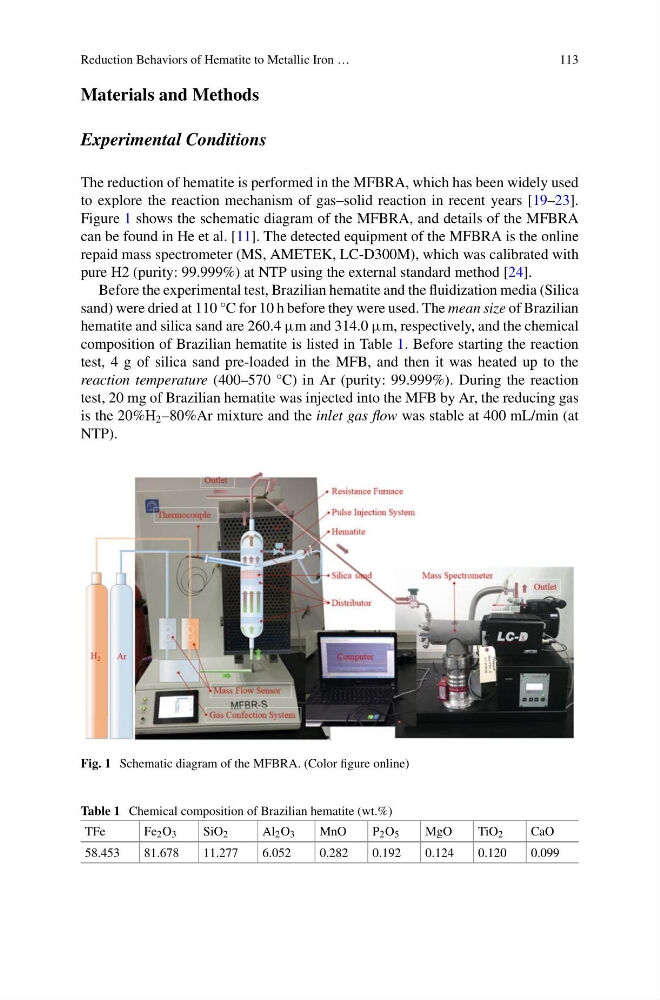
The reduction of hematite is performed in the MFBRA, which has been widely used
to explore the reaction mechanism of gas–solid reaction in recent years [19–23].
Figure 1 shows the schematic diagram of the MFBRA, and details of the MFBRA
can be found in He et al. [11]. The detected equipment of the MFBRA is the online
repaid mass spectrometer (MS, AMETEK, LC-D300M), which was calibrated with
pure H2 (purity: 99.999%) at NTP using the external standard method [24].
Before the experimental test, Brazilian hematite and the fluidization media (Silica
sand) were dried at 110 °C for 10 h before they were used. The mean size of Brazilian
hematite and silica sand are 260.4 μm and 314.0 μm, respectively, and the chemical
composition of Brazilian hematite is listed in Table 1. Before starting the reaction
test, 4 g of silica sand pre-loaded in the MFB, and then it was heated up to the
reaction temperature (400–570 °C) in Ar (purity: 99.999%). During the reaction
test, 20 mg of Brazilian hematite was injected into the MFB by Ar, the reducing gas
is the 20%H 2 –80%Ar mixture and the inlet gas flow was stable at 400 mL/min (at
NTP).
Fig. 1 Schematic diagram of the MFBRA. (Color figure online)
Table 1 Chemical composition of Brazilian hematite (wt.%)
TFe
Fe 2 O 3
SiO 2
Al 2 O 3
MnO
P 2 O 5
MgO
TiO 2
CaO
58.453
81.678
11.277
6.052
0.282
0.192
0.124
0.120
0.099
113
Materials and Methods
Experimental Conditions
The reduction of hematite is performed in the MFBRA, which has been widely used
to explore the reaction mechanism of gas–solid reaction in recent years [19–23].
Figure 1 shows the schematic diagram of the MFBRA, and details of the MFBRA
can be found in He et al. [11]. The detected equipment of the MFBRA is the online
repaid mass spectrometer (MS, AMETEK, LC-D300M), which was calibrated with
pure H2 (purity: 99.999%) at NTP using the external standard method [24].
Before the experimental test, Brazilian hematite and the fluidization media (Silica
sand) were dried at 110 °C for 10 h before they were used. The mean size of Brazilian
hematite and silica sand are 260.4 μm and 314.0 μm, respectively, and the chemical
composition of Brazilian hematite is listed in Table 1. Before starting the reaction
test, 4 g of silica sand pre-loaded in the MFB, and then it was heated up to the
reaction temperature (400–570 °C) in Ar (purity: 99.999%). During the reaction
test, 20 mg of Brazilian hematite was injected into the MFB by Ar, the reducing gas
is the 20%H 2 –80%Ar mixture and the inlet gas flow was stable at 400 mL/min (at
NTP).
Fig. 1 Schematic diagram of the MFBRA. (Color figure online)
Table 1 Chemical composition of Brazilian hematite (wt.%)
TFe
Fe 2 O 3
SiO 2
Al 2 O 3
MnO
P 2 O 5
MgO
TiO 2
CaO
58.453
81.678
11.277
6.052
0.282
0.192
0.124
0.120
0.099