

5.3 Case Studies for Determining the Potential of Renewable Hydrogen …
83
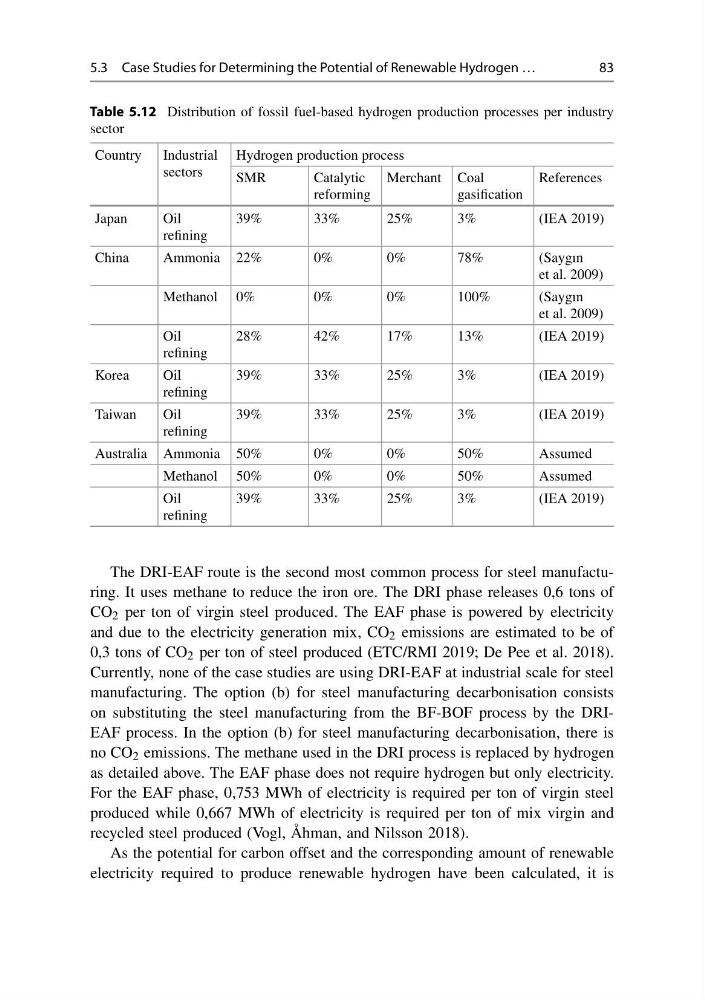
Table 5.12 Distribution of fossil fuel-based hydrogen production processes per industry
sector
Country
Industrial
sectors
Hydrogen production process
SMR
Catalytic
reforming
Merchant Coal
gasification
References
Japan
Oil
refining
39%
33%
25%
3%
(IEA 2019)
China
Ammonia 22%
0%
0%
78%
(Saygın
et al. 2009)
Methanol 0%
0%
0%
100%
(Saygın
et al. 2009)
Oil
refining
28%
42%
17%
13%
(IEA 2019)
Korea
Oil
refining
39%
33%
25%
3%
(IEA 2019)
Taiwan
Oil
refining
39%
33%
25%
3%
(IEA 2019)
Australia Ammonia 50%
0%
0%
50%
Assumed
Methanol 50%
0%
0%
50%
Assumed
Oil
refining
39%
33%
25%
3%
(IEA 2019)
The DRI-EAF route is the second most common process for steel manufacturing. It uses methane to reduce the iron ore. The DRI phase releases 0,6 tons of
CO 2 per ton of virgin steel produced. The EAF phase is powered by electricity
and due to the electricity generation mix, CO 2 emissions are estimated to be of
0,3 tons of CO 2 per ton of steel produced (ETC/RMI 2019; De Pee et al. 2018).
Currently, none of the case studies are using DRI-EAF at industrial scale for steel
manufacturing. The option (b) for steel manufacturing decarbonisation consists
on substituting the steel manufacturing from the BF-BOF process by the DRIEAF process. In the option (b) for steel manufacturing decarbonisation, there is
no CO 2 emissions. The methane used in the DRI process is replaced by hydrogen
as detailed above. The EAF phase does not require hydrogen but only electricity.
For the EAF phase, 0,753 MWh of electricity is required per ton of virgin steel
produced while 0,667 MWh of electricity is required per ton of mix virgin and
recycled steel produced (Vogl, Åhman, and Nilsson 2018).
As the potential for carbon offset and the corresponding amount of renewable
electricity required to produce renewable hydrogen have been calculated, it is
83
Table 5.12 Distribution of fossil fuel-based hydrogen production processes per industry
sector
Country
Industrial
sectors
Hydrogen production process
SMR
Catalytic
reforming
Merchant Coal
gasification
References
Japan
Oil
refining
39%
33%
25%
3%
(IEA 2019)
China
Ammonia 22%
0%
0%
78%
(Saygın
et al. 2009)
Methanol 0%
0%
0%
100%
(Saygın
et al. 2009)
Oil
refining
28%
42%
17%
13%
(IEA 2019)
Korea
Oil
refining
39%
33%
25%
3%
(IEA 2019)
Taiwan
Oil
refining
39%
33%
25%
3%
(IEA 2019)
Australia Ammonia 50%
0%
0%
50%
Assumed
Methanol 50%
0%
0%
50%
Assumed
Oil
refining
39%
33%
25%
3%
(IEA 2019)
The DRI-EAF route is the second most common process for steel manufacturing. It uses methane to reduce the iron ore. The DRI phase releases 0,6 tons of
CO 2 per ton of virgin steel produced. The EAF phase is powered by electricity
and due to the electricity generation mix, CO 2 emissions are estimated to be of
0,3 tons of CO 2 per ton of steel produced (ETC/RMI 2019; De Pee et al. 2018).
Currently, none of the case studies are using DRI-EAF at industrial scale for steel
manufacturing. The option (b) for steel manufacturing decarbonisation consists
on substituting the steel manufacturing from the BF-BOF process by the DRIEAF process. In the option (b) for steel manufacturing decarbonisation, there is
no CO 2 emissions. The methane used in the DRI process is replaced by hydrogen
as detailed above. The EAF phase does not require hydrogen but only electricity.
For the EAF phase, 0,753 MWh of electricity is required per ton of virgin steel
produced while 0,667 MWh of electricity is required per ton of mix virgin and
recycled steel produced (Vogl, Åhman, and Nilsson 2018).
As the potential for carbon offset and the corresponding amount of renewable
electricity required to produce renewable hydrogen have been calculated, it is