

76
5 Empirical Research for Establishing the Potential of Renewable Hydrogen …
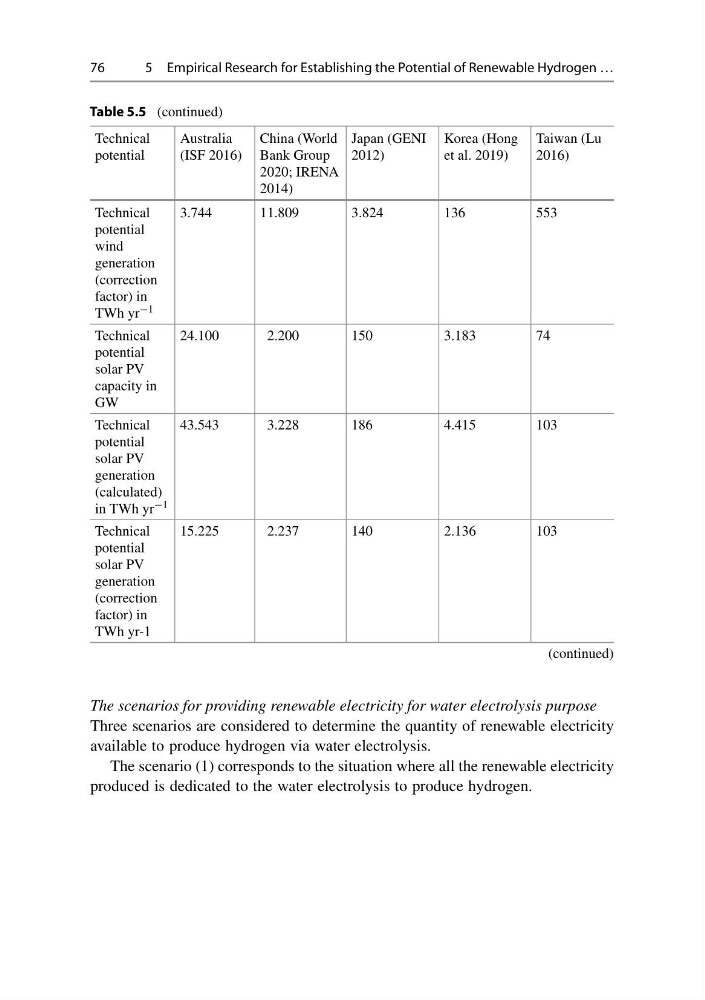
Table 5.5 (continued)
Technical
potential
Australia
(ISF 2016)
China (World
Bank Group
2020; IRENA
2014)
Japan (GENI
2012)
Korea (Hong
et al. 2019)
Taiwan (Lu
2016)
Technical
potential
wind
generation
(correction
factor) in
TWh yr −1
3.744
11.809
3.824
136
553
Technical
potential
solar PV
capacity in
GW
24.100
2.200
150
3.183
74
Technical
potential
solar PV
generation
(calculated)
in TWh yr −1
43.543
3.228
186
4.415
103
Technical
potential
solar PV
generation
(correction
factor) in
TWh yr-1
15.225
2.237
140
2.136
103
(continued)
The scenarios for providing renewable electricity for water electrolysis purpose
Three scenarios are considered to determine the quantity of renewable electricity
available to produce hydrogen via water electrolysis.
The scenario (1) corresponds to the situation where all the renewable electricity
produced is dedicated to the water electrolysis to produce hydrogen.
5 Empirical Research for Establishing the Potential of Renewable Hydrogen …
Table 5.5 (continued)
Technical
potential
Australia
(ISF 2016)
China (World
Bank Group
2020; IRENA
2014)
Japan (GENI
2012)
Korea (Hong
et al. 2019)
Taiwan (Lu
2016)
Technical
potential
wind
generation
(correction
factor) in
TWh yr −1
3.744
11.809
3.824
136
553
Technical
potential
solar PV
capacity in
GW
24.100
2.200
150
3.183
74
Technical
potential
solar PV
generation
(calculated)
in TWh yr −1
43.543
3.228
186
4.415
103
Technical
potential
solar PV
generation
(correction
factor) in
TWh yr-1
15.225
2.237
140
2.136
103
(continued)
The scenarios for providing renewable electricity for water electrolysis purpose
Three scenarios are considered to determine the quantity of renewable electricity
available to produce hydrogen via water electrolysis.
The scenario (1) corresponds to the situation where all the renewable electricity
produced is dedicated to the water electrolysis to produce hydrogen.