

18
2 Simulation-Based Optimization
split, combined, etc.” [BF2004, p. 6], following the process-oriented world view.
ABS is a relatively new simulation approach, which is used to model complex systems of interacting agents for a broad spread of disciplines such as supply chains,
modeling the behavior of the stock market or the spread of diseases [MN2014,
p. 11; Ta2014, p. 2]. Wooldridge defines an agent being an “computer system
that is situated in some environment, and that is capable of autonomous action
in this environment in order to meet its delegated objectives” [Wo2009, p. 21].
Therefore, every agent is a modular and identifiable individual, having an internal
state and a set of rules and behavior patterns representing its current situation
within the model [NM2007, p. 24; He+2011, p. 2791]. The major differences
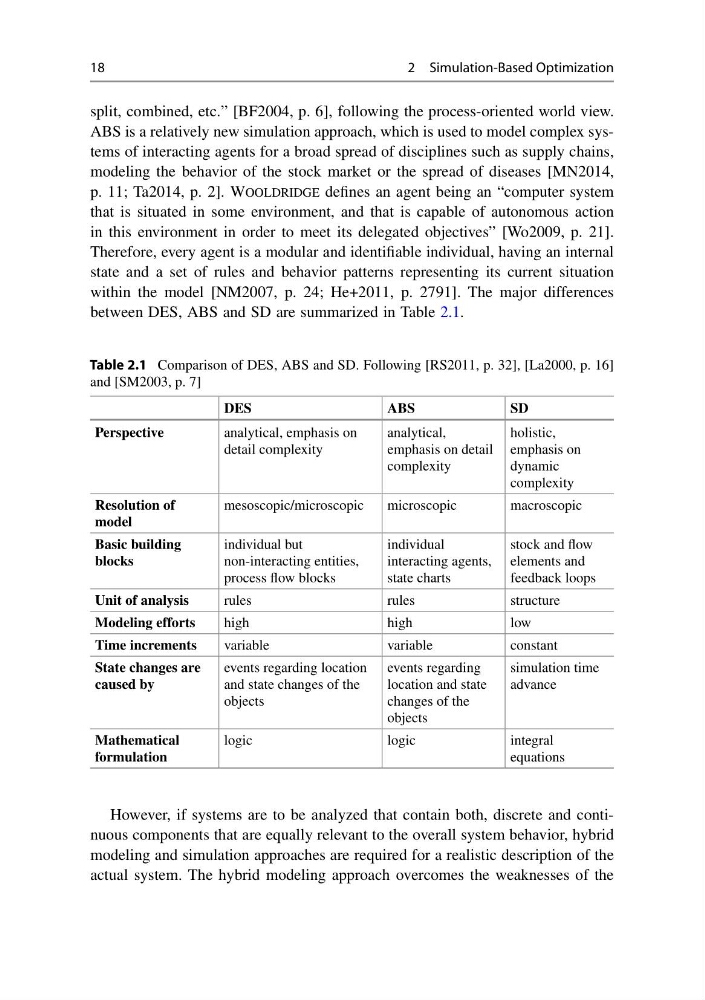
between DES, ABS and SD are summarized in Table 2.1.
Table 2.1 Comparison of DES, ABS and SD. Following [RS2011, p. 32], [La2000, p. 16]
and [SM2003, p. 7]
DES
ABS
SD
Perspective
analytical, emphasis on
detail complexity
analytical,
emphasis on detail
complexity
holistic,
emphasis on
dynamic
complexity
Resolution of
model
mesoscopic/microscopic
microscopic
macroscopic
Basic building
blocks
individual but
non-interacting entities,
process flow blocks
individual
interacting agents,
state charts
stock and flow
elements and
feedback loops
Unit of analysis
rules
rules
structure
Modeling efforts
high
high
low
Time increments
variable
variable
constant
State changes are
caused by
events regarding location
and state changes of the
objects
events regarding
location and state
changes of the
objects
simulation time
advance
Mathematical
formulation
logic
logic
integral
equations
However, if systems are to be analyzed that contain both, discrete and continuous components that are equally relevant to the overall system behavior, hybrid
modeling and simulation approaches are required for a realistic description of the
actual system. The hybrid modeling approach overcomes the weaknesses of the
2 Simulation-Based Optimization
split, combined, etc.” [BF2004, p. 6], following the process-oriented world view.
ABS is a relatively new simulation approach, which is used to model complex systems of interacting agents for a broad spread of disciplines such as supply chains,
modeling the behavior of the stock market or the spread of diseases [MN2014,
p. 11; Ta2014, p. 2]. Wooldridge defines an agent being an “computer system
that is situated in some environment, and that is capable of autonomous action
in this environment in order to meet its delegated objectives” [Wo2009, p. 21].
Therefore, every agent is a modular and identifiable individual, having an internal
state and a set of rules and behavior patterns representing its current situation
within the model [NM2007, p. 24; He+2011, p. 2791]. The major differences
between DES, ABS and SD are summarized in Table 2.1.
Table 2.1 Comparison of DES, ABS and SD. Following [RS2011, p. 32], [La2000, p. 16]
and [SM2003, p. 7]
DES
ABS
SD
Perspective
analytical, emphasis on
detail complexity
analytical,
emphasis on detail
complexity
holistic,
emphasis on
dynamic
complexity
Resolution of
model
mesoscopic/microscopic
microscopic
macroscopic
Basic building
blocks
individual but
non-interacting entities,
process flow blocks
individual
interacting agents,
state charts
stock and flow
elements and
feedback loops
Unit of analysis
rules
rules
structure
Modeling efforts
high
high
low
Time increments
variable
variable
constant
State changes are
caused by
events regarding location
and state changes of the
objects
events regarding
location and state
changes of the
objects
simulation time
advance
Mathematical
formulation
logic
logic
integral
equations
However, if systems are to be analyzed that contain both, discrete and continuous components that are equally relevant to the overall system behavior, hybrid
modeling and simulation approaches are required for a realistic description of the
actual system. The hybrid modeling approach overcomes the weaknesses of the