

2.1 Modeling and Simulation
17
Based on the above-mentioned classification, three major modeling paradigms
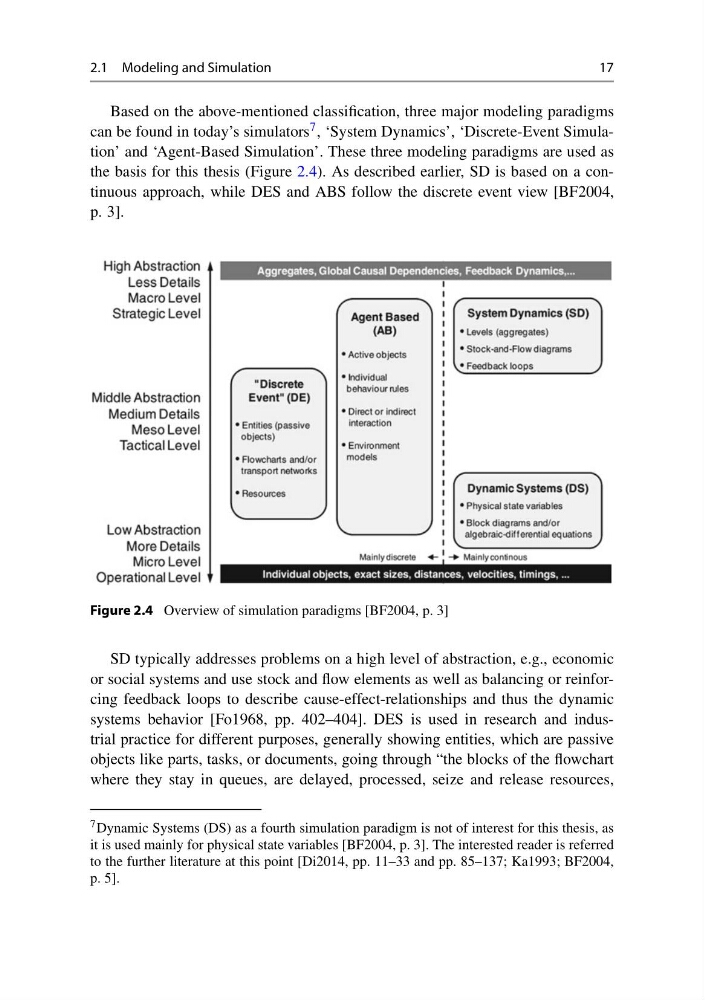
can be found in today’s simulators 7 , ‘System Dynamics’, ‘Discrete-Event Simulation’ and ‘Agent-Based Simulation’. These three modeling paradigms are used as
the basis for this thesis (Figure 2.4). As described earlier, SD is based on a continuous approach, while DES and ABS follow the discrete event view [BF2004,
p. 3].
Figure 2.4 Overview of simulation paradigms [BF2004, p. 3]
SD typically addresses problems on a high level of abstraction, e.g., economic
or social systems and use stock and flow elements as well as balancing or reinforcing feedback loops to describe cause-effect-relationships and thus the dynamic
systems behavior [Fo1968, pp. 402–404]. DES is used in research and industrial practice for different purposes, generally showing entities, which are passive
objects like parts, tasks, or documents, going through “the blocks of the flowchart
where they stay in queues, are delayed, processed, seize and release resources,
7 Dynamic Systems (DS) as a fourth simulation paradigm is not of interest for this thesis, as
it is used mainly for physical state variables [BF2004, p. 3]. The interested reader is referred
to the further literature at this point [Di2014, pp. 11–33 and pp. 85–137; Ka1993; BF2004,
p. 5].
17
Based on the above-mentioned classification, three major modeling paradigms
can be found in today’s simulators 7 , ‘System Dynamics’, ‘Discrete-Event Simulation’ and ‘Agent-Based Simulation’. These three modeling paradigms are used as
the basis for this thesis (Figure 2.4). As described earlier, SD is based on a continuous approach, while DES and ABS follow the discrete event view [BF2004,
p. 3].
Figure 2.4 Overview of simulation paradigms [BF2004, p. 3]
SD typically addresses problems on a high level of abstraction, e.g., economic
or social systems and use stock and flow elements as well as balancing or reinforcing feedback loops to describe cause-effect-relationships and thus the dynamic
systems behavior [Fo1968, pp. 402–404]. DES is used in research and industrial practice for different purposes, generally showing entities, which are passive
objects like parts, tasks, or documents, going through “the blocks of the flowchart
where they stay in queues, are delayed, processed, seize and release resources,
7 Dynamic Systems (DS) as a fourth simulation paradigm is not of interest for this thesis, as
it is used mainly for physical state variables [BF2004, p. 3]. The interested reader is referred
to the further literature at this point [Di2014, pp. 11–33 and pp. 85–137; Ka1993; BF2004,
p. 5].