

6.5 Evaluation of the Practical Applicability …
193
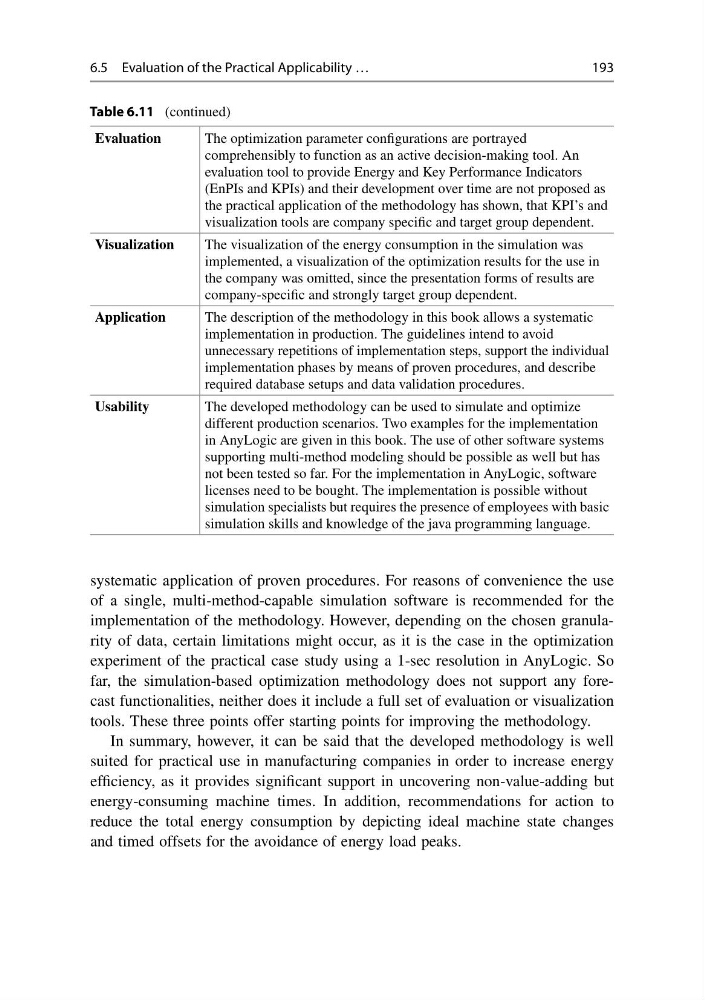
Table 6.11 (continued)
Evaluation
The optimization parameter configurations are portrayed
comprehensibly to function as an active decision-making tool. An
evaluation tool to provide Energy and Key Performance Indicators
(EnPIs and KPIs) and their development over time are not proposed as
the practical application of the methodology has shown, that KPI’s and
visualization tools are company specific and target group dependent.
Visualization
The visualization of the energy consumption in the simulation was
implemented, a visualization of the optimization results for the use in
the company was omitted, since the presentation forms of results are
company-specific and strongly target group dependent.
Application
The description of the methodology in this book allows a systematic
implementation in production. The guidelines intend to avoid
unnecessary repetitions of implementation steps, support the individual
implementation phases by means of proven procedures, and describe
required database setups and data validation procedures.
Usability
The developed methodology can be used to simulate and optimize
different production scenarios. Two examples for the implementation
in AnyLogic are given in this book. The use of other software systems
supporting multi-method modeling should be possible as well but has
not been tested so far. For the implementation in AnyLogic, software
licenses need to be bought. The implementation is possible without
simulation specialists but requires the presence of employees with basic
simulation skills and knowledge of the java programming language.
systematic application of proven procedures. For reasons of convenience the use
of a single, multi-method-capable simulation software is recommended for the
implementation of the methodology. However, depending on the chosen granularity of data, certain limitations might occur, as it is the case in the optimization
experiment of the practical case study using a 1-sec resolution in AnyLogic. So
far, the simulation-based optimization methodology does not support any forecast functionalities, neither does it include a full set of evaluation or visualization
tools. These three points offer starting points for improving the methodology.
In summary, however, it can be said that the developed methodology is well
suited for practical use in manufacturing companies in order to increase energy
efficiency, as it provides significant support in uncovering non-value-adding but
energy-consuming machine times. In addition, recommendations for action to
reduce the total energy consumption by depicting ideal machine state changes
and timed offsets for the avoidance of energy load peaks.
193
Table 6.11 (continued)
Evaluation
The optimization parameter configurations are portrayed
comprehensibly to function as an active decision-making tool. An
evaluation tool to provide Energy and Key Performance Indicators
(EnPIs and KPIs) and their development over time are not proposed as
the practical application of the methodology has shown, that KPI’s and
visualization tools are company specific and target group dependent.
Visualization
The visualization of the energy consumption in the simulation was
implemented, a visualization of the optimization results for the use in
the company was omitted, since the presentation forms of results are
company-specific and strongly target group dependent.
Application
The description of the methodology in this book allows a systematic
implementation in production. The guidelines intend to avoid
unnecessary repetitions of implementation steps, support the individual
implementation phases by means of proven procedures, and describe
required database setups and data validation procedures.
Usability
The developed methodology can be used to simulate and optimize
different production scenarios. Two examples for the implementation
in AnyLogic are given in this book. The use of other software systems
supporting multi-method modeling should be possible as well but has
not been tested so far. For the implementation in AnyLogic, software
licenses need to be bought. The implementation is possible without
simulation specialists but requires the presence of employees with basic
simulation skills and knowledge of the java programming language.
systematic application of proven procedures. For reasons of convenience the use
of a single, multi-method-capable simulation software is recommended for the
implementation of the methodology. However, depending on the chosen granularity of data, certain limitations might occur, as it is the case in the optimization
experiment of the practical case study using a 1-sec resolution in AnyLogic. So
far, the simulation-based optimization methodology does not support any forecast functionalities, neither does it include a full set of evaluation or visualization
tools. These three points offer starting points for improving the methodology.
In summary, however, it can be said that the developed methodology is well
suited for practical use in manufacturing companies in order to increase energy
efficiency, as it provides significant support in uncovering non-value-adding but
energy-consuming machine times. In addition, recommendations for action to
reduce the total energy consumption by depicting ideal machine state changes
and timed offsets for the avoidance of energy load peaks.