

5.6 Prototypical Implementation
139
of optimization parameters is required for those machines that have non-valueadded states in their machine logic. Machines operating on a low complexity
machine logic do not contain standby or idle states and thus do not require optimization parameters. The medium and the high complexity machine logic types
comprehend non-productive states (standby and idle), which can be used to bridge
short production interruptions. With the introduction of optimization parameters
for exactly those states, it is possible to determine the period of time that these
non-value-adding states should be used for bridging production interruptions and
as of when a shutdown of the machines is the more energy-efficient variant. As
an example, the parameter optimizerCNC1idle determines the length of the time
period for which it is more energy efficient to remain in idle state than to switch
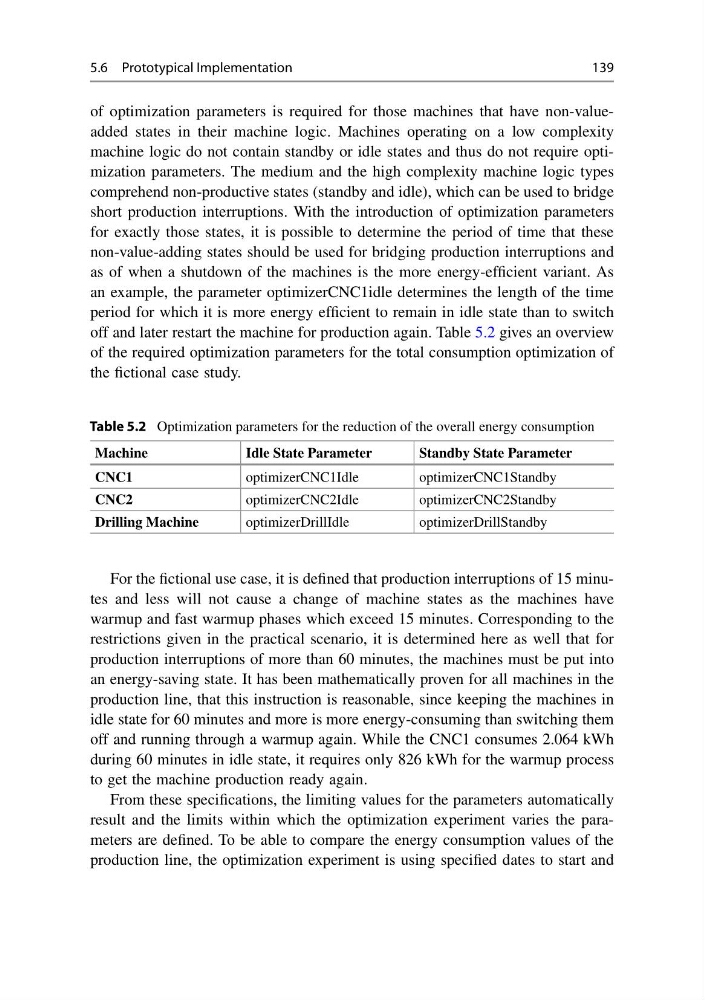
off and later restart the machine for production again. Table 5.2 gives an overview
of the required optimization parameters for the total consumption optimization of
the fictional case study.
Table 5.2 Optimization parameters for the reduction of the overall energy consumption
Machine
Idle State Parameter
Standby State Parameter
CNC1
optimizerCNC1Idle
optimizerCNC1Standby
CNC2
optimizerCNC2Idle
optimizerCNC2Standby
Drilling Machine
optimizerDrillIdle
optimizerDrillStandby
For the fictional use case, it is defined that production interruptions of 15 minutes and less will not cause a change of machine states as the machines have
warmup and fast warmup phases which exceed 15 minutes. Corresponding to the
restrictions given in the practical scenario, it is determined here as well that for
production interruptions of more than 60 minutes, the machines must be put into
an energy-saving state. It has been mathematically proven for all machines in the
production line, that this instruction is reasonable, since keeping the machines in
idle state for 60 minutes and more is more energy-consuming than switching them
off and running through a warmup again. While the CNC1 consumes 2.064 kWh
during 60 minutes in idle state, it requires only 826 kWh for the warmup process
to get the machine production ready again.
From these specifications, the limiting values for the parameters automatically
result and the limits within which the optimization experiment varies the parameters are defined. To be able to compare the energy consumption values of the
production line, the optimization experiment is using specified dates to start and
139
of optimization parameters is required for those machines that have non-valueadded states in their machine logic. Machines operating on a low complexity
machine logic do not contain standby or idle states and thus do not require optimization parameters. The medium and the high complexity machine logic types
comprehend non-productive states (standby and idle), which can be used to bridge
short production interruptions. With the introduction of optimization parameters
for exactly those states, it is possible to determine the period of time that these
non-value-adding states should be used for bridging production interruptions and
as of when a shutdown of the machines is the more energy-efficient variant. As
an example, the parameter optimizerCNC1idle determines the length of the time
period for which it is more energy efficient to remain in idle state than to switch
off and later restart the machine for production again. Table 5.2 gives an overview
of the required optimization parameters for the total consumption optimization of
the fictional case study.
Table 5.2 Optimization parameters for the reduction of the overall energy consumption
Machine
Idle State Parameter
Standby State Parameter
CNC1
optimizerCNC1Idle
optimizerCNC1Standby
CNC2
optimizerCNC2Idle
optimizerCNC2Standby
Drilling Machine
optimizerDrillIdle
optimizerDrillStandby
For the fictional use case, it is defined that production interruptions of 15 minutes and less will not cause a change of machine states as the machines have
warmup and fast warmup phases which exceed 15 minutes. Corresponding to the
restrictions given in the practical scenario, it is determined here as well that for
production interruptions of more than 60 minutes, the machines must be put into
an energy-saving state. It has been mathematically proven for all machines in the
production line, that this instruction is reasonable, since keeping the machines in
idle state for 60 minutes and more is more energy-consuming than switching them
off and running through a warmup again. While the CNC1 consumes 2.064 kWh
during 60 minutes in idle state, it requires only 826 kWh for the warmup process
to get the machine production ready again.
From these specifications, the limiting values for the parameters automatically
result and the limits within which the optimization experiment varies the parameters are defined. To be able to compare the energy consumption values of the
production line, the optimization experiment is using specified dates to start and