

112
5 Development of a Simulation-based Methodology …
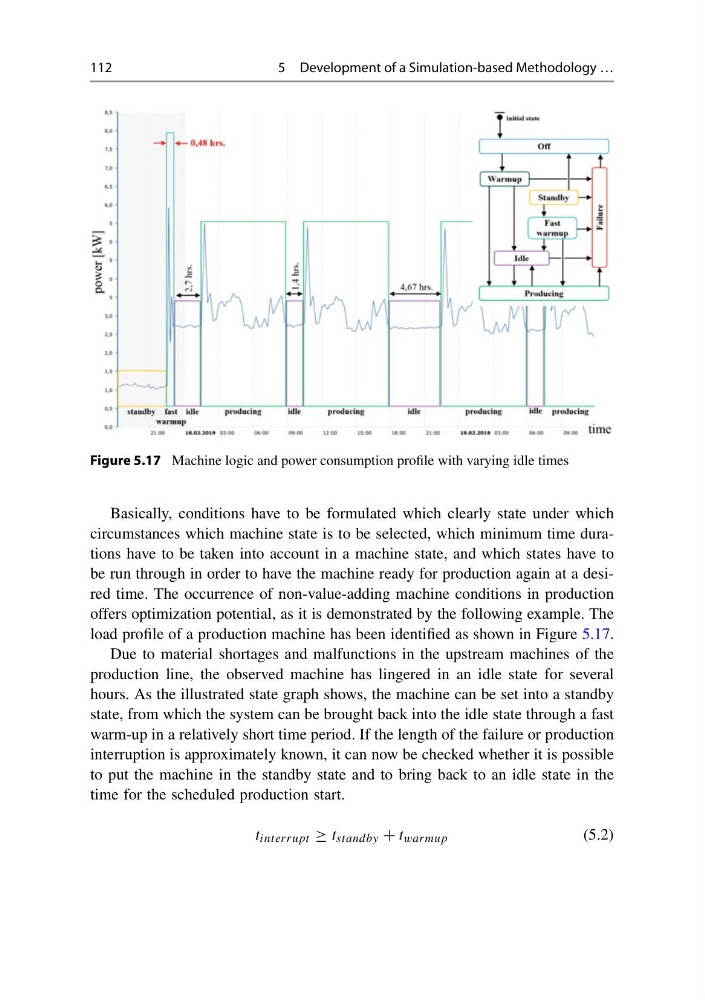
Figure 5.17 Machine logic and power consumption profile with varying idle times
Basically, conditions have to be formulated which clearly state under which
circumstances which machine state is to be selected, which minimum time durations have to be taken into account in a machine state, and which states have to
be run through in order to have the machine ready for production again at a desired time. The occurrence of non-value-adding machine conditions in production
offers optimization potential, as it is demonstrated by the following example. The
load profile of a production machine has been identified as shown in Figure 5.17.
Due to material shortages and malfunctions in the upstream machines of the
production line, the observed machine has lingered in an idle state for several
hours. As the illustrated state graph shows, the machine can be set into a standby
state, from which the system can be brought back into the idle state through a fast
warm-up in a relatively short time period. If the length of the failure or production
interruption is approximately known, it can now be checked whether it is possible
to put the machine in the standby state and to bring back to an idle state in the
time for the scheduled production start.
t interrupt ≥ t standby + t warmup
(5.2)
5 Development of a Simulation-based Methodology …
Figure 5.17 Machine logic and power consumption profile with varying idle times
Basically, conditions have to be formulated which clearly state under which
circumstances which machine state is to be selected, which minimum time durations have to be taken into account in a machine state, and which states have to
be run through in order to have the machine ready for production again at a desired time. The occurrence of non-value-adding machine conditions in production
offers optimization potential, as it is demonstrated by the following example. The
load profile of a production machine has been identified as shown in Figure 5.17.
Due to material shortages and malfunctions in the upstream machines of the
production line, the observed machine has lingered in an idle state for several
hours. As the illustrated state graph shows, the machine can be set into a standby
state, from which the system can be brought back into the idle state through a fast
warm-up in a relatively short time period. If the length of the failure or production
interruption is approximately known, it can now be checked whether it is possible
to put the machine in the standby state and to bring back to an idle state in the
time for the scheduled production start.
t interrupt ≥ t standby + t warmup
(5.2)