

5.3 Description of the M&S Approach
105
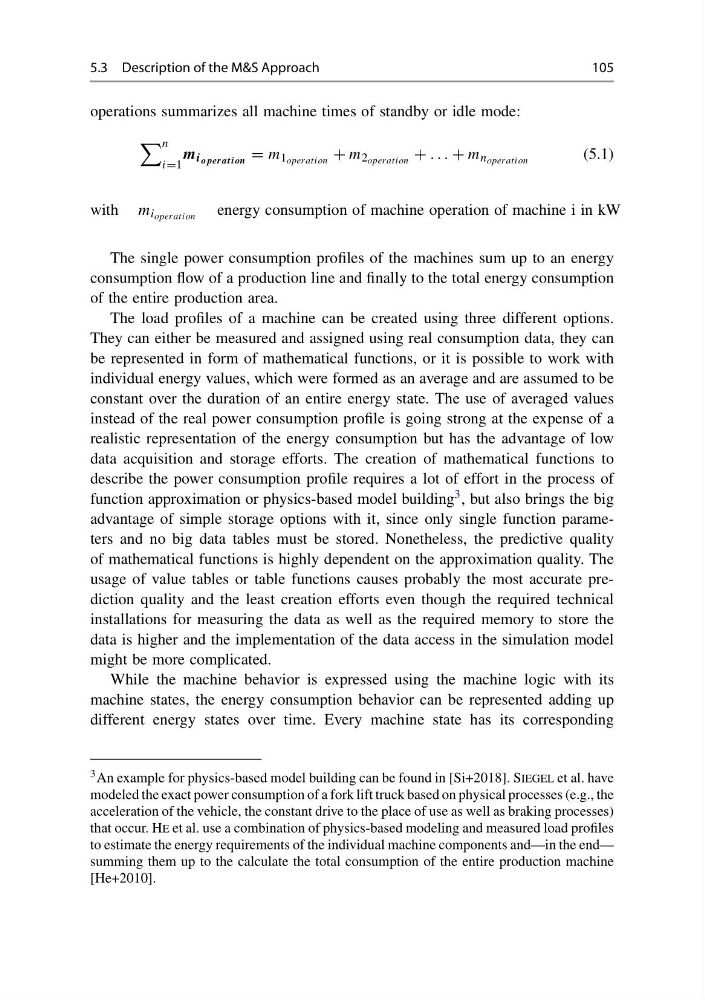
operations summarizes all machine times of standby or idle mode:
n
i=1
m i o peration = m 1 operation + m 2 operation + . . . + m n operation
(5.1)
with m i operation energy consumption of machine operation of machine i in kW
The single power consumption profiles of the machines sum up to an energy
consumption flow of a production line and finally to the total energy consumption
of the entire production area.
The load profiles of a machine can be created using three different options.
They can either be measured and assigned using real consumption data, they can
be represented in form of mathematical functions, or it is possible to work with
individual energy values, which were formed as an average and are assumed to be
constant over the duration of an entire energy state. The use of averaged values
instead of the real power consumption profile is going strong at the expense of a
realistic representation of the energy consumption but has the advantage of low
data acquisition and storage efforts. The creation of mathematical functions to
describe the power consumption profile requires a lot of effort in the process of
function approximation or physics-based model building 3 , but also brings the big
advantage of simple storage options with it, since only single function parameters and no big data tables must be stored. Nonetheless, the predictive quality
of mathematical functions is highly dependent on the approximation quality. The
usage of value tables or table functions causes probably the most accurate prediction quality and the least creation efforts even though the required technical
installations for measuring the data as well as the required memory to store the
data is higher and the implementation of the data access in the simulation model
might be more complicated.
While the machine behavior is expressed using the machine logic with its
machine states, the energy consumption behavior can be represented adding up
different energy states over time. Every machine state has its corresponding
3 An example for physics-based model building can be found in [Si+2018]. Siegel et al. have
modeled the exact power consumption of a fork lift truck based on physical processes (e.g., the
acceleration of the vehicle, the constant drive to the place of use as well as braking processes)
that occur. He et al. use a combination of physics-based modeling and measured load profiles
to estimate the energy requirements of the individual machine components and—in the end—
summing them up to the calculate the total consumption of the entire production machine
[He+2010].
105
operations summarizes all machine times of standby or idle mode:
n
i=1
m i o peration = m 1 operation + m 2 operation + . . . + m n operation
(5.1)
with m i operation energy consumption of machine operation of machine i in kW
The single power consumption profiles of the machines sum up to an energy
consumption flow of a production line and finally to the total energy consumption
of the entire production area.
The load profiles of a machine can be created using three different options.
They can either be measured and assigned using real consumption data, they can
be represented in form of mathematical functions, or it is possible to work with
individual energy values, which were formed as an average and are assumed to be
constant over the duration of an entire energy state. The use of averaged values
instead of the real power consumption profile is going strong at the expense of a
realistic representation of the energy consumption but has the advantage of low
data acquisition and storage efforts. The creation of mathematical functions to
describe the power consumption profile requires a lot of effort in the process of
function approximation or physics-based model building 3 , but also brings the big
advantage of simple storage options with it, since only single function parameters and no big data tables must be stored. Nonetheless, the predictive quality
of mathematical functions is highly dependent on the approximation quality. The
usage of value tables or table functions causes probably the most accurate prediction quality and the least creation efforts even though the required technical
installations for measuring the data as well as the required memory to store the
data is higher and the implementation of the data access in the simulation model
might be more complicated.
While the machine behavior is expressed using the machine logic with its
machine states, the energy consumption behavior can be represented adding up
different energy states over time. Every machine state has its corresponding
3 An example for physics-based model building can be found in [Si+2018]. Siegel et al. have
modeled the exact power consumption of a fork lift truck based on physical processes (e.g., the
acceleration of the vehicle, the constant drive to the place of use as well as braking processes)
that occur. He et al. use a combination of physics-based modeling and measured load profiles
to estimate the energy requirements of the individual machine components and—in the end—
summing them up to the calculate the total consumption of the entire production machine
[He+2010].