

104
5 Development of a Simulation-based Methodology …
machine. Thus, the number n of required machine components in the simulation
module equals the number of machines in the production flow.
5.3.3 Energy Component
The energy component is used to model the energy consumption behavior of production machines continuously for any moment in time. The modeling of the
energy consumption is done using stock and flow elements of the system dynamics library of the simulation software. Every machine has its power consumption
profile, which can be split up in sequences and then be assigned to different energy
states. As described in section 3.2.3, the energy states are differentiated according
to time and optimization aspects and can be split up into three groups, technically
relevant operations, value-adding, and non-value-adding operations. For reasons
of clarity, it makes sense to depict the energy flow using this grouping, before the
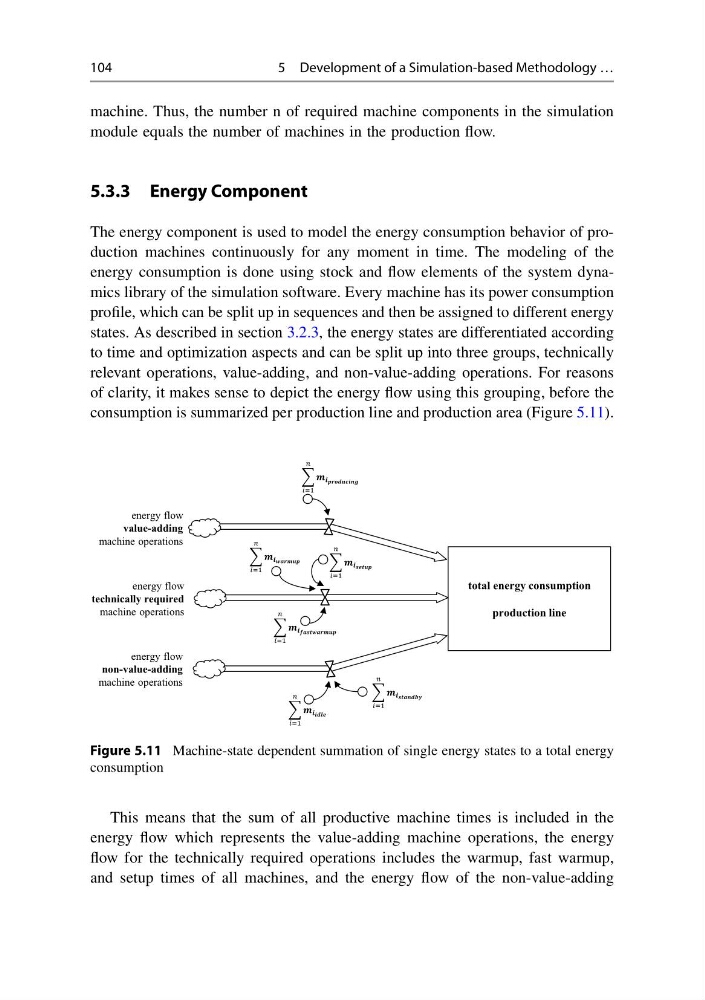
consumption is summarized per production line and production area (Figure 5.11).
total energy consumption
production line
energy flow
value-adding
machine operations
energy flow
non-value-adding
machine operations
energy flow
technically required
machine operations
Figure 5.11 Machine-state dependent summation of single energy states to a total energy
consumption
This means that the sum of all productive machine times is included in the
energy flow which represents the value-adding machine operations, the energy
flow for the technically required operations includes the warmup, fast warmup,
and setup times of all machines, and the energy flow of the non-value-adding
5 Development of a Simulation-based Methodology …
machine. Thus, the number n of required machine components in the simulation
module equals the number of machines in the production flow.
5.3.3 Energy Component
The energy component is used to model the energy consumption behavior of production machines continuously for any moment in time. The modeling of the
energy consumption is done using stock and flow elements of the system dynamics library of the simulation software. Every machine has its power consumption
profile, which can be split up in sequences and then be assigned to different energy
states. As described in section 3.2.3, the energy states are differentiated according
to time and optimization aspects and can be split up into three groups, technically
relevant operations, value-adding, and non-value-adding operations. For reasons
of clarity, it makes sense to depict the energy flow using this grouping, before the
consumption is summarized per production line and production area (Figure 5.11).
total energy consumption
production line
energy flow
value-adding
machine operations
energy flow
non-value-adding
machine operations
energy flow
technically required
machine operations
Figure 5.11 Machine-state dependent summation of single energy states to a total energy
consumption
This means that the sum of all productive machine times is included in the
energy flow which represents the value-adding machine operations, the energy
flow for the technically required operations includes the warmup, fast warmup,
and setup times of all machines, and the energy flow of the non-value-adding