

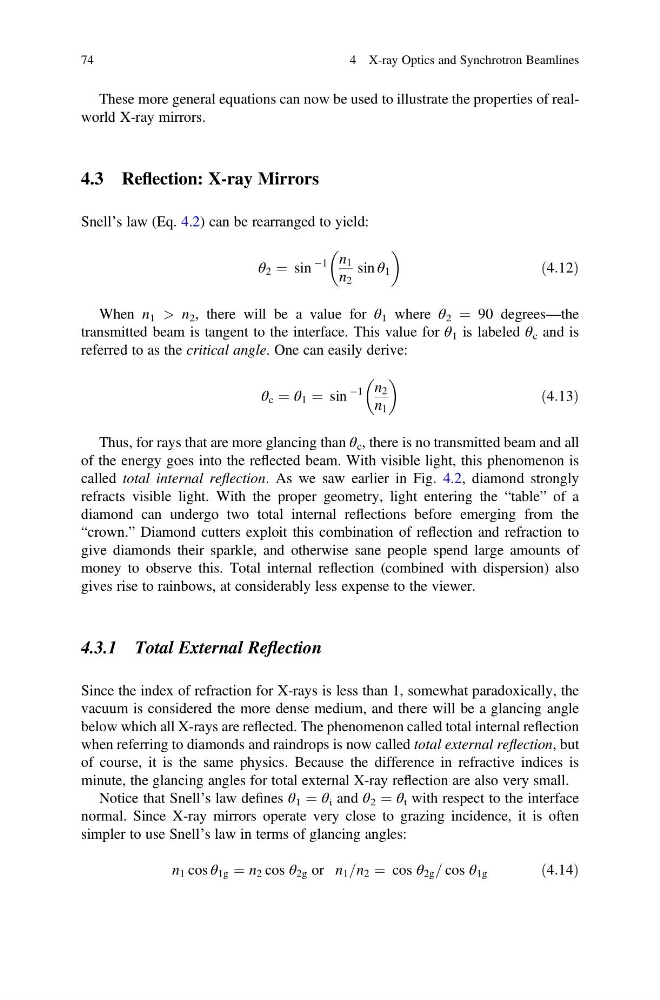
These more general equations can now be used to illustrate the properties of realworld X-ray mirrors.
4.3 Reflection: X-ray Mirrors
Snell’s law (Eq. 4.2) can be rearranged to yield:
θ 2 ¼ sin
À1 n 1
n 2
sin θ 1
ð4:12Þ
When n 1 > n 2 , there will be a value for θ 1 where θ 2 ¼ 90 degrees—the
transmitted beam is tangent to the interface. This value for θ 1 is labeled θ c and is
referred to as the critical angle. One can easily derive:
θ c ¼ θ 1 ¼ sin
À1 n 2
n 1
ð4:13Þ
Thus, for rays that are more glancing than θ c , there is no transmitted beam and all
of the energy goes into the reflected beam. With visible light, this phenomenon is
called total internal reflection. As we saw earlier in Fig. 4.2, diamond strongly
refracts visible light. With the proper geometry, light entering the “table” of a
diamond can undergo two total internal reflections before emerging from the
“crown.” Diamond cutters exploit this combination of reflection and refraction to
give diamonds their sparkle, and otherwise sane people spend large amounts of
money to observe this. Total internal reflection (combined with dispersion) also
gives rise to rainbows, at considerably less expense to the viewer.
4.3.1 Total External Reflection
Since the index of refraction for X-rays is less than 1, somewhat paradoxically, the
vacuum is considered the more dense medium, and there will be a glancing angle
below which all X-rays are reflected. The phenomenon called total internal reflection
when referring to diamonds and raindrops is now called total external reflection, but
of course, it is the same physics. Because the difference in refractive indices is
minute, the glancing angles for total external X-ray reflection are also very small.
Notice that Snell’s law defines θ 1 ¼ θ i and θ 2 ¼ θ t with respect to the interface
normal. Since X-ray mirrors operate very close to grazing incidence, it is often
simpler to use Snell’s law in terms of glancing angles:
n 1 cos θ 1g ¼ n 2 cos θ 2g or n 1 =n 2 ¼ cos θ 2g = cos θ 1g
ð4:14Þ
74
4 X-ray Optics and Synchrotron Beamlines
4.3 Reflection: X-ray Mirrors
Snell’s law (Eq. 4.2) can be rearranged to yield:
θ 2 ¼ sin
À1 n 1
n 2
sin θ 1
ð4:12Þ
When n 1 > n 2 , there will be a value for θ 1 where θ 2 ¼ 90 degrees—the
transmitted beam is tangent to the interface. This value for θ 1 is labeled θ c and is
referred to as the critical angle. One can easily derive:
θ c ¼ θ 1 ¼ sin
À1 n 2
n 1
ð4:13Þ
Thus, for rays that are more glancing than θ c , there is no transmitted beam and all
of the energy goes into the reflected beam. With visible light, this phenomenon is
called total internal reflection. As we saw earlier in Fig. 4.2, diamond strongly
refracts visible light. With the proper geometry, light entering the “table” of a
diamond can undergo two total internal reflections before emerging from the
“crown.” Diamond cutters exploit this combination of reflection and refraction to
give diamonds their sparkle, and otherwise sane people spend large amounts of
money to observe this. Total internal reflection (combined with dispersion) also
gives rise to rainbows, at considerably less expense to the viewer.
4.3.1 Total External Reflection
Since the index of refraction for X-rays is less than 1, somewhat paradoxically, the
vacuum is considered the more dense medium, and there will be a glancing angle
below which all X-rays are reflected. The phenomenon called total internal reflection
when referring to diamonds and raindrops is now called total external reflection, but
of course, it is the same physics. Because the difference in refractive indices is
minute, the glancing angles for total external X-ray reflection are also very small.
Notice that Snell’s law defines θ 1 ¼ θ i and θ 2 ¼ θ t with respect to the interface
normal. Since X-ray mirrors operate very close to grazing incidence, it is often
simpler to use Snell’s law in terms of glancing angles:
n 1 cos θ 1g ¼ n 2 cos θ 2g or n 1 =n 2 ¼ cos θ 2g = cos θ 1g
ð4:14Þ
74
4 X-ray Optics and Synchrotron Beamlines