

significant interference effects between the different magnetic poles. A wiggler thus
behaves like a series of bend magnet sources, except that the sinusoidal field means
that the bends have variable radii. At the opposite extreme, in the small deflection or
low K limit, there is interference between radiation from different poles, and the
properties of undulators are very different from bend magnets and wigglers.
3.5 Wiggler Radiation
Wiggler magnets have been used to increase the flux at synchrotron radiation sources
for more than 40 years. Because they deflect the electron beam first in one direction
and then back in the opposite direction, they can employ stronger magnets than used
for the bend dipoles, and they can produce this flux from dozens of deflections. The
resulting source spectra resemble bend magnet dipole spectra with one significant
difference: the apparent magnet strength and bend radius depend on the angle of
observation.
3.5.1 Wiggler Power
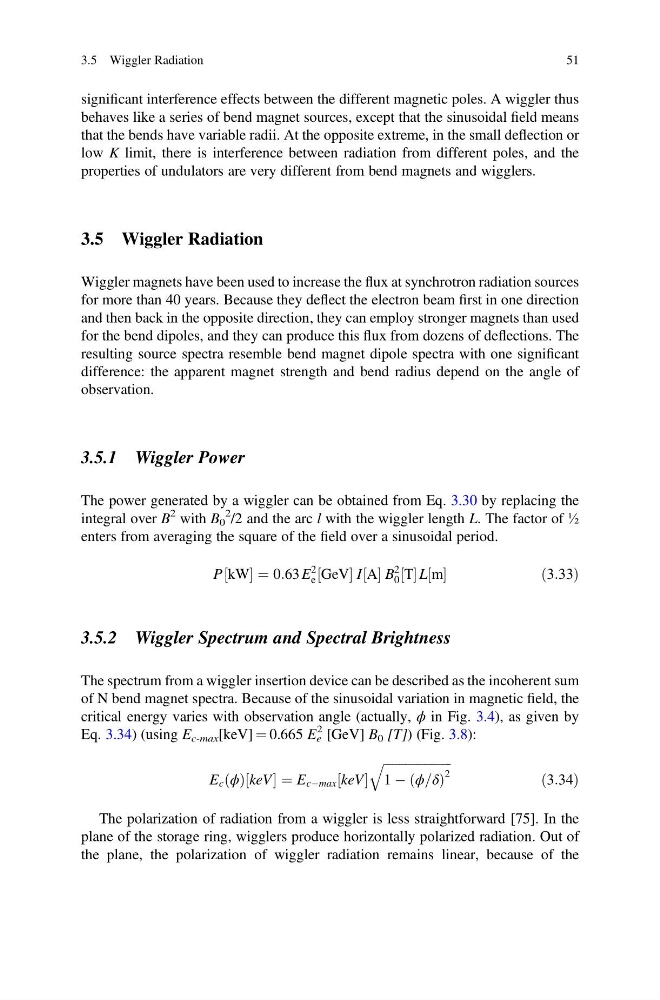
The power generated by a wiggler can be obtained from Eq. 3.30 by replacing the
integral over B
2 with B 0
2 /2 and the arc l with the wiggler length L. The factor of ½
enters from averaging the square of the field over a sinusoidal period.
P kW
½ ¼ 0:63 E
2
e GeV
½
I A
½ B
2
0 T
½ L m
½
ð3:33Þ
3.5.2 Wiggler Spectrum and Spectral Brightness
The spectrum from a wiggler insertion device can be described as the incoherent sum
of N bend magnet spectra. Because of the sinusoidal variation in magnetic field, the
critical energy varies with observation angle (actually, ϕ in Fig. 3.4), as given by
Eq. 3.34) (using E c-max [keV] ¼ 0.665 E e
2 [GeV] B 0 [T]) (Fig. 3.8):
E c ϕ
ð Þ keV
½
¼ E cÀmax keV
½
ffiffiffiffiffiffiffiffiffiffiffiffiffiffiffiffiffiffiffiffiffi ffi
1 À ϕ=δ
ð
Þ
2
q
ð3:34Þ
The polarization of radiation from a wiggler is less straightforward [75]. In the
plane of the storage ring, wigglers produce horizontally polarized radiation. Out of
the plane, the polarization of wiggler radiation remains linear, because of the
3.5 Wiggler Radiation
51
behaves like a series of bend magnet sources, except that the sinusoidal field means
that the bends have variable radii. At the opposite extreme, in the small deflection or
low K limit, there is interference between radiation from different poles, and the
properties of undulators are very different from bend magnets and wigglers.
3.5 Wiggler Radiation
Wiggler magnets have been used to increase the flux at synchrotron radiation sources
for more than 40 years. Because they deflect the electron beam first in one direction
and then back in the opposite direction, they can employ stronger magnets than used
for the bend dipoles, and they can produce this flux from dozens of deflections. The
resulting source spectra resemble bend magnet dipole spectra with one significant
difference: the apparent magnet strength and bend radius depend on the angle of
observation.
3.5.1 Wiggler Power
The power generated by a wiggler can be obtained from Eq. 3.30 by replacing the
integral over B
2 with B 0
2 /2 and the arc l with the wiggler length L. The factor of ½
enters from averaging the square of the field over a sinusoidal period.
P kW
½ ¼ 0:63 E
2
e GeV
½
I A
½ B
2
0 T
½ L m
½
ð3:33Þ
3.5.2 Wiggler Spectrum and Spectral Brightness
The spectrum from a wiggler insertion device can be described as the incoherent sum
of N bend magnet spectra. Because of the sinusoidal variation in magnetic field, the
critical energy varies with observation angle (actually, ϕ in Fig. 3.4), as given by
Eq. 3.34) (using E c-max [keV] ¼ 0.665 E e
2 [GeV] B 0 [T]) (Fig. 3.8):
E c ϕ
ð Þ keV
½
¼ E cÀmax keV
½
ffiffiffiffiffiffiffiffiffiffiffiffiffiffiffiffiffiffiffiffiffi ffi
1 À ϕ=δ
ð
Þ
2
q
ð3:34Þ
The polarization of radiation from a wiggler is less straightforward [75]. In the
plane of the storage ring, wigglers produce horizontally polarized radiation. Out of
the plane, the polarization of wiggler radiation remains linear, because of the
3.5 Wiggler Radiation
51