

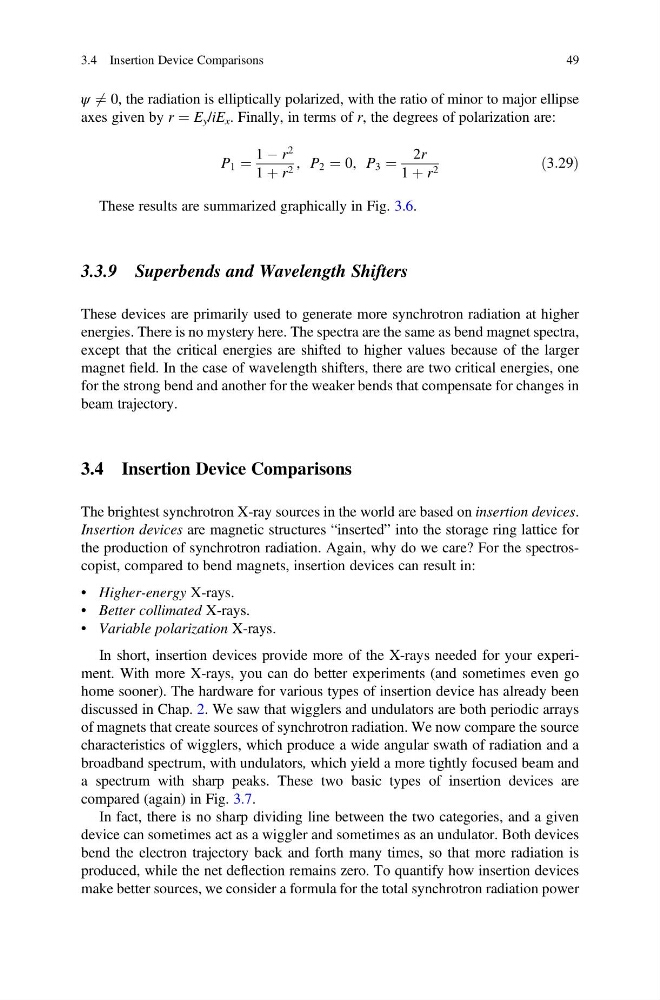
ψ 6 ¼ 0, the radiation is elliptically polarized, with the ratio of minor to major ellipse
axes given by r ¼ E y /iE x . Finally, in terms of r, the degrees of polarization are:
P 1 ¼
1 À r
2
1 þ r 2 , P 2 ¼ 0, P 3 ¼
2r
1 þ r 2
ð3:29Þ
These results are summarized graphically in Fig. 3.6.
3.3.9 Superbends and Wavelength Shifters
These devices are primarily used to generate more synchrotron radiation at higher
energies. There is no mystery here. The spectra are the same as bend magnet spectra,
except that the critical energies are shifted to higher values because of the larger
magnet field. In the case of wavelength shifters, there are two critical energies, one
for the strong bend and another for the weaker bends that compensate for changes in
beam trajectory.
3.4 Insertion Device Comparisons
The brightest synchrotron X-ray sources in the world are based on insertion devices.
Insertion devices are magnetic structures “inserted” into the storage ring lattice for
the production of synchrotron radiation. Again, why do we care? For the spectroscopist, compared to bend magnets, insertion devices can result in:
• Higher-energy X-rays.
• Better collimated X-rays.
• Variable polarization X-rays.
In short, insertion devices provide more of the X-rays needed for your experiment. With more X-rays, you can do better experiments (and sometimes even go
home sooner). The hardware for various types of insertion device has already been
discussed in Chap. 2. We saw that wigglers and undulators are both periodic arrays
of magnets that create sources of synchrotron radiation. We now compare the source
characteristics of wigglers, which produce a wide angular swath of radiation and a
broadband spectrum, with undulators, which yield a more tightly focused beam and
a spectrum with sharp peaks. These two basic types of insertion devices are
compared (again) in Fig. 3.7.
In fact, there is no sharp dividing line between the two categories, and a given
device can sometimes act as a wiggler and sometimes as an undulator. Both devices
bend the electron trajectory back and forth many times, so that more radiation is
produced, while the net deflection remains zero. To quantify how insertion devices
make better sources, we consider a formula for the total synchrotron radiation power
3.4 Insertion Device Comparisons
49
axes given by r ¼ E y /iE x . Finally, in terms of r, the degrees of polarization are:
P 1 ¼
1 À r
2
1 þ r 2 , P 2 ¼ 0, P 3 ¼
2r
1 þ r 2
ð3:29Þ
These results are summarized graphically in Fig. 3.6.
3.3.9 Superbends and Wavelength Shifters
These devices are primarily used to generate more synchrotron radiation at higher
energies. There is no mystery here. The spectra are the same as bend magnet spectra,
except that the critical energies are shifted to higher values because of the larger
magnet field. In the case of wavelength shifters, there are two critical energies, one
for the strong bend and another for the weaker bends that compensate for changes in
beam trajectory.
3.4 Insertion Device Comparisons
The brightest synchrotron X-ray sources in the world are based on insertion devices.
Insertion devices are magnetic structures “inserted” into the storage ring lattice for
the production of synchrotron radiation. Again, why do we care? For the spectroscopist, compared to bend magnets, insertion devices can result in:
• Higher-energy X-rays.
• Better collimated X-rays.
• Variable polarization X-rays.
In short, insertion devices provide more of the X-rays needed for your experiment. With more X-rays, you can do better experiments (and sometimes even go
home sooner). The hardware for various types of insertion device has already been
discussed in Chap. 2. We saw that wigglers and undulators are both periodic arrays
of magnets that create sources of synchrotron radiation. We now compare the source
characteristics of wigglers, which produce a wide angular swath of radiation and a
broadband spectrum, with undulators, which yield a more tightly focused beam and
a spectrum with sharp peaks. These two basic types of insertion devices are
compared (again) in Fig. 3.7.
In fact, there is no sharp dividing line between the two categories, and a given
device can sometimes act as a wiggler and sometimes as an undulator. Both devices
bend the electron trajectory back and forth many times, so that more radiation is
produced, while the net deflection remains zero. To quantify how insertion devices
make better sources, we consider a formula for the total synchrotron radiation power
3.4 Insertion Device Comparisons
49