

κ ffi
1
2
1
γ 2 þ θ
2
; θ ( 1
ð3:4Þ
Thus, a dramatic contraction in Δt in the observer frame compared to Δt´ in the
particle frame can occur when γ is large and θ is small, in other words at high particle
energies and in the forward direction. For example, at a typical 3 GeV ring, γ ffi 6000
and for θ close to 0, κ ffi 3.6 Â 10
6 ! Furthermore, the apparent acceleration will
depend on the square of the “time-squeezing factor” κ, via:
d
2 x
dt
2
%
Δx
Δt 2
ð Þ
%
Δx
κΔt 0
ð
Þ
2
%
Δx
κ 2 Δt 0 2
À
Á % γ
4 c
2
ρ
ð3:5Þ
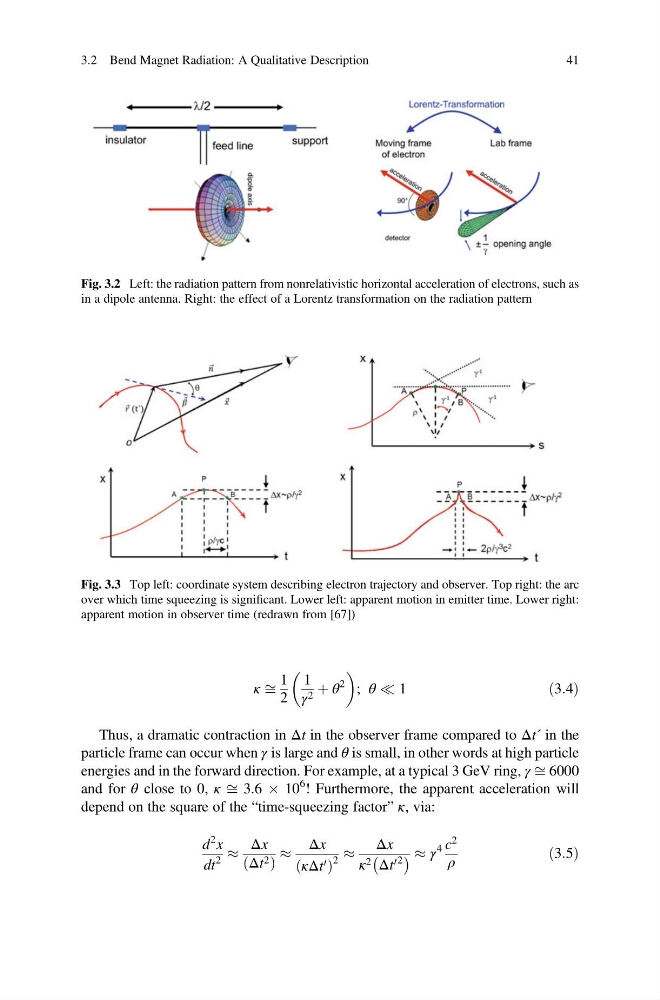
Fig. 3.3 Top left: coordinate system describing electron trajectory and observer. Top right: the arc
over which time squeezing is significant. Lower left: apparent motion in emitter time. Lower right:
apparent motion in observer time (redrawn from [67])
Fig. 3.2 Left: the radiation pattern from nonrelativistic horizontal acceleration of electrons, such as
in a dipole antenna. Right: the effect of a Lorentz transformation on the radiation pattern
3.2 Bend Magnet Radiation: A Qualitative Description
41
1
2
1
γ 2 þ θ
2
; θ ( 1
ð3:4Þ
Thus, a dramatic contraction in Δt in the observer frame compared to Δt´ in the
particle frame can occur when γ is large and θ is small, in other words at high particle
energies and in the forward direction. For example, at a typical 3 GeV ring, γ ffi 6000
and for θ close to 0, κ ffi 3.6 Â 10
6 ! Furthermore, the apparent acceleration will
depend on the square of the “time-squeezing factor” κ, via:
d
2 x
dt
2
%
Δx
Δt 2
ð Þ
%
Δx
κΔt 0
ð
Þ
2
%
Δx
κ 2 Δt 0 2
À
Á % γ
4 c
2
ρ
ð3:5Þ
Fig. 3.3 Top left: coordinate system describing electron trajectory and observer. Top right: the arc
over which time squeezing is significant. Lower left: apparent motion in emitter time. Lower right:
apparent motion in observer time (redrawn from [67])
Fig. 3.2 Left: the radiation pattern from nonrelativistic horizontal acceleration of electrons, such as
in a dipole antenna. Right: the effect of a Lorentz transformation on the radiation pattern
3.2 Bend Magnet Radiation: A Qualitative Description
41