

3.2 Bend Magnet Radiation: A Qualitative Description
The bend magnet is the simplest synchrotron radiation source in a storage ring. For a
couple of decades, they were the only synchrotron sources available, and even now,
they are excellent sources for a variety of experiments. What makes bend magnets
such good X-ray sources? As explained by Kim, it has to do with relativity [66, 67].
A well-known result from electromagnetic theory is that acceleration of charged
particles results in electromagnetic radiation, with the electric field, E
!
, proportional
to the observed acceleration, a
! , thus E
! / a
! . In addition, the radiated power P per
unit area is proportional to the so-called Poynting vector S
!
, which is proportional to
the square of the electric field: E
2 , and thus:
P / S
! / E
2
/ a
2
ð3:2Þ
For a simple dipole antenna, the observed acceleration is proportional to cos θ,
where θ is the angle with respect to the plane perpendicular to the dipole axis
(Fig. 3.2). Hence the radiated power varies as cos
2
θ. Now consider a relativistic
electron traveling through a magnet with velocity v ¼ βc. An observer traveling with
the same speed in a reference frame parallel to the electron sees a horizontal
acceleration in which the electron travels back and forth through a distance of length
ρ/γ
2 in a time interval Δt´ ¼ 2ρ/γc (Fig. 3.3). In this reference frame, the same donutshaped pattern is expected as for the dipole antenna.
Now consider the reference frame of the synchrotron radiation user (Figs. 3.2 and
3.3). Special relativity tells us that time passes at different rates in these two frames.
Because the particle is traveling with velocity βc, the apparent time interval Δt in the
laboratory frame, the “observer time,” is related to a time interval Δt´ in the particle
frame, the “emitter time”, by the equation:
Δt ¼ κΔt
0
¼ 1 À β cos θ
ð
Þ Δt
0
ð3:3Þ
Without too much math (see Exercise 3.1), one can show that:
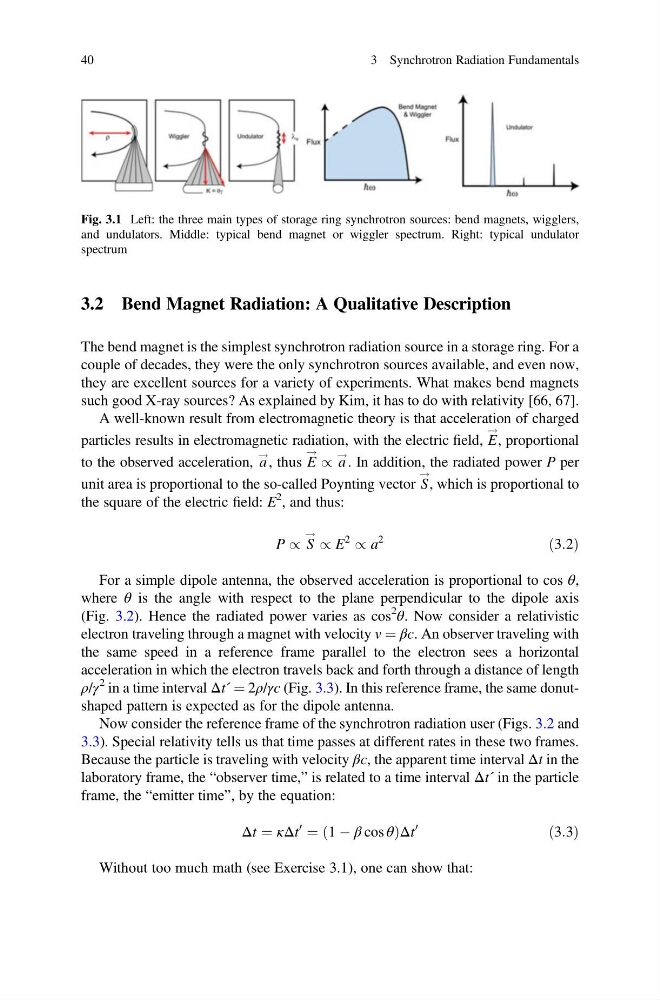
Fig. 3.1 Left: the three main types of storage ring synchrotron sources: bend magnets, wigglers,
and undulators. Middle: typical bend magnet or wiggler spectrum. Right: typical undulator
spectrum
40
3 Synchrotron Radiation Fundamentals
The bend magnet is the simplest synchrotron radiation source in a storage ring. For a
couple of decades, they were the only synchrotron sources available, and even now,
they are excellent sources for a variety of experiments. What makes bend magnets
such good X-ray sources? As explained by Kim, it has to do with relativity [66, 67].
A well-known result from electromagnetic theory is that acceleration of charged
particles results in electromagnetic radiation, with the electric field, E
!
, proportional
to the observed acceleration, a
! , thus E
! / a
! . In addition, the radiated power P per
unit area is proportional to the so-called Poynting vector S
!
, which is proportional to
the square of the electric field: E
2 , and thus:
P / S
! / E
2
/ a
2
ð3:2Þ
For a simple dipole antenna, the observed acceleration is proportional to cos θ,
where θ is the angle with respect to the plane perpendicular to the dipole axis
(Fig. 3.2). Hence the radiated power varies as cos
2
θ. Now consider a relativistic
electron traveling through a magnet with velocity v ¼ βc. An observer traveling with
the same speed in a reference frame parallel to the electron sees a horizontal
acceleration in which the electron travels back and forth through a distance of length
ρ/γ
2 in a time interval Δt´ ¼ 2ρ/γc (Fig. 3.3). In this reference frame, the same donutshaped pattern is expected as for the dipole antenna.
Now consider the reference frame of the synchrotron radiation user (Figs. 3.2 and
3.3). Special relativity tells us that time passes at different rates in these two frames.
Because the particle is traveling with velocity βc, the apparent time interval Δt in the
laboratory frame, the “observer time,” is related to a time interval Δt´ in the particle
frame, the “emitter time”, by the equation:
Δt ¼ κΔt
0
¼ 1 À β cos θ
ð
Þ Δt
0
ð3:3Þ
Without too much math (see Exercise 3.1), one can show that:
Fig. 3.1 Left: the three main types of storage ring synchrotron sources: bend magnets, wigglers,
and undulators. Middle: typical bend magnet or wiggler spectrum. Right: typical undulator
spectrum
40
3 Synchrotron Radiation Fundamentals