

f rf ¼ h Á f particle ¼
h
T orbit
¼
h Á c
L
ð2:20Þ
The above requirement is referred to as the synchronicity condition, and h is
called the harmonic number. If h > 1 (and it is usually several hundred), then
h bunches of particles can be placed around the ring, with a minimum spacing such
that the cavity goes through just one cycle. At the ALS, L is 196.8 m and f rf is
nominally 500 MHz, so h ¼ 328. In principle, one could fill the ring with
328 bunches, with a separation given by the time for one rf cycle—2 ns or ~0.6 m
between bunches. The locations where particles can be stored are referred to as
buckets, and in practice, not all buckets are filled.
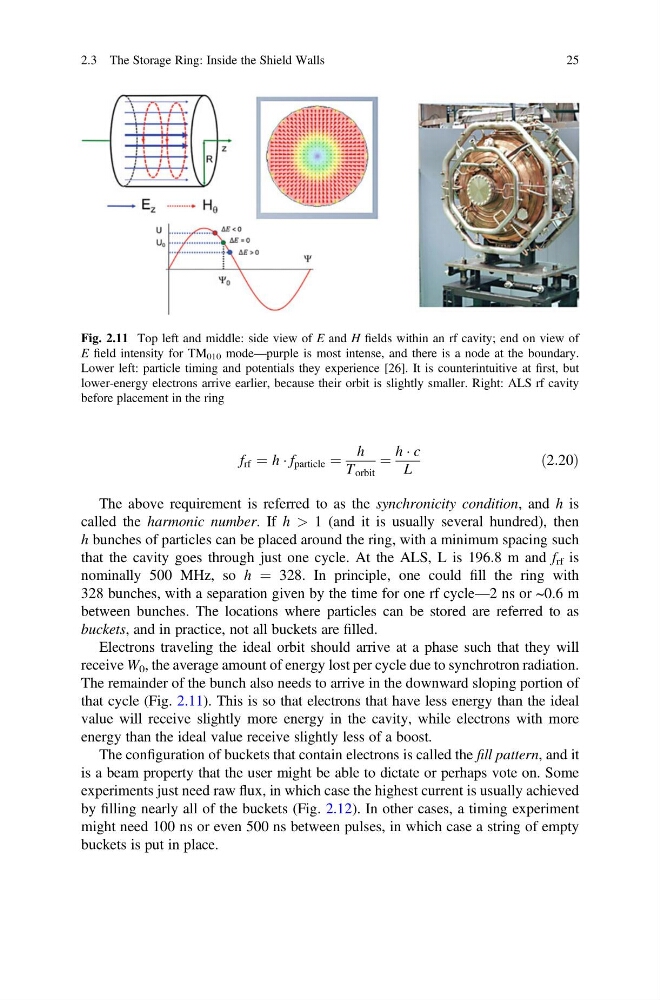
Electrons traveling the ideal orbit should arrive at a phase such that they will
receive W 0 , the average amount of energy lost per cycle due to synchrotron radiation.
The remainder of the bunch also needs to arrive in the downward sloping portion of
that cycle (Fig. 2.11). This is so that electrons that have less energy than the ideal
value will receive slightly more energy in the cavity, while electrons with more
energy than the ideal value receive slightly less of a boost.
The configuration of buckets that contain electrons is called the fill pattern, and it
is a beam property that the user might be able to dictate or perhaps vote on. Some
experiments just need raw flux, in which case the highest current is usually achieved
by filling nearly all of the buckets (Fig. 2.12). In other cases, a timing experiment
might need 100 ns or even 500 ns between pulses, in which case a string of empty
buckets is put in place.
Fig. 2.11 Top left and middle: side view of E and H fields within an rf cavity; end on view of
E field intensity for TM 010 mode—purple is most intense, and there is a node at the boundary.
Lower left: particle timing and potentials they experience [26]. It is counterintuitive at first, but
lower-energy electrons arrive earlier, because their orbit is slightly smaller. Right: ALS rf cavity
before placement in the ring
2.3 The Storage Ring: Inside the Shield Walls
25
h
T orbit
¼
h Á c
L
ð2:20Þ
The above requirement is referred to as the synchronicity condition, and h is
called the harmonic number. If h > 1 (and it is usually several hundred), then
h bunches of particles can be placed around the ring, with a minimum spacing such
that the cavity goes through just one cycle. At the ALS, L is 196.8 m and f rf is
nominally 500 MHz, so h ¼ 328. In principle, one could fill the ring with
328 bunches, with a separation given by the time for one rf cycle—2 ns or ~0.6 m
between bunches. The locations where particles can be stored are referred to as
buckets, and in practice, not all buckets are filled.
Electrons traveling the ideal orbit should arrive at a phase such that they will
receive W 0 , the average amount of energy lost per cycle due to synchrotron radiation.
The remainder of the bunch also needs to arrive in the downward sloping portion of
that cycle (Fig. 2.11). This is so that electrons that have less energy than the ideal
value will receive slightly more energy in the cavity, while electrons with more
energy than the ideal value receive slightly less of a boost.
The configuration of buckets that contain electrons is called the fill pattern, and it
is a beam property that the user might be able to dictate or perhaps vote on. Some
experiments just need raw flux, in which case the highest current is usually achieved
by filling nearly all of the buckets (Fig. 2.12). In other cases, a timing experiment
might need 100 ns or even 500 ns between pulses, in which case a string of empty
buckets is put in place.
Fig. 2.11 Top left and middle: side view of E and H fields within an rf cavity; end on view of
E field intensity for TM 010 mode—purple is most intense, and there is a node at the boundary.
Lower left: particle timing and potentials they experience [26]. It is counterintuitive at first, but
lower-energy electrons arrive earlier, because their orbit is slightly smaller. Right: ALS rf cavity
before placement in the ring
2.3 The Storage Ring: Inside the Shield Walls
25