

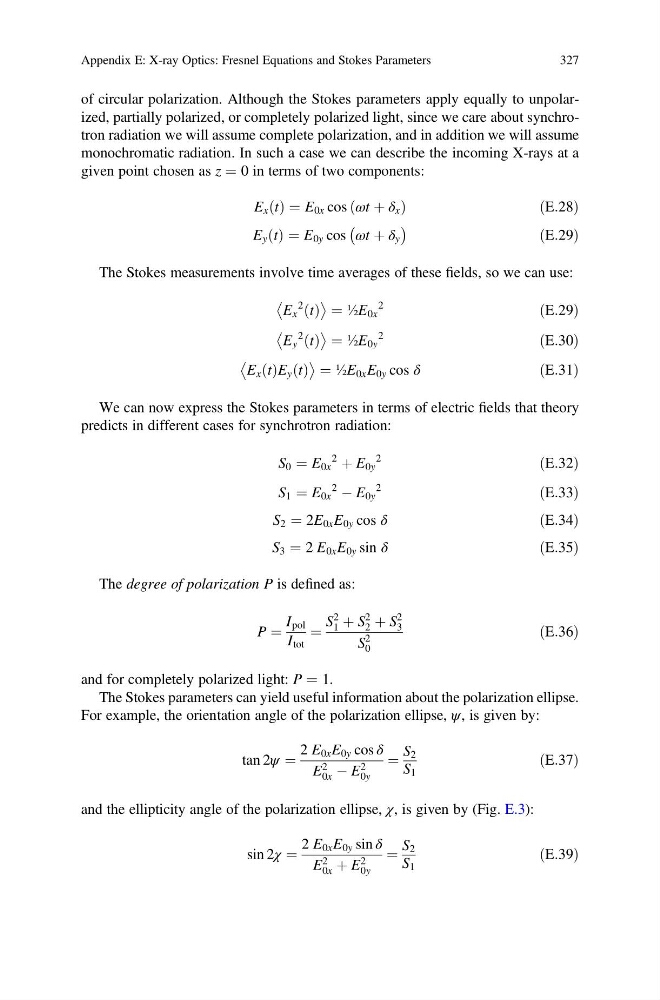
of circular polarization. Although the Stokes parameters apply equally to unpolarized, partially polarized, or completely polarized light, since we care about synchrotron radiation we will assume complete polarization, and in addition we will assume
monochromatic radiation. In such a case we can describe the incoming X-rays at a
given point chosen as z ¼ 0 in terms of two components:
E x t
ð Þ ¼ E 0x cos ωt þ δ x
ð
Þ
ð E:28Þ
E y t
ð Þ ¼ E 0y cos ωt þ δ y
À
Á
ðE:29Þ
The Stokes measurements involve time averages of these fields, so we can use:
E x
2 t
ð Þ
¼ ½E 0x
2
ðE:29Þ
E y
2 t
ð Þ
¼ ½E 0y
2
ðE:30Þ
E x t
ð ÞE y t
ð Þ
¼ ½E 0x E 0y cos δ
ðE:31Þ
We can now express the Stokes parameters in terms of electric fields that theory
predicts in different cases for synchrotron radiation:
S 0 ¼ E 0x
2
þ E 0y
2
ðE:32Þ
S 1 ¼ E 0x
2
À E 0y
2
ðE:33Þ
S 2 ¼ 2E 0x E 0y cos δ
ðE:34Þ
S 3 ¼ 2 E 0x E 0y sin δ
ðE:35Þ
The degree of polarization P is defined as:
P ¼
I pol
I tot
¼
S
2
1 þ S
2
2 þ S
2
3
S
2
0
ðE:36Þ
and for completely polarized light: P ¼ 1.
The Stokes parameters can yield useful information about the polarization ellipse.
For example, the orientation angle of the polarization ellipse, ψ, is given by:
tan 2ψ ¼
2 E 0x E 0y cos δ
E
2
0x À E
2
0y
¼
S 2
S 1
ðE:37Þ
and the ellipticity angle of the polarization ellipse, χ, is given by (Fig. E.3):
sin 2χ ¼
2 E 0x E 0y sin δ
E
2
0x þ E
2
0y
¼
S 2
S 1
ðE:39Þ
Appendix E: X-ray Optics: Fresnel Equations and Stokes Parameters
327
monochromatic radiation. In such a case we can describe the incoming X-rays at a
given point chosen as z ¼ 0 in terms of two components:
E x t
ð Þ ¼ E 0x cos ωt þ δ x
ð
Þ
ð E:28Þ
E y t
ð Þ ¼ E 0y cos ωt þ δ y
À
Á
ðE:29Þ
The Stokes measurements involve time averages of these fields, so we can use:
E x
2 t
ð Þ
¼ ½E 0x
2
ðE:29Þ
E y
2 t
ð Þ
¼ ½E 0y
2
ðE:30Þ
E x t
ð ÞE y t
ð Þ
¼ ½E 0x E 0y cos δ
ðE:31Þ
We can now express the Stokes parameters in terms of electric fields that theory
predicts in different cases for synchrotron radiation:
S 0 ¼ E 0x
2
þ E 0y
2
ðE:32Þ
S 1 ¼ E 0x
2
À E 0y
2
ðE:33Þ
S 2 ¼ 2E 0x E 0y cos δ
ðE:34Þ
S 3 ¼ 2 E 0x E 0y sin δ
ðE:35Þ
The degree of polarization P is defined as:
P ¼
I pol
I tot
¼
S
2
1 þ S
2
2 þ S
2
3
S
2
0
ðE:36Þ
and for completely polarized light: P ¼ 1.
The Stokes parameters can yield useful information about the polarization ellipse.
For example, the orientation angle of the polarization ellipse, ψ, is given by:
tan 2ψ ¼
2 E 0x E 0y cos δ
E
2
0x À E
2
0y
¼
S 2
S 1
ðE:37Þ
and the ellipticity angle of the polarization ellipse, χ, is given by (Fig. E.3):
sin 2χ ¼
2 E 0x E 0y sin δ
E
2
0x þ E
2
0y
¼
S 2
S 1
ðE:39Þ
Appendix E: X-ray Optics: Fresnel Equations and Stokes Parameters
327