

Appendix E: X-ray Optics: Fresnel Equations
and Stokes Parameters
Appendix E.1: Fresnel Equations
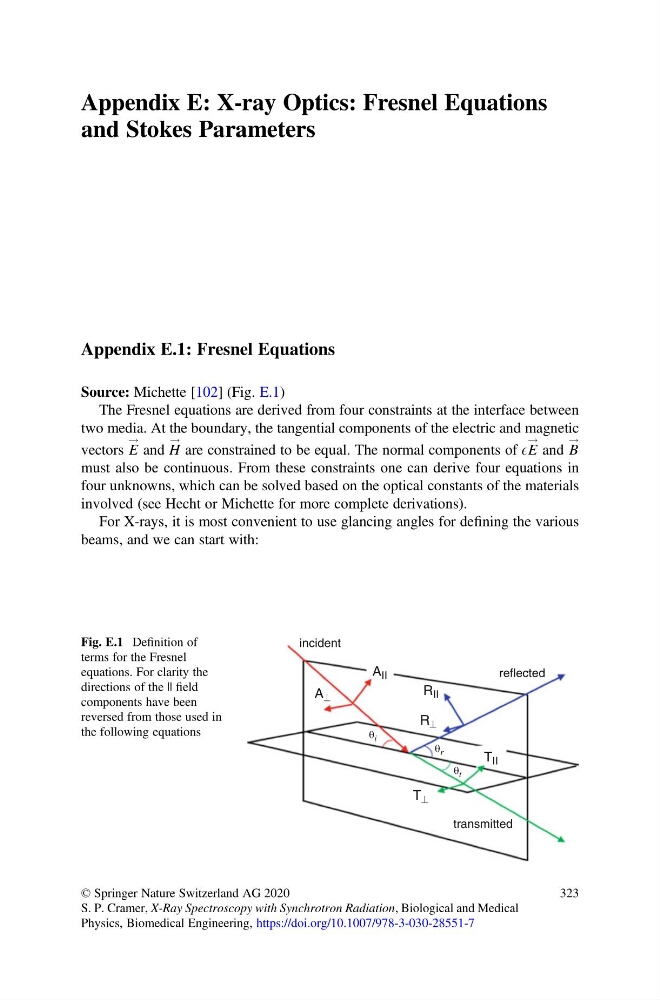
Source: Michette [102] (Fig. E.1)
The Fresnel equations are derived from four constraints at the interface between
two media. At the boundary, the tangential components of the electric and magnetic
vectors E
!
and H
!
are constrained to be equal. The normal components of EE
!
and B
!
must also be continuous. From these constraints one can derive four equations in
four unknowns, which can be solved based on the optical constants of the materials
involved (see Hecht or Michette for more complete derivations).
For X-rays, it is most convenient to use glancing angles for defining the various
beams, and we can start with:
incident
reflected
transmitted
A II
A ⊥
R ⊥
T ⊥
θ i
θ r
θ t
R II
T II
Fig. E.1 Definition of
terms for the Fresnel
equations. For clarity the
directions of the || field
components have been
reversed from those used in
the following equations
© Springer Nature Switzerland AG 2020
S. P. Cramer, X-Ray Spectroscopy with Synchrotron Radiation, Biological and Medical
Physics, Biomedical Engineering, https://doi.org/10.1007/978-3-030-28551-7
323
and Stokes Parameters
Appendix E.1: Fresnel Equations
Source: Michette [102] (Fig. E.1)
The Fresnel equations are derived from four constraints at the interface between
two media. At the boundary, the tangential components of the electric and magnetic
vectors E
!
and H
!
are constrained to be equal. The normal components of EE
!
and B
!
must also be continuous. From these constraints one can derive four equations in
four unknowns, which can be solved based on the optical constants of the materials
involved (see Hecht or Michette for more complete derivations).
For X-rays, it is most convenient to use glancing angles for defining the various
beams, and we can start with:
incident
reflected
transmitted
A II
A ⊥
R ⊥
T ⊥
θ i
θ r
θ t
R II
T II
Fig. E.1 Definition of
terms for the Fresnel
equations. For clarity the
directions of the || field
components have been
reversed from those used in
the following equations
© Springer Nature Switzerland AG 2020
S. P. Cramer, X-Ray Spectroscopy with Synchrotron Radiation, Biological and Medical
Physics, Biomedical Engineering, https://doi.org/10.1007/978-3-030-28551-7
323