

11.8 More Is Not Always Better
We began this book describing the remarkable increases in brightness of synchrotron
radiation over the past four decades. But, in the case of electron spectroscopy, more
photons per unit time or per spatial area are not always better. Two issues are
particular to methods that detect electrons: sample charging and space-charge
effects. And of course, there is always the issue of sample damage, but this is
common to all other X-ray methods.
11.8.1 Sample Charging
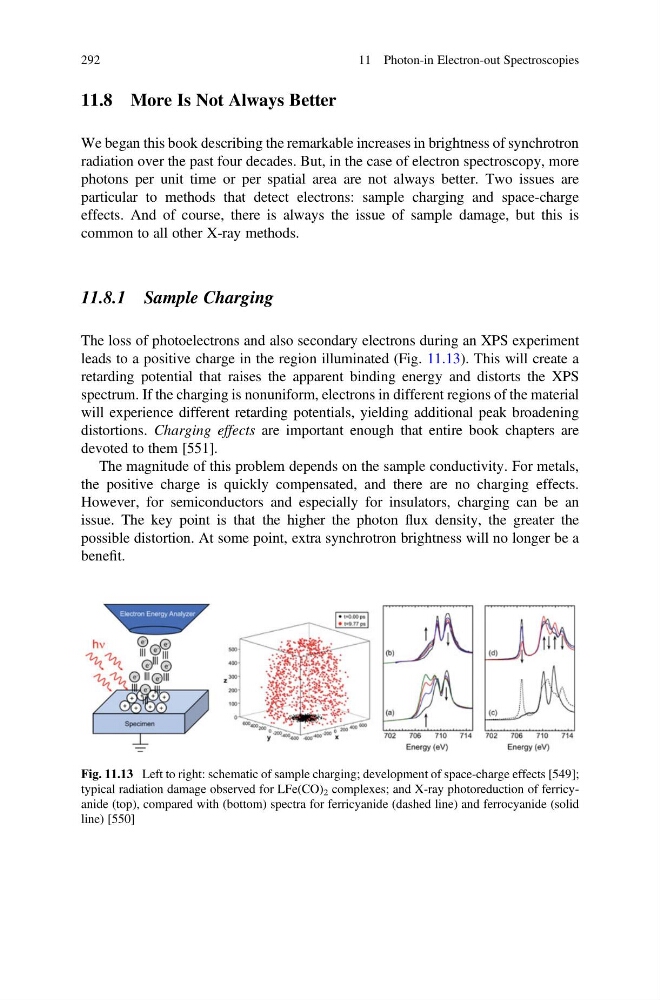
The loss of photoelectrons and also secondary electrons during an XPS experiment
leads to a positive charge in the region illuminated (Fig. 11.13). This will create a
retarding potential that raises the apparent binding energy and distorts the XPS
spectrum. If the charging is nonuniform, electrons in different regions of the material
will experience different retarding potentials, yielding additional peak broadening
distortions. Charging effects are important enough that entire book chapters are
devoted to them [551].
The magnitude of this problem depends on the sample conductivity. For metals,
the positive charge is quickly compensated, and there are no charging effects.
However, for semiconductors and especially for insulators, charging can be an
issue. The key point is that the higher the photon flux density, the greater the
possible distortion. At some point, extra synchrotron brightness will no longer be a
benefit.
Fig. 11.13 Left to right: schematic of sample charging; development of space-charge effects [549];
typical radiation damage observed for LFe(CO) 2 complexes; and X-ray photoreduction of ferricyanide (top), compared with (bottom) spectra for ferricyanide (dashed line) and ferrocyanide (solid
line) [550]
292
11 Photon-in Electron-out Spectroscopies
We began this book describing the remarkable increases in brightness of synchrotron
radiation over the past four decades. But, in the case of electron spectroscopy, more
photons per unit time or per spatial area are not always better. Two issues are
particular to methods that detect electrons: sample charging and space-charge
effects. And of course, there is always the issue of sample damage, but this is
common to all other X-ray methods.
11.8.1 Sample Charging
The loss of photoelectrons and also secondary electrons during an XPS experiment
leads to a positive charge in the region illuminated (Fig. 11.13). This will create a
retarding potential that raises the apparent binding energy and distorts the XPS
spectrum. If the charging is nonuniform, electrons in different regions of the material
will experience different retarding potentials, yielding additional peak broadening
distortions. Charging effects are important enough that entire book chapters are
devoted to them [551].
The magnitude of this problem depends on the sample conductivity. For metals,
the positive charge is quickly compensated, and there are no charging effects.
However, for semiconductors and especially for insulators, charging can be an
issue. The key point is that the higher the photon flux density, the greater the
possible distortion. At some point, extra synchrotron brightness will no longer be a
benefit.
Fig. 11.13 Left to right: schematic of sample charging; development of space-charge effects [549];
typical radiation damage observed for LFe(CO) 2 complexes; and X-ray photoreduction of ferricyanide (top), compared with (bottom) spectra for ferricyanide (dashed line) and ferrocyanide (solid
line) [550]
292
11 Photon-in Electron-out Spectroscopies