

Finally, there is another technique that probes the vibrational motions associated
with the nucleus under study, which we save for the next chapter:
• Nuclear resonance vibrational spectroscopy (NRVS).
All of these measurements have become vastly improved by the high brightness
of modern synchrotron radiation sources.
9.1 Nuclear Properties and Nuclear Transitions
From a chemist’s point of view, a nucleus can be considered as a bag of nucleons
(protons and neutrons) with a particular size and shape. Just as electronic transitions
involve a rearrangement of an electron’s probability distribution (wave function)
within an atom or molecule, nuclear transitions involve a rearrangement of the
nucleons. The possible nuclear wave functions and their associated energies are
quantized by a nuclear Hamiltonian operating on a nuclear wave function:
H ψ N ¼ E N ψ N
ð9:1Þ
9.1.1 Energy Levels, Spins, Lifetimes, and Linewidths
Nucleons are held together primarily by the so-called strong interaction. Just as
electrons in an atom can be promoted to excited states, the nucleus can also be
excited to higher levels and make transitions back to lower levels, absorbing or
emitting photons in the process. Nuclear states have characteristic energies E N and
total angular momenta characterized by nuclear spin quantum number I. Note that
when speaking about nuclear properties, “spin” often refers to the total angular
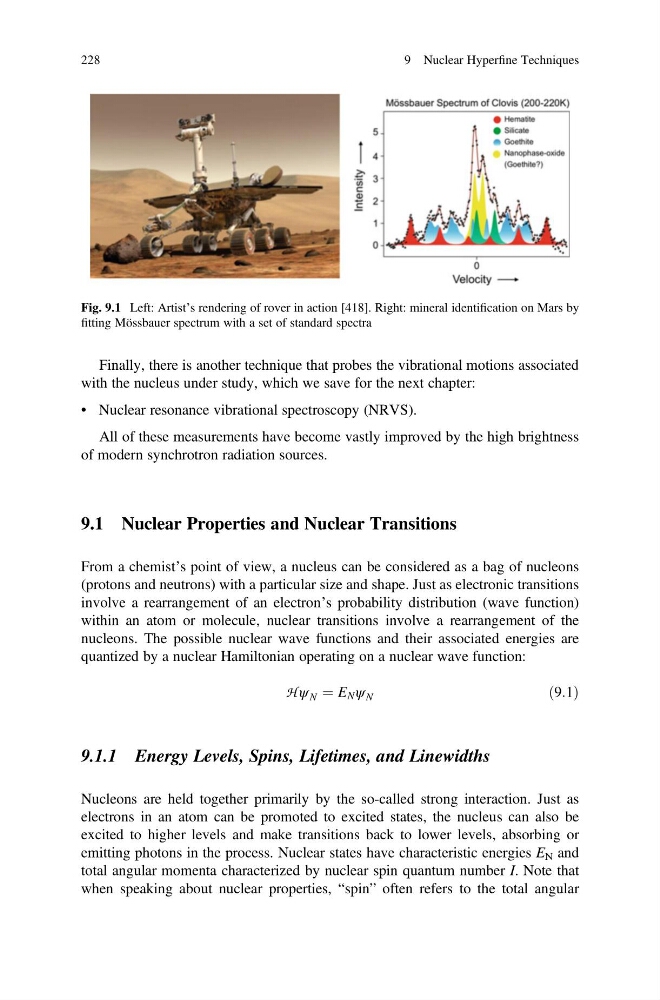
Fig. 9.1 Left: Artist’s rendering of rover in action [418]. Right: mineral identification on Mars by
fitting Mössbauer spectrum with a set of standard spectra
228
9 Nuclear Hyperfine Techniques
with the nucleus under study, which we save for the next chapter:
• Nuclear resonance vibrational spectroscopy (NRVS).
All of these measurements have become vastly improved by the high brightness
of modern synchrotron radiation sources.
9.1 Nuclear Properties and Nuclear Transitions
From a chemist’s point of view, a nucleus can be considered as a bag of nucleons
(protons and neutrons) with a particular size and shape. Just as electronic transitions
involve a rearrangement of an electron’s probability distribution (wave function)
within an atom or molecule, nuclear transitions involve a rearrangement of the
nucleons. The possible nuclear wave functions and their associated energies are
quantized by a nuclear Hamiltonian operating on a nuclear wave function:
H ψ N ¼ E N ψ N
ð9:1Þ
9.1.1 Energy Levels, Spins, Lifetimes, and Linewidths
Nucleons are held together primarily by the so-called strong interaction. Just as
electrons in an atom can be promoted to excited states, the nucleus can also be
excited to higher levels and make transitions back to lower levels, absorbing or
emitting photons in the process. Nuclear states have characteristic energies E N and
total angular momenta characterized by nuclear spin quantum number I. Note that
when speaking about nuclear properties, “spin” often refers to the total angular
Fig. 9.1 Left: Artist’s rendering of rover in action [418]. Right: mineral identification on Mars by
fitting Mössbauer spectrum with a set of standard spectra
228
9 Nuclear Hyperfine Techniques