

J ¼ L À S ¼ 1/2. The energies of these terms are split by the “spin-orbit interaction”
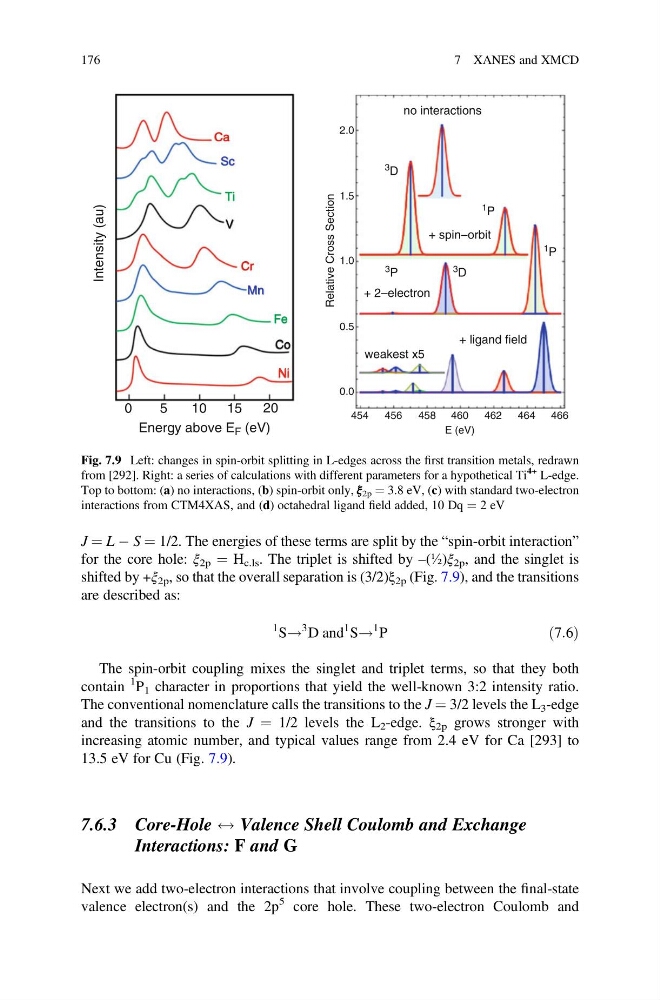
for the core hole: ξ 2p ¼ H c.ls . The triplet is shifted by –(½)ξ 2p , and the singlet is
shifted by +ξ 2p , so that the overall separation is (3/2)ξ 2p (Fig. 7.9), and the transitions
are described as:
1 S!
3 D and
1 S!
1 P
ð7:6Þ
The spin-orbit coupling mixes the singlet and triplet terms, so that they both
contain
1 P 1 character in proportions that yield the well-known 3:2 intensity ratio.
The conventional nomenclature calls the transitions to the J ¼ 3/2 levels the L 3 -edge
and the transitions to the J ¼ 1/2 levels the L 2 -edge. ξ 2p grows stronger with
increasing atomic number, and typical values range from 2.4 eV for Ca [293] to
13.5 eV for Cu (Fig. 7.9).
7.6.3 Core-Hole $ Valence Shell Coulomb and Exchange
Interactions: F and G
Next we add two-electron interactions that involve coupling between the final-state
valence electron(s) and the 2p
5 core hole. These two-electron Coulomb and
2.0
1.5
1.0
0.5
5
10
15
20
0
Energy above E F (eV)
Ca
Sc
Ti
Cr
Mn
Fe
Ni
V
Co
Intensity (au)
0.0
454
456
458 460
462
464 466
E (eV)
weakest x5
+ ligand field
Relative Cross Section
+ 2–electron
+ spin–orbit
no interactions
3 D
3 D
3 P
1 P
1 P
Fig. 7.9 Left: changes in spin-orbit splitting in L-edges across the first transition metals, redrawn
from [292]. Right: a series of calculations with different parameters for a hypothetical Ti
4+ L-edge.
Top to bottom: (a) no interactions, (b) spin-orbit only, ξ 2p ¼ 3.8 eV, (c) with standard two-electron
interactions from CTM4XAS, and (d) octahedral ligand field added, 10 Dq ¼ 2 eV
176
7 XANES and XMCD
for the core hole: ξ 2p ¼ H c.ls . The triplet is shifted by –(½)ξ 2p , and the singlet is
shifted by +ξ 2p , so that the overall separation is (3/2)ξ 2p (Fig. 7.9), and the transitions
are described as:
1 S!
3 D and
1 S!
1 P
ð7:6Þ
The spin-orbit coupling mixes the singlet and triplet terms, so that they both
contain
1 P 1 character in proportions that yield the well-known 3:2 intensity ratio.
The conventional nomenclature calls the transitions to the J ¼ 3/2 levels the L 3 -edge
and the transitions to the J ¼ 1/2 levels the L 2 -edge. ξ 2p grows stronger with
increasing atomic number, and typical values range from 2.4 eV for Ca [293] to
13.5 eV for Cu (Fig. 7.9).
7.6.3 Core-Hole $ Valence Shell Coulomb and Exchange
Interactions: F and G
Next we add two-electron interactions that involve coupling between the final-state
valence electron(s) and the 2p
5 core hole. These two-electron Coulomb and
2.0
1.5
1.0
0.5
5
10
15
20
0
Energy above E F (eV)
Ca
Sc
Ti
Cr
Mn
Fe
Ni
V
Co
Intensity (au)
0.0
454
456
458 460
462
464 466
E (eV)
weakest x5
+ ligand field
Relative Cross Section
+ 2–electron
+ spin–orbit
no interactions
3 D
3 D
3 P
1 P
1 P
Fig. 7.9 Left: changes in spin-orbit splitting in L-edges across the first transition metals, redrawn
from [292]. Right: a series of calculations with different parameters for a hypothetical Ti
4+ L-edge.
Top to bottom: (a) no interactions, (b) spin-orbit only, ξ 2p ¼ 3.8 eV, (c) with standard two-electron
interactions from CTM4XAS, and (d) octahedral ligand field added, 10 Dq ¼ 2 eV
176
7 XANES and XMCD