

6.4.1.1 Phase Shifts
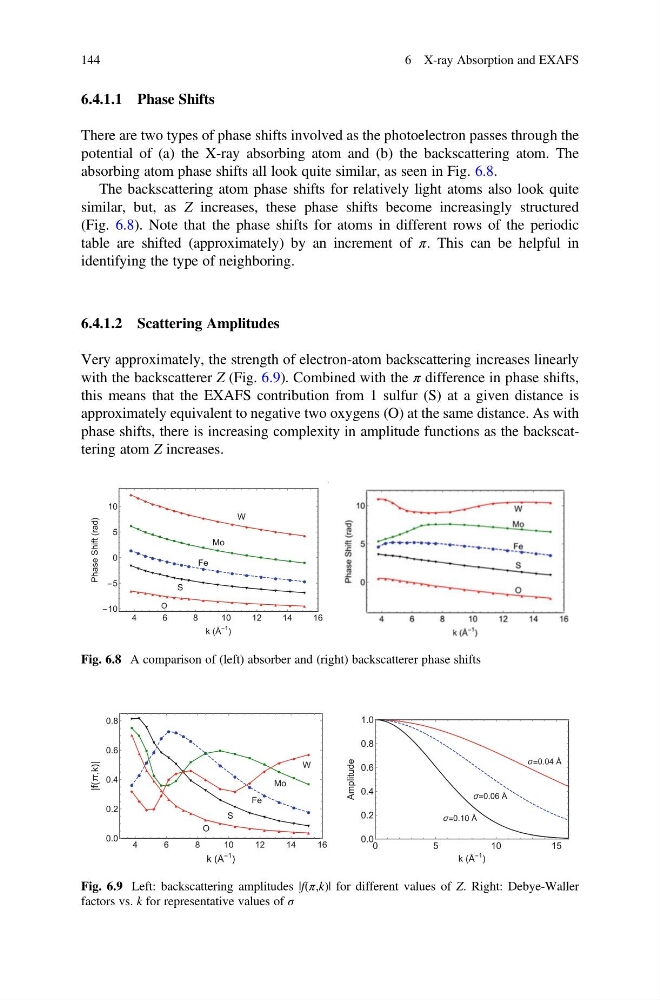
There are two types of phase shifts involved as the photoelectron passes through the
potential of (a) the X-ray absorbing atom and (b) the backscattering atom. The
absorbing atom phase shifts all look quite similar, as seen in Fig. 6.8.
The backscattering atom phase shifts for relatively light atoms also look quite
similar, but, as Z increases, these phase shifts become increasingly structured
(Fig. 6.8). Note that the phase shifts for atoms in different rows of the periodic
table are shifted (approximately) by an increment of π. This can be helpful in
identifying the type of neighboring.
6.4.1.2 Scattering Amplitudes
Very approximately, the strength of electron-atom backscattering increases linearly
with the backscatterer Z (Fig. 6.9). Combined with the π difference in phase shifts,
this means that the EXAFS contribution from 1 sulfur (S) at a given distance is
approximately equivalent to negative two oxygens (O) at the same distance. As with
phase shifts, there is increasing complexity in amplitude functions as the backscattering atom Z increases.
Fig. 6.8 A comparison of (left) absorber and (right) backscatterer phase shifts
Fig. 6.9 Left: backscattering amplitudes |f(π,k)| for different values of Z. Right: Debye-Waller
factors vs. k for representative values of σ
144
6 X-ray Absorption and EXAFS
There are two types of phase shifts involved as the photoelectron passes through the
potential of (a) the X-ray absorbing atom and (b) the backscattering atom. The
absorbing atom phase shifts all look quite similar, as seen in Fig. 6.8.
The backscattering atom phase shifts for relatively light atoms also look quite
similar, but, as Z increases, these phase shifts become increasingly structured
(Fig. 6.8). Note that the phase shifts for atoms in different rows of the periodic
table are shifted (approximately) by an increment of π. This can be helpful in
identifying the type of neighboring.
6.4.1.2 Scattering Amplitudes
Very approximately, the strength of electron-atom backscattering increases linearly
with the backscatterer Z (Fig. 6.9). Combined with the π difference in phase shifts,
this means that the EXAFS contribution from 1 sulfur (S) at a given distance is
approximately equivalent to negative two oxygens (O) at the same distance. As with
phase shifts, there is increasing complexity in amplitude functions as the backscattering atom Z increases.
Fig. 6.8 A comparison of (left) absorber and (right) backscatterer phase shifts
Fig. 6.9 Left: backscattering amplitudes |f(π,k)| for different values of Z. Right: Debye-Waller
factors vs. k for representative values of σ
144
6 X-ray Absorption and EXAFS