

6.3.1 The Matrix Element
In standard quantum mechanics textbooks (see Resources at end of Chapter), it is
derived that the absorption coefficient (or cross section) for the absorption of light is
proportional to the square of a matrix element that involves the initial |ii and final |fi
state wave functions and the interaction Hamilton H I :
μ / σ / M if
2 ¼ f H I
j ji
h
i
j
j
2
ð6:6Þ
We assume for now that only the wave function for a single electron changes.
Then, for X-ray absorption, the initial wave function is that of a core electron, and
the final-state wave function involves an outgoing electron wave. Following
Als-Nielsen and McMorrow [224], we write the final-state wave function as the
combination of an outgoing wave |f 0 i and a scattered wave |Δfi, so the matrix
element becomes:
M if
2 ¼ f 0 þ Δf H I
j ji
h
i
j
j
2
¼ f 0 H I
j ji
h
i
j
j
2 1 þ
f 0 H I
j ji
h
i Δf H I
j ji
h
i
f 0 H I
j ji
h
i
j
j
2
þ c:c:
(
) !
ð6:7Þ
where c.c. means complex conjugate. If we look back to Eq. 6.5, we see that the last
part of this equation refers to the absorption coefficient of the free atom, μ 0 (E), while
the remainder represents the EXAFS oscillations χ(E):
χ E
ð Þ / Δf jH I ji
h
i
ð6:8Þ
From these manipulations we see an essential result—the strength of the
EXAFS depends on the overlap between the scattered wave hΔfj and the core
19900
0
20300
E
Absorbance
nergy (eV)
x-ray
absorber
scatterer
Energy
E 0
Absorbance
core level
photo-electron
μ Δμ
c =
Δm
m 0
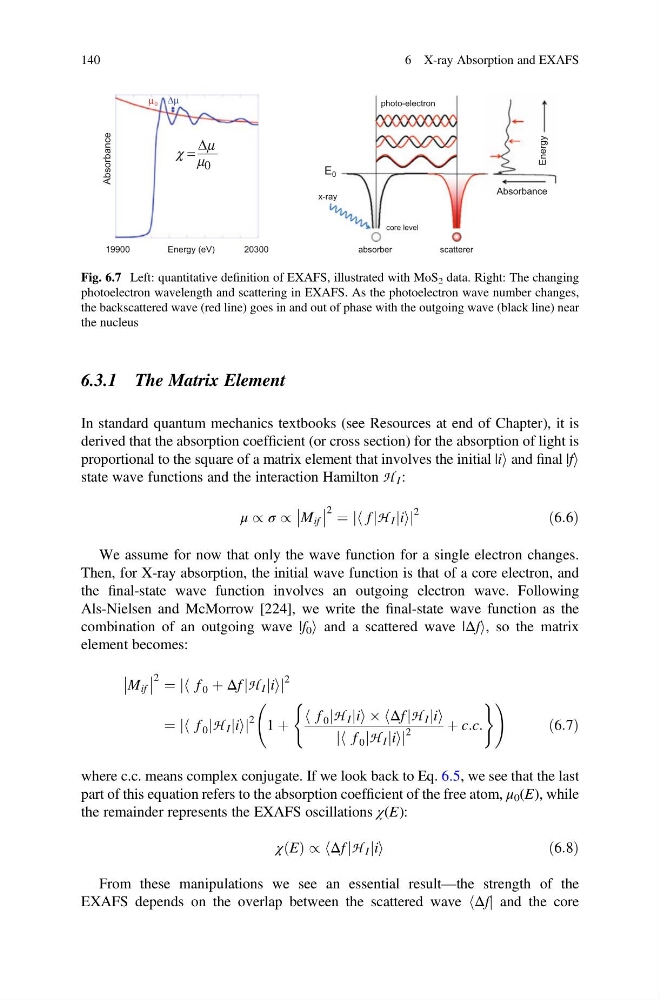
Fig. 6.7 Left: quantitative definition of EXAFS, illustrated with MoS 2 data. Right: The changing
photoelectron wavelength and scattering in EXAFS. As the photoelectron wave number changes,
the backscattered wave (red line) goes in and out of phase with the outgoing wave (black line) near
the nucleus
140
6 X-ray Absorption and EXAFS
In standard quantum mechanics textbooks (see Resources at end of Chapter), it is
derived that the absorption coefficient (or cross section) for the absorption of light is
proportional to the square of a matrix element that involves the initial |ii and final |fi
state wave functions and the interaction Hamilton H I :
μ / σ / M if
2 ¼ f H I
j ji
h
i
j
j
2
ð6:6Þ
We assume for now that only the wave function for a single electron changes.
Then, for X-ray absorption, the initial wave function is that of a core electron, and
the final-state wave function involves an outgoing electron wave. Following
Als-Nielsen and McMorrow [224], we write the final-state wave function as the
combination of an outgoing wave |f 0 i and a scattered wave |Δfi, so the matrix
element becomes:
M if
2 ¼ f 0 þ Δf H I
j ji
h
i
j
j
2
¼ f 0 H I
j ji
h
i
j
j
2 1 þ
f 0 H I
j ji
h
i Δf H I
j ji
h
i
f 0 H I
j ji
h
i
j
j
2
þ c:c:
(
) !
ð6:7Þ
where c.c. means complex conjugate. If we look back to Eq. 6.5, we see that the last
part of this equation refers to the absorption coefficient of the free atom, μ 0 (E), while
the remainder represents the EXAFS oscillations χ(E):
χ E
ð Þ / Δf jH I ji
h
i
ð6:8Þ
From these manipulations we see an essential result—the strength of the
EXAFS depends on the overlap between the scattered wave hΔfj and the core
19900
0
20300
E
Absorbance
nergy (eV)
x-ray
absorber
scatterer
Energy
E 0
Absorbance
core level
photo-electron
μ Δμ
c =
Δm
m 0
Fig. 6.7 Left: quantitative definition of EXAFS, illustrated with MoS 2 data. Right: The changing
photoelectron wavelength and scattering in EXAFS. As the photoelectron wave number changes,
the backscattered wave (red line) goes in and out of phase with the outgoing wave (black line) near
the nucleus
140
6 X-ray Absorption and EXAFS