

χ E
ð Þ ¼
μ E
ð Þ À μ 0 E
ð Þ
μ 0 E
ð Þ
ð6:4Þ
where μ(E) is the observed absorption coefficient for a particular absorption edge
and μ 0 (E) is the structureless, atomic-like background absorption coefficient for that
same edge [213,222,223]. In terms of the absorption coefficient, we can rewrite the
above as:
μ E
ð Þ ¼ μ 0 E
ð Þ 1 þ χ E
ð Þ
½
ð 6:5Þ
All of this is graphically illustrated in Fig. 6.7. In an X-ray absorption event, a
photon is absorbed, and its energy is used to promote a core electron (to a valence
level or the continuum), with a core hole left on the absorbing atom [222–224]. In the
simplest continuum events, the kinetic energy of the photoelectron is given by the
difference between the photon energy and the electron binding energy, so as the
X-ray photon energy is scanned, the photoelectron kinetic energy also changes. If
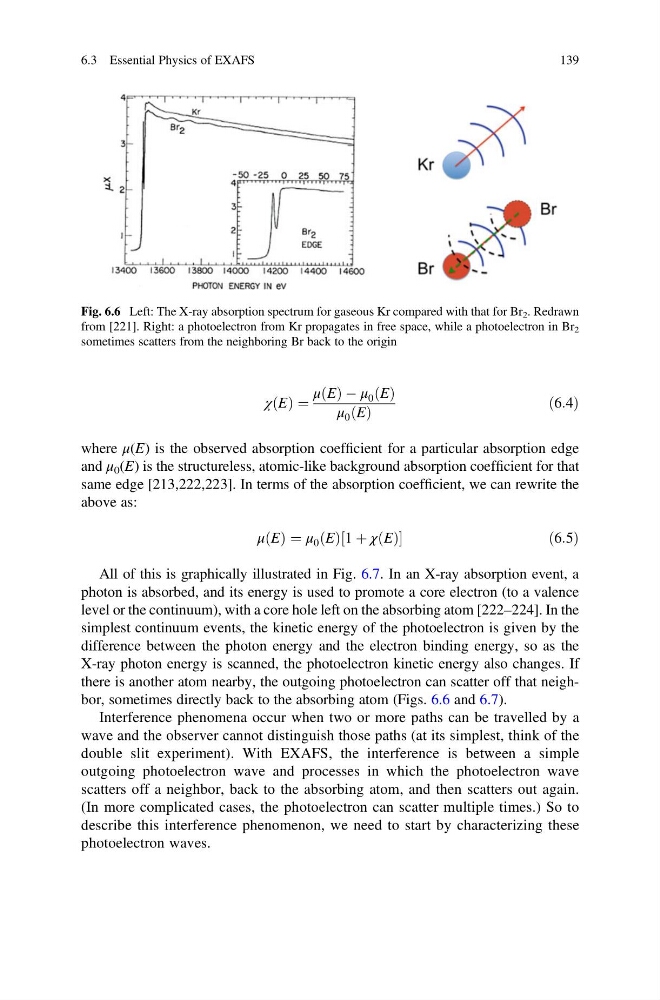
there is another atom nearby, the outgoing photoelectron can scatter off that neighbor, sometimes directly back to the absorbing atom (Figs. 6.6 and 6.7).
Interference phenomena occur when two or more paths can be travelled by a
wave and the observer cannot distinguish those paths (at its simplest, think of the
double slit experiment). With EXAFS, the interference is between a simple
outgoing photoelectron wave and processes in which the photoelectron wave
scatters off a neighbor, back to the absorbing atom, and then scatters out again.
(In more complicated cases, the photoelectron can scatter multiple times.) So to
describe this interference phenomenon, we need to start by characterizing these
photoelectron waves.
Fig. 6.6 Left: The X-ray absorption spectrum for gaseous Kr compared with that for Br 2 . Redrawn
from [221]. Right: a photoelectron from Kr propagates in free space, while a photoelectron in Br 2
sometimes scatters from the neighboring Br back to the origin
6.3 Essential Physics of EXAFS
139
ð Þ ¼
μ E
ð Þ À μ 0 E
ð Þ
μ 0 E
ð Þ
ð6:4Þ
where μ(E) is the observed absorption coefficient for a particular absorption edge
and μ 0 (E) is the structureless, atomic-like background absorption coefficient for that
same edge [213,222,223]. In terms of the absorption coefficient, we can rewrite the
above as:
μ E
ð Þ ¼ μ 0 E
ð Þ 1 þ χ E
ð Þ
½
ð 6:5Þ
All of this is graphically illustrated in Fig. 6.7. In an X-ray absorption event, a
photon is absorbed, and its energy is used to promote a core electron (to a valence
level or the continuum), with a core hole left on the absorbing atom [222–224]. In the
simplest continuum events, the kinetic energy of the photoelectron is given by the
difference between the photon energy and the electron binding energy, so as the
X-ray photon energy is scanned, the photoelectron kinetic energy also changes. If
there is another atom nearby, the outgoing photoelectron can scatter off that neighbor, sometimes directly back to the absorbing atom (Figs. 6.6 and 6.7).
Interference phenomena occur when two or more paths can be travelled by a
wave and the observer cannot distinguish those paths (at its simplest, think of the
double slit experiment). With EXAFS, the interference is between a simple
outgoing photoelectron wave and processes in which the photoelectron wave
scatters off a neighbor, back to the absorbing atom, and then scatters out again.
(In more complicated cases, the photoelectron can scatter multiple times.) So to
describe this interference phenomenon, we need to start by characterizing these
photoelectron waves.
Fig. 6.6 Left: The X-ray absorption spectrum for gaseous Kr compared with that for Br 2 . Redrawn
from [221]. Right: a photoelectron from Kr propagates in free space, while a photoelectron in Br 2
sometimes scatters from the neighboring Br back to the origin
6.3 Essential Physics of EXAFS
139