

know what you are looking at. Conversely, if you want to study a particular
element, you know where to look.
• Sensitive to molecular structure. In particular, the extended X-ray absorption fine
structure (EXAFS) provides information about the number and types of atoms
surrounding an absorber and especially the interatomic distances.
• Responsive to electronic structure and magnetic properties. This information is
primarily in the absorption edge region (Table 6.1) and will be treated in the
following chapter.
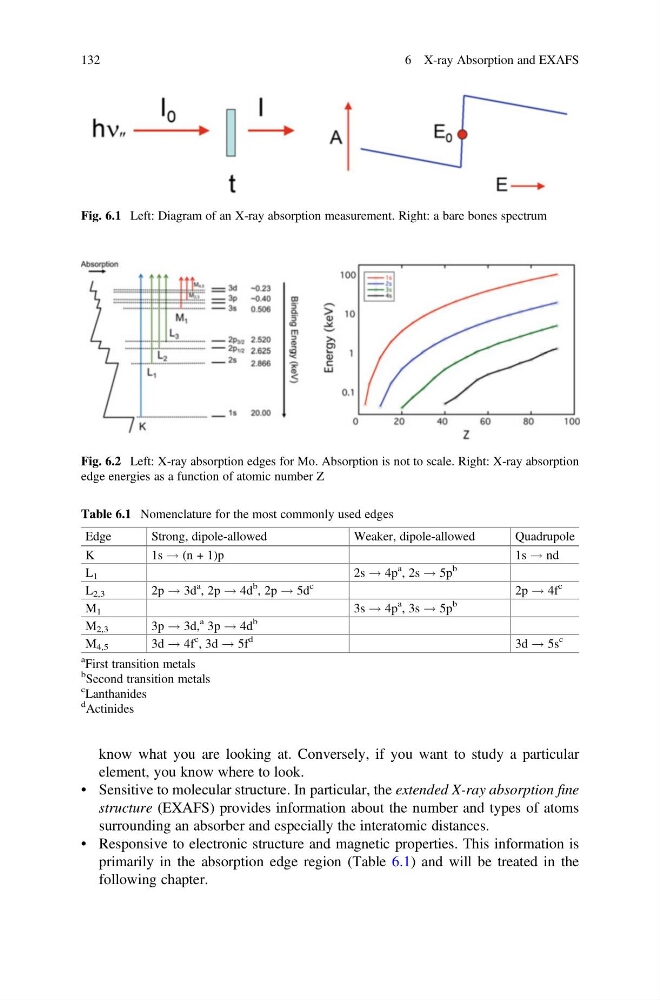
Fig. 6.1 Left: Diagram of an X-ray absorption measurement. Right: a bare bones spectrum
Fig. 6.2 Left: X-ray absorption edges for Mo. Absorption is not to scale. Right: X-ray absorption
edge energies as a function of atomic number Z
Table 6.1 Nomenclature for the most commonly used edges
Edge
Strong, dipole-allowed
Weaker, dipole-allowed
Quadrupole
K
1 s! (n + 1)p
1s ! nd
L 1
2s ! 4p
a , 2s ! 5p
b
L 2,3
2p ! 3d
a , 2p ! 4d
b
, 2p ! 5d
c
2p ! 4f
c
M 1
3s ! 4p
a , 3s ! 5p
b
M 2,3
3p ! 3d,
a 3p ! 4d
b
M 4,5
3d ! 4f
c , 3d ! 5f
d
3d ! 5s
c
a First transition metals
b
Second transition metals
c Lanthanides
d
Actinides
132
6 X-ray Absorption and EXAFS
element, you know where to look.
• Sensitive to molecular structure. In particular, the extended X-ray absorption fine
structure (EXAFS) provides information about the number and types of atoms
surrounding an absorber and especially the interatomic distances.
• Responsive to electronic structure and magnetic properties. This information is
primarily in the absorption edge region (Table 6.1) and will be treated in the
following chapter.
Fig. 6.1 Left: Diagram of an X-ray absorption measurement. Right: a bare bones spectrum
Fig. 6.2 Left: X-ray absorption edges for Mo. Absorption is not to scale. Right: X-ray absorption
edge energies as a function of atomic number Z
Table 6.1 Nomenclature for the most commonly used edges
Edge
Strong, dipole-allowed
Weaker, dipole-allowed
Quadrupole
K
1 s! (n + 1)p
1s ! nd
L 1
2s ! 4p
a , 2s ! 5p
b
L 2,3
2p ! 3d
a , 2p ! 4d
b
, 2p ! 5d
c
2p ! 4f
c
M 1
3s ! 4p
a , 3s ! 5p
b
M 2,3
3p ! 3d,
a 3p ! 4d
b
M 4,5
3d ! 4f
c , 3d ! 5f
d
3d ! 5s
c
a First transition metals
b
Second transition metals
c Lanthanides
d
Actinides
132
6 X-ray Absorption and EXAFS