

temperature variation that remains. Designers thus use the ratio of coefficients k for
thermal conductivity to thermal expansion coefficient α as a figure of merit
(Table 4.2).
One approach is diamond, which has the best thermal conductivity of candidate
monochromator crystals. In many cases water cooling is sufficient. The simplicity
and low cost of water cooling have made diamond crystals one of the popular
options, and they have been used at a variety of sources [128].
An alternate and clever approach involves liquid nitrogen cooling of silicon
crystals to ~80 K. The thermal conductivities of Si and Ge increase at low temperatures, and the coefficients of expansion for Si and Ge go to zero at 125 K and 50 K,
respectively. Very stable high heat load LN 2 -cooled monochromators are in use at
ESRF [129], and a recent comparative study came out in favor of silicon over
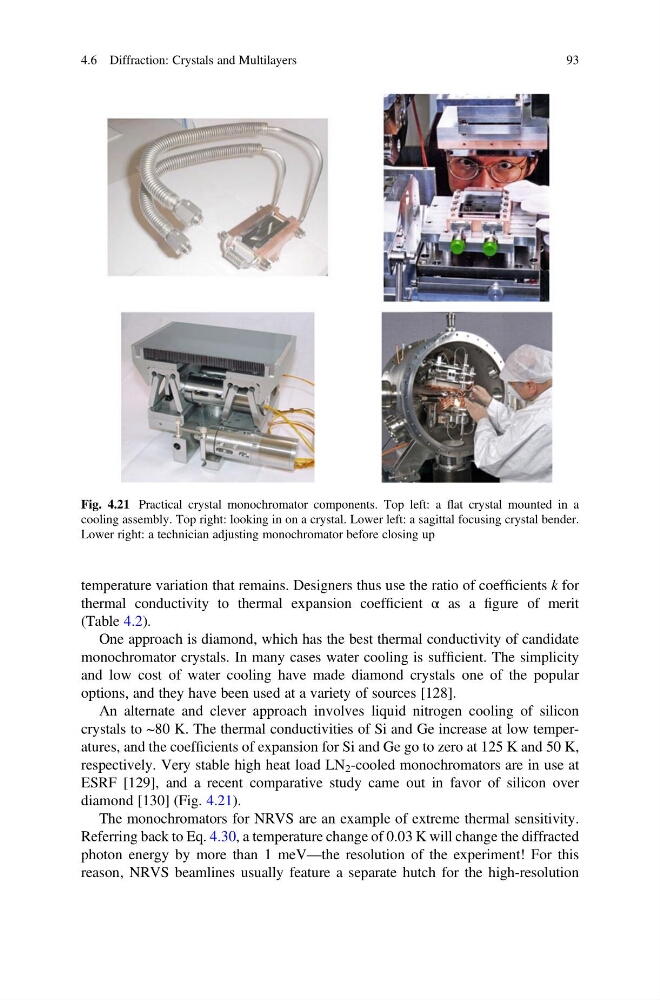
diamond [130] (Fig. 4.21).
The monochromators for NRVS are an example of extreme thermal sensitivity.
Referring back to Eq. 4.30, a temperature change of 0.03 K will change the diffracted
photon energy by more than 1 meV—the resolution of the experiment! For this
reason, NRVS beamlines usually feature a separate hutch for the high-resolution
Fig. 4.21 Practical crystal monochromator components. Top left: a flat crystal mounted in a
cooling assembly. Top right: looking in on a crystal. Lower left: a sagittal focusing crystal bender.
Lower right: a technician adjusting monochromator before closing up
4.6 Diffraction: Crystals and Multilayers
93
thermal conductivity to thermal expansion coefficient α as a figure of merit
(Table 4.2).
One approach is diamond, which has the best thermal conductivity of candidate
monochromator crystals. In many cases water cooling is sufficient. The simplicity
and low cost of water cooling have made diamond crystals one of the popular
options, and they have been used at a variety of sources [128].
An alternate and clever approach involves liquid nitrogen cooling of silicon
crystals to ~80 K. The thermal conductivities of Si and Ge increase at low temperatures, and the coefficients of expansion for Si and Ge go to zero at 125 K and 50 K,
respectively. Very stable high heat load LN 2 -cooled monochromators are in use at
ESRF [129], and a recent comparative study came out in favor of silicon over
diamond [130] (Fig. 4.21).
The monochromators for NRVS are an example of extreme thermal sensitivity.
Referring back to Eq. 4.30, a temperature change of 0.03 K will change the diffracted
photon energy by more than 1 meV—the resolution of the experiment! For this
reason, NRVS beamlines usually feature a separate hutch for the high-resolution
Fig. 4.21 Practical crystal monochromator components. Top left: a flat crystal mounted in a
cooling assembly. Top right: looking in on a crystal. Lower left: a sagittal focusing crystal bender.
Lower right: a technician adjusting monochromator before closing up
4.6 Diffraction: Crystals and Multilayers
93