

Since it is only the overlap region that matters, it is common to plot just the range
of angles around the diffraction condition (θ À α), and to make the energy resolution
explicit, one can use the range of energies (ΔE ¼ E À E 0 ) as the ordinate. Such a plot
is illustrated in Fig. 4.17 for a variety of monochromator crystals at a PETRA-III
beamline.
4.6.2 Crystal Monochromators
Although a single crystal is sufficient for creating a monochromatic beam, it is
obvious that as the angle is changed for different energies, the exiting X-ray beam
will change direction, and downstream its position will move significantly. The
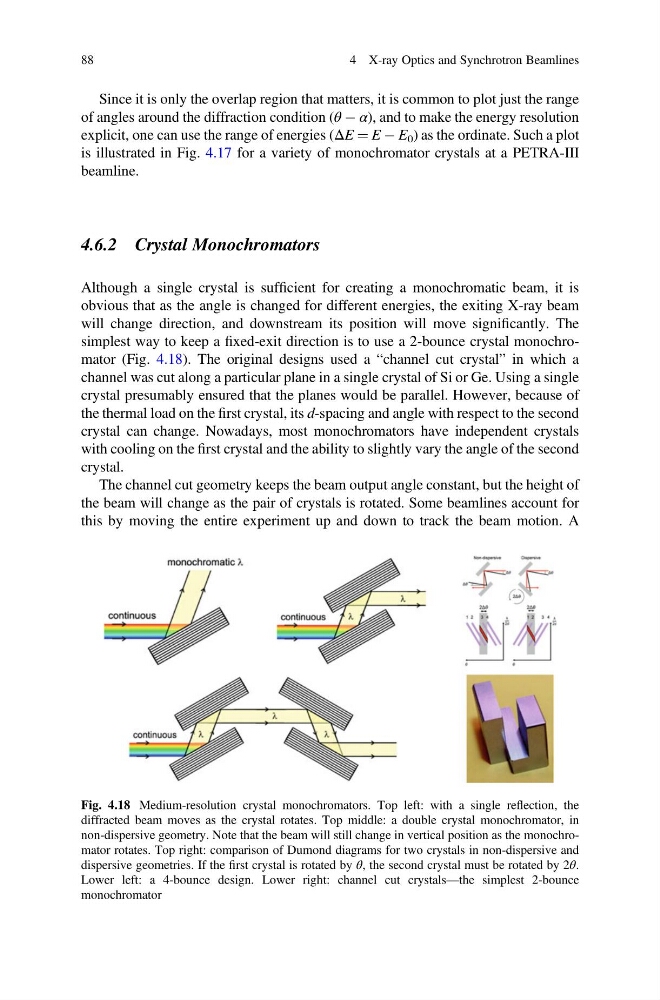
simplest way to keep a fixed-exit direction is to use a 2-bounce crystal monochromator (Fig. 4.18). The original designs used a “channel cut crystal” in which a
channel was cut along a particular plane in a single crystal of Si or Ge. Using a single
crystal presumably ensured that the planes would be parallel. However, because of
the thermal load on the first crystal, its d-spacing and angle with respect to the second
crystal can change. Nowadays, most monochromators have independent crystals
with cooling on the first crystal and the ability to slightly vary the angle of the second
crystal.
The channel cut geometry keeps the beam output angle constant, but the height of
the beam will change as the pair of crystals is rotated. Some beamlines account for
this by moving the entire experiment up and down to track the beam motion. A
Fig. 4.18 Medium-resolution crystal monochromators. Top left: with a single reflection, the
diffracted beam moves as the crystal rotates. Top middle: a double crystal monochromator, in
non-dispersive geometry. Note that the beam will still change in vertical position as the monochromator rotates. Top right: comparison of Dumond diagrams for two crystals in non-dispersive and
dispersive geometries. If the first crystal is rotated by θ, the second crystal must be rotated by 2θ.
Lower left: a 4-bounce design. Lower right: channel cut crystals—the simplest 2-bounce
monochromator
88
4 X-ray Optics and Synchrotron Beamlines
of angles around the diffraction condition (θ À α), and to make the energy resolution
explicit, one can use the range of energies (ΔE ¼ E À E 0 ) as the ordinate. Such a plot
is illustrated in Fig. 4.17 for a variety of monochromator crystals at a PETRA-III
beamline.
4.6.2 Crystal Monochromators
Although a single crystal is sufficient for creating a monochromatic beam, it is
obvious that as the angle is changed for different energies, the exiting X-ray beam
will change direction, and downstream its position will move significantly. The
simplest way to keep a fixed-exit direction is to use a 2-bounce crystal monochromator (Fig. 4.18). The original designs used a “channel cut crystal” in which a
channel was cut along a particular plane in a single crystal of Si or Ge. Using a single
crystal presumably ensured that the planes would be parallel. However, because of
the thermal load on the first crystal, its d-spacing and angle with respect to the second
crystal can change. Nowadays, most monochromators have independent crystals
with cooling on the first crystal and the ability to slightly vary the angle of the second
crystal.
The channel cut geometry keeps the beam output angle constant, but the height of
the beam will change as the pair of crystals is rotated. Some beamlines account for
this by moving the entire experiment up and down to track the beam motion. A
Fig. 4.18 Medium-resolution crystal monochromators. Top left: with a single reflection, the
diffracted beam moves as the crystal rotates. Top middle: a double crystal monochromator, in
non-dispersive geometry. Note that the beam will still change in vertical position as the monochromator rotates. Top right: comparison of Dumond diagrams for two crystals in non-dispersive and
dispersive geometries. If the first crystal is rotated by θ, the second crystal must be rotated by 2θ.
Lower left: a 4-bounce design. Lower right: channel cut crystals—the simplest 2-bounce
monochromator
88
4 X-ray Optics and Synchrotron Beamlines