

71
5
noids that are clinically used. These include dronabinol and nabilone, synthetic THCs,
both of which have been approved for use against chemotherapy-induced emesis in
Canada and the USA, nabilone also against anorexia associated with AIDS-related weight
loss and diabetic neuropathy. Rimonabant is a synthetic receptor antagonist. It was
approved for use in obesity and smoking cessation; however, it had to be withdrawn due
to the occurrence of depression. Another component of Cannabis sativa plants is cannabidiol. It has low psychoactivity and interacts with CB1 and CB2 receptors but probably
has other targets too (Bergamaschi et al. 2011).
2-AG
12-Hydroperoxyeicosa-5,8,10,14-tetraenoic
acid glycerylester
Arachidonic acid
Glycerol
DAG
LPA
Prostaglandin
E 2
glycerylester
+
COX-2
MAG
Acyltransferase
MAG Kinase
MAGL
ABHD6
ABHD12
Lipoxygenases
a
b
DAG
2-AG
DAGL
O
O
O
O
HO
OH
O
O
O
O
O
O
O
O
R
O
R
H 2 C
CH 2 OH
CH 2 OH
CH 2 OH
CH 2 OH
CH 2 OH
CH 2 OH
CH 2 OH
CH 2 OH
O
O
CH 2 OH
CH 2 OH
CH 2 OH
O
O
HOO
CH 2 OH
HO
OH
O
+
H 2 C
H 2 C
O
O
O
O
OH
OH
P
CH 2 OH
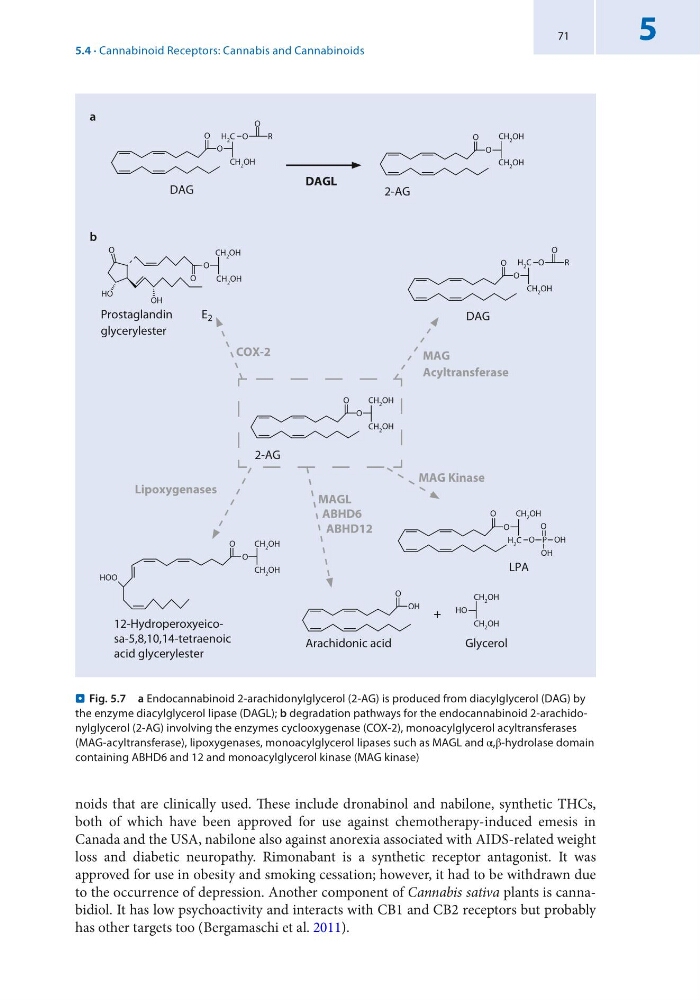
. Fig. 5.7 a Endocannabinoid 2-arachidonylglycerol (2-AG) is produced from diacylglycerol (DAG) by
the enzyme diacylglycerol lipase (DAGL); b degradation pathways for the endocannabinoid 2-arachidonylglycerol (2-AG) involving the enzymes cyclooxygenase (COX-2), monoacylglycerol acyltransferases
(MAG-acyltransferase), lipoxygenases, monoacylglycerol lipases such as MAGL and α,β-hydrolase domain
containing ABHD6 and 12 and monoacylglycerol kinase (MAG kinase)
5.4 · Cannabinoid Receptors: Cannabis and Cannabinoids
5
noids that are clinically used. These include dronabinol and nabilone, synthetic THCs,
both of which have been approved for use against chemotherapy-induced emesis in
Canada and the USA, nabilone also against anorexia associated with AIDS-related weight
loss and diabetic neuropathy. Rimonabant is a synthetic receptor antagonist. It was
approved for use in obesity and smoking cessation; however, it had to be withdrawn due
to the occurrence of depression. Another component of Cannabis sativa plants is cannabidiol. It has low psychoactivity and interacts with CB1 and CB2 receptors but probably
has other targets too (Bergamaschi et al. 2011).
2-AG
12-Hydroperoxyeicosa-5,8,10,14-tetraenoic
acid glycerylester
Arachidonic acid
Glycerol
DAG
LPA
Prostaglandin
E 2
glycerylester
+
COX-2
MAG
Acyltransferase
MAG Kinase
MAGL
ABHD6
ABHD12
Lipoxygenases
a
b
DAG
2-AG
DAGL
O
O
O
O
HO
OH
O
O
O
O
O
O
O
O
R
O
R
H 2 C
CH 2 OH
CH 2 OH
CH 2 OH
CH 2 OH
CH 2 OH
CH 2 OH
CH 2 OH
CH 2 OH
O
O
CH 2 OH
CH 2 OH
CH 2 OH
O
O
HOO
CH 2 OH
HO
OH
O
+
H 2 C
H 2 C
O
O
O
O
OH
OH
P
CH 2 OH
. Fig. 5.7 a Endocannabinoid 2-arachidonylglycerol (2-AG) is produced from diacylglycerol (DAG) by
the enzyme diacylglycerol lipase (DAGL); b degradation pathways for the endocannabinoid 2-arachidonylglycerol (2-AG) involving the enzymes cyclooxygenase (COX-2), monoacylglycerol acyltransferases
(MAG-acyltransferase), lipoxygenases, monoacylglycerol lipases such as MAGL and α,β-hydrolase domain
containing ABHD6 and 12 and monoacylglycerol kinase (MAG kinase)
5.4 · Cannabinoid Receptors: Cannabis and Cannabinoids