

70
5
CB1 receptors are the primary target for Δ 9 -tetrahydrocannabinol (THC) from the
plant Cannabis sativa. THC functions as a partial agonist at CB1 receptors. Exposure to
THC produces several physiological effects including catalepsy, analgesia, hypolocomotion and hypothermia. It also has psychological effects like heightened sensory awareness, euphoria and hyperphagia and induces impairment of short-term memory (Pertwee
2008). Analgesia is mainly mediated by blocking neurotransmission of the GABA and
glycine inhibitory interneurons that, in the absence of pain, keep the break on descending nerve tracts from the brain (in the periaqueductal grey matter; see opiate signalling).
After chronic exposure tolerance to most of the THC effects is produced. However,
THC is very lipophilic and appears to accumulate in fatty tissue from where it can be
released for a long time after drug withdrawal. Therefore severe symptoms of withdrawal
and dependence are hard to demonstrate in laboratory animals (Johnson and Lovinger
2016). Besides endogenous and phytocannabinoids, there are some synthetic cannabiCB1
2-AG
AEA
Presynaptic
neuron
Postsynaptic
neuron
GABA or
glutamate
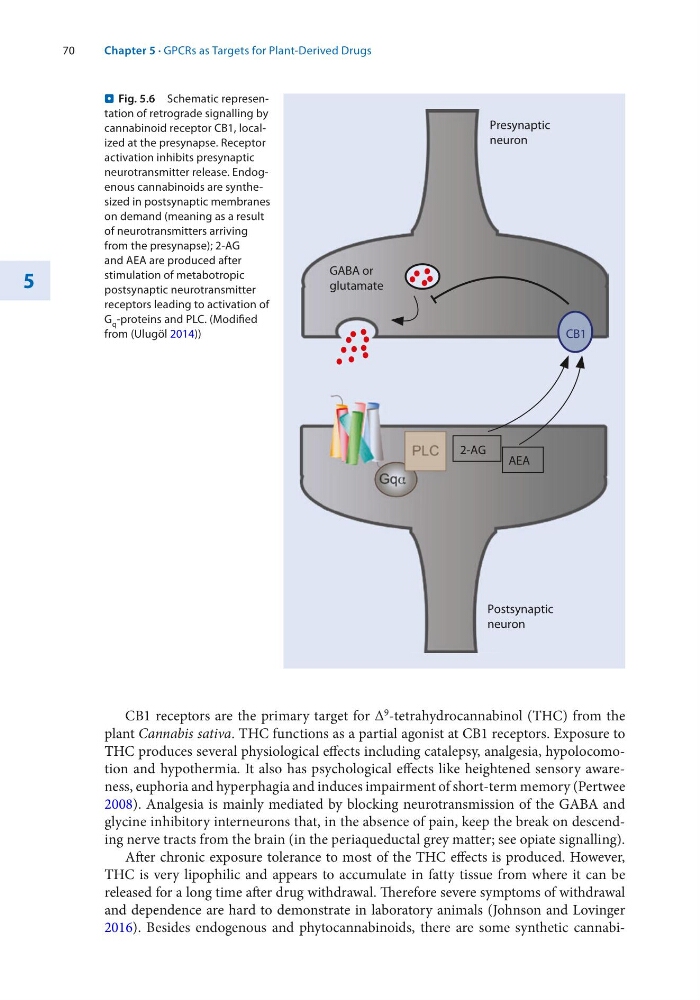
. Fig. 5.6 Schematic representation of retrograde signalling by
cannabinoid receptor CB1, localized at the presynapse. Receptor
activation inhibits presynaptic
neurotransmitter release. Endogenous cannabinoids are synthesized in postsynaptic membranes
on demand (meaning as a result
of neurotransmitters arriving
from the presynapse); 2-AG
and AEA are produced after
stimulation of metabotropic
postsynaptic neurotransmitter
receptors leading to activation of
G q -proteins and PLC. (Modified
from (Ulugöl 2014))
Chapter 5 · GPCRs as Targets for Plant-Derived Drugs
5
CB1 receptors are the primary target for Δ 9 -tetrahydrocannabinol (THC) from the
plant Cannabis sativa. THC functions as a partial agonist at CB1 receptors. Exposure to
THC produces several physiological effects including catalepsy, analgesia, hypolocomotion and hypothermia. It also has psychological effects like heightened sensory awareness, euphoria and hyperphagia and induces impairment of short-term memory (Pertwee
2008). Analgesia is mainly mediated by blocking neurotransmission of the GABA and
glycine inhibitory interneurons that, in the absence of pain, keep the break on descending nerve tracts from the brain (in the periaqueductal grey matter; see opiate signalling).
After chronic exposure tolerance to most of the THC effects is produced. However,
THC is very lipophilic and appears to accumulate in fatty tissue from where it can be
released for a long time after drug withdrawal. Therefore severe symptoms of withdrawal
and dependence are hard to demonstrate in laboratory animals (Johnson and Lovinger
2016). Besides endogenous and phytocannabinoids, there are some synthetic cannabiCB1
2-AG
AEA
Presynaptic
neuron
Postsynaptic
neuron
GABA or
glutamate
. Fig. 5.6 Schematic representation of retrograde signalling by
cannabinoid receptor CB1, localized at the presynapse. Receptor
activation inhibits presynaptic
neurotransmitter release. Endogenous cannabinoids are synthesized in postsynaptic membranes
on demand (meaning as a result
of neurotransmitters arriving
from the presynapse); 2-AG
and AEA are produced after
stimulation of metabotropic
postsynaptic neurotransmitter
receptors leading to activation of
G q -proteins and PLC. (Modified
from (Ulugöl 2014))
Chapter 5 · GPCRs as Targets for Plant-Derived Drugs