

60
5
excitability of synaptic membranes. M1, M3 and M5 receptors also inhibit Ca 2+ -channels
at presynapses; however, at the postsynaptic membrane, they modulate several ion channels via the generation of intracellular Ca 2+ -signals and the activation of the phospholipid
pathway. This leads to closure of several types of K + -channels and to membrane depolarization (Thiele 2013). Hence, muscarinic acetylcholine signalling in the central nervous
system contributes to information processing in different neuronal circuits in a complex
manner.
For instance, special attention was given to M1 receptors, by developing specific positive allosteric regulators that have the potential to weaken the cognitive symptoms of
Alzheimer’s disease. M1 receptor knockout mice show an age-dependent cognitive
decline, and mouse models for Alzheimer’s disease seem to benefit from such compounds
(Melancon et al. 2013). A similar idea is applied to schizophrenia, where M1 and M4
receptor agonists with antipsychotic activity are being developed (Shekhar et al. 2008).
The recently solved structures of M2 and M3 receptors have shown that the ligand- binding
sites for receptors of both types are deeply buried inside the membrane and that the amino
acids directly engaging into ligand binding are almost the same. Therefore, the design of
subtype-selective muscarinic receptor ligands might be difficult, and pharmacological
research is concentrating on developing allosteric interactors; see 7 Box 5.1 (Kruse et al.
2013).
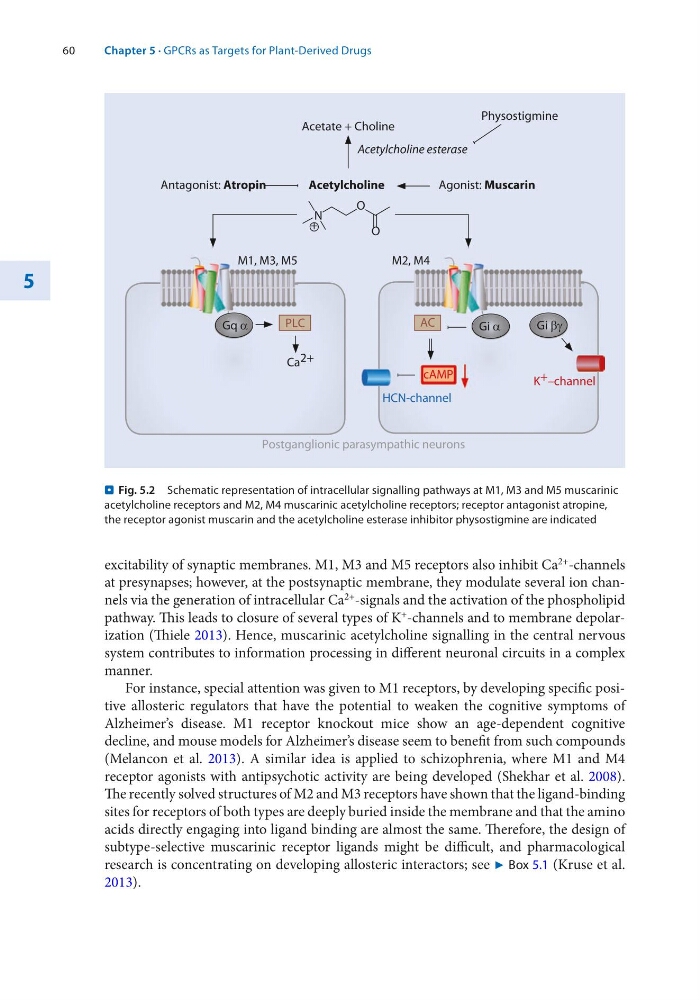
. Fig. 5.2 Schematic representation of intracellular signalling pathways at M1, M3 and M5 muscarinic
acetylcholine receptors and M2, M4 muscarinic acetylcholine receptors; receptor antagonist atropine,
the receptor agonist muscarin and the acetylcholine esterase inhibitor physostigmine are indicated
Chapter 5 · GPCRs as Targets for Plant-Derived Drugs
5
excitability of synaptic membranes. M1, M3 and M5 receptors also inhibit Ca 2+ -channels
at presynapses; however, at the postsynaptic membrane, they modulate several ion channels via the generation of intracellular Ca 2+ -signals and the activation of the phospholipid
pathway. This leads to closure of several types of K + -channels and to membrane depolarization (Thiele 2013). Hence, muscarinic acetylcholine signalling in the central nervous
system contributes to information processing in different neuronal circuits in a complex
manner.
For instance, special attention was given to M1 receptors, by developing specific positive allosteric regulators that have the potential to weaken the cognitive symptoms of
Alzheimer’s disease. M1 receptor knockout mice show an age-dependent cognitive
decline, and mouse models for Alzheimer’s disease seem to benefit from such compounds
(Melancon et al. 2013). A similar idea is applied to schizophrenia, where M1 and M4
receptor agonists with antipsychotic activity are being developed (Shekhar et al. 2008).
The recently solved structures of M2 and M3 receptors have shown that the ligand- binding
sites for receptors of both types are deeply buried inside the membrane and that the amino
acids directly engaging into ligand binding are almost the same. Therefore, the design of
subtype-selective muscarinic receptor ligands might be difficult, and pharmacological
research is concentrating on developing allosteric interactors; see 7 Box 5.1 (Kruse et al.
2013).
. Fig. 5.2 Schematic representation of intracellular signalling pathways at M1, M3 and M5 muscarinic
acetylcholine receptors and M2, M4 muscarinic acetylcholine receptors; receptor antagonist atropine,
the receptor agonist muscarin and the acetylcholine esterase inhibitor physostigmine are indicated
Chapter 5 · GPCRs as Targets for Plant-Derived Drugs