

59
5
copyrronium and tiotropium bromide, which have been approved for treating chronic
airway disease in Europe. The latter work on M1, M2 and M3 receptors that are present in
epithelial cells, inflammatory cells, submucosal gland cells, smooth muscle cells and neurons of tissues in the bronchial tree (Alagha et al. 2014). In addition, muscarinic MAchRs
are targets for designing subtype-specific drugs affecting the brain. The receptor subtypes
are expressed in different areas; M1, M2 and M4 especially in the cortex and M1, M2,
M3 and M4 in the hippocampus. M5 receptors are prominent in the striatum and the
ventral tegmental area (Thiele 2013). All receptors are expressed post- and presynaptically.
M2/M4 activation on postsynaptic membranes leads to the opening of GIRK channels and
the closure of high-voltage-gated Ca 2+ -channels (including P/Q-, L- and N-type), thus
mediating membrane hyperpolarization. On presynaptic membranes, it predominantly
closes high-voltage-gated Ca 2+ -channels and thus decreases neurotransmitter release and
Sympathetic
Parasympathetic
Acetylcholine
Nicotinic acetylcholine receptor
Muscarinic
Adrenergic
Norepinephrine
Postganglionic fibers
(Long)
( Short)
Preganglionic fibers
(Short)
( Long)
α
β
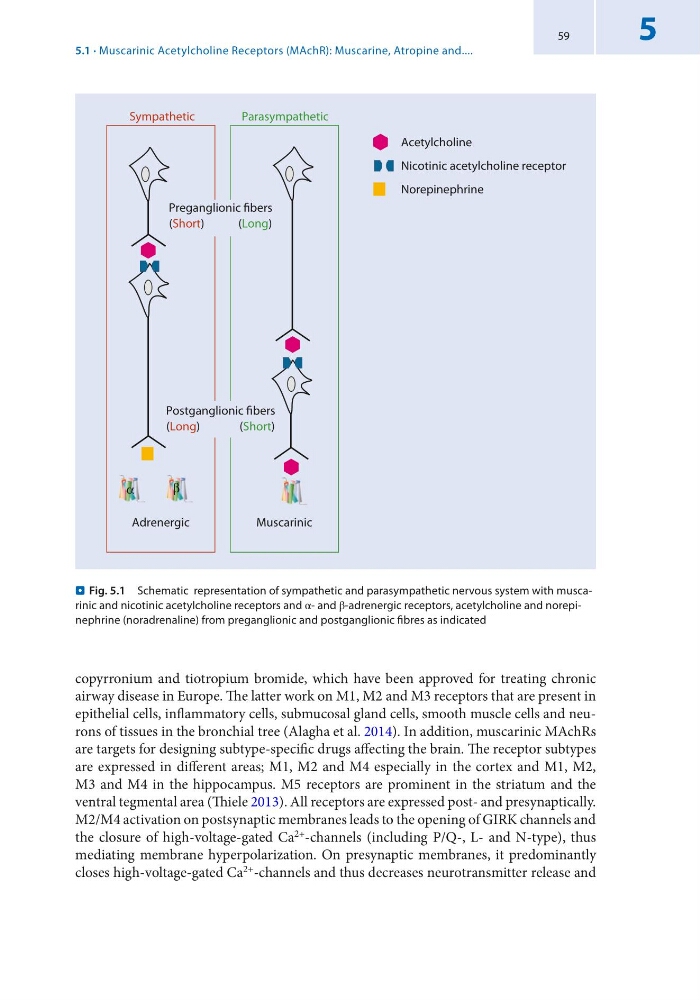
. Fig. 5.1 Schematic representation of sympathetic and parasympathetic nervous system with muscarinic and nicotinic acetylcholine receptors and α- and β-adrenergic receptors, acetylcholine and norepinephrine (noradrenaline) from preganglionic and postganglionic fibres as indicated
5.1 · Muscarinic Acetylcholine Receptors (MAchR): Muscarine, Atropine and....
5
copyrronium and tiotropium bromide, which have been approved for treating chronic
airway disease in Europe. The latter work on M1, M2 and M3 receptors that are present in
epithelial cells, inflammatory cells, submucosal gland cells, smooth muscle cells and neurons of tissues in the bronchial tree (Alagha et al. 2014). In addition, muscarinic MAchRs
are targets for designing subtype-specific drugs affecting the brain. The receptor subtypes
are expressed in different areas; M1, M2 and M4 especially in the cortex and M1, M2,
M3 and M4 in the hippocampus. M5 receptors are prominent in the striatum and the
ventral tegmental area (Thiele 2013). All receptors are expressed post- and presynaptically.
M2/M4 activation on postsynaptic membranes leads to the opening of GIRK channels and
the closure of high-voltage-gated Ca 2+ -channels (including P/Q-, L- and N-type), thus
mediating membrane hyperpolarization. On presynaptic membranes, it predominantly
closes high-voltage-gated Ca 2+ -channels and thus decreases neurotransmitter release and
Sympathetic
Parasympathetic
Acetylcholine
Nicotinic acetylcholine receptor
Muscarinic
Adrenergic
Norepinephrine
Postganglionic fibers
(Long)
( Short)
Preganglionic fibers
(Short)
( Long)
α
β
. Fig. 5.1 Schematic representation of sympathetic and parasympathetic nervous system with muscarinic and nicotinic acetylcholine receptors and α- and β-adrenergic receptors, acetylcholine and norepinephrine (noradrenaline) from preganglionic and postganglionic fibres as indicated
5.1 · Muscarinic Acetylcholine Receptors (MAchR): Muscarine, Atropine and....