

40
3
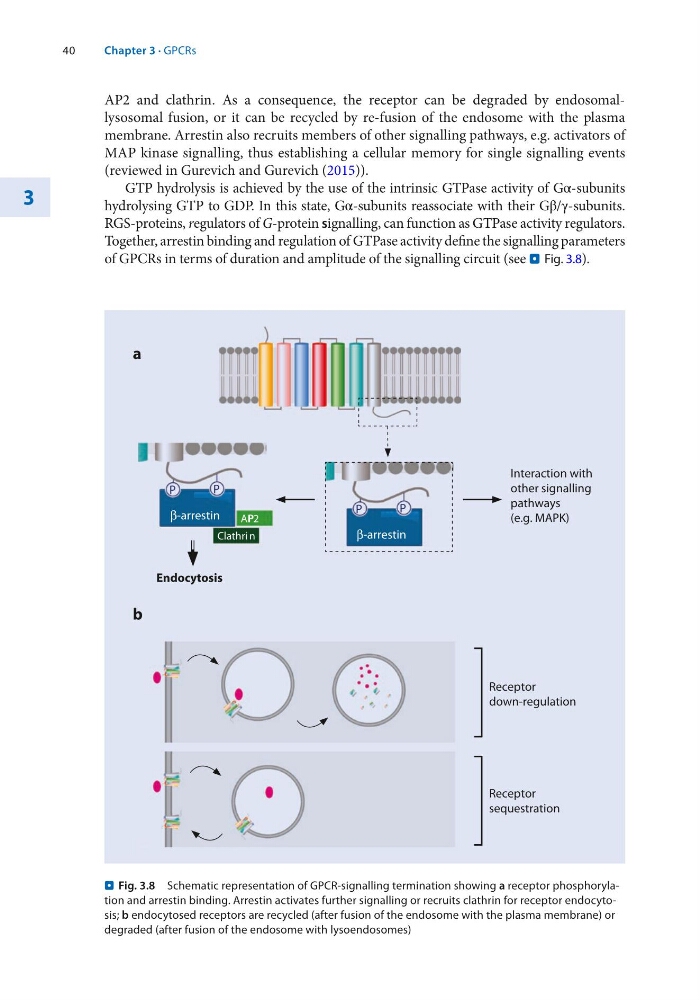
AP2 and clathrin. As a consequence, the receptor can be degraded by endosomallysosomal fusion, or it can be recycled by re-fusion of the endosome with the plasma
membrane. Arrestin also recruits members of other signalling pathways, e.g. activators of
MAP kinase signalling, thus establishing a cellular memory for single signalling events
(reviewed in Gurevich and Gurevich (2015)).
GTP hydrolysis is achieved by the use of the intrinsic GTPase activity of Gα-subunits
hydrolysing GTP to GDP. In this state, Gα-subunits reassociate with their Gβ/γ-subunits.
RGS-proteins, regulators of G-protein signalling, can function as GTPase activity regulators.
Together, arrestin binding and regulation of GTPase activity define the signalling parameters
of GPCRs in terms of duration and amplitude of the signalling circuit (see . Fig. 3.8).
P
P
β-arrestin
Interaction with
other signalling
pathways
(e.g. MAPK)
AP2
Clathri n
P
P
P
β-arrestin
Endocytosis
a
b
Receptor
sequestration
Receptor
down-regulation
. Fig. 3.8 Schematic representation of GPCR-signalling termination showing a receptor phosphorylation and arrestin binding. Arrestin activates further signalling or recruits clathrin for receptor endocytosis; b endocytosed receptors are recycled (after fusion of the endosome with the plasma membrane) or
degraded (after fusion of the endosome with lysoendosomes)
Chapter 3 · GPCRs
3
AP2 and clathrin. As a consequence, the receptor can be degraded by endosomallysosomal fusion, or it can be recycled by re-fusion of the endosome with the plasma
membrane. Arrestin also recruits members of other signalling pathways, e.g. activators of
MAP kinase signalling, thus establishing a cellular memory for single signalling events
(reviewed in Gurevich and Gurevich (2015)).
GTP hydrolysis is achieved by the use of the intrinsic GTPase activity of Gα-subunits
hydrolysing GTP to GDP. In this state, Gα-subunits reassociate with their Gβ/γ-subunits.
RGS-proteins, regulators of G-protein signalling, can function as GTPase activity regulators.
Together, arrestin binding and regulation of GTPase activity define the signalling parameters
of GPCRs in terms of duration and amplitude of the signalling circuit (see . Fig. 3.8).
P
P
β-arrestin
Interaction with
other signalling
pathways
(e.g. MAPK)
AP2
Clathri n
P
P
P
β-arrestin
Endocytosis
a
b
Receptor
sequestration
Receptor
down-regulation
. Fig. 3.8 Schematic representation of GPCR-signalling termination showing a receptor phosphorylation and arrestin binding. Arrestin activates further signalling or recruits clathrin for receptor endocytosis; b endocytosed receptors are recycled (after fusion of the endosome with the plasma membrane) or
degraded (after fusion of the endosome with lysoendosomes)
Chapter 3 · GPCRs