

174
11
coumaroyl-CoA. These enzymes seem to act in a multienzyme complex anchored to the
endoplasmic reticulum membrane (“metabolon”). The activated coumaroyl-CoA is the
main precursor of many pathways, the major end products being lignins, lignans, suberin,
flavonoids, stilbenes and coumarins. As not many phenylpropanoids are known to interact with human receptors, only the most important steps of this biosynthetic pathway are
described here (Kennedy 2014, 2015; Jiang et al. 2016).
11.2 Phenylpropanoids (Derived from Phenylalanine)
Phenylpropanoid compounds are usually further modified by methylation, hydroxylation and acetylation. These modifications can enhance the volatility of scent compounds (Schwab et al. 2008; Baldwin 2010; Colquhoun and Clark 2011; Maffei et al. 2011;
Cinnamic acid
Aurones
Isoflavonoids
Naringenin
Coumaroyl-CoA
Catechine
Anthocyanidines
Anthocyane
Tannins
Plastid
Chalcone
Stilbene
Coumarins
Fouranocoumarins
3x Malonyl-CoA
Epicatechine
Gallocatechine
Galloepicatechine
CHS
STS
Dihydroflavonols
CHI
Feruloyl-CoA
Monolignols
Lignin
PAL
H
H
OH
OH
O
NH 2
O
Phenylalaninee
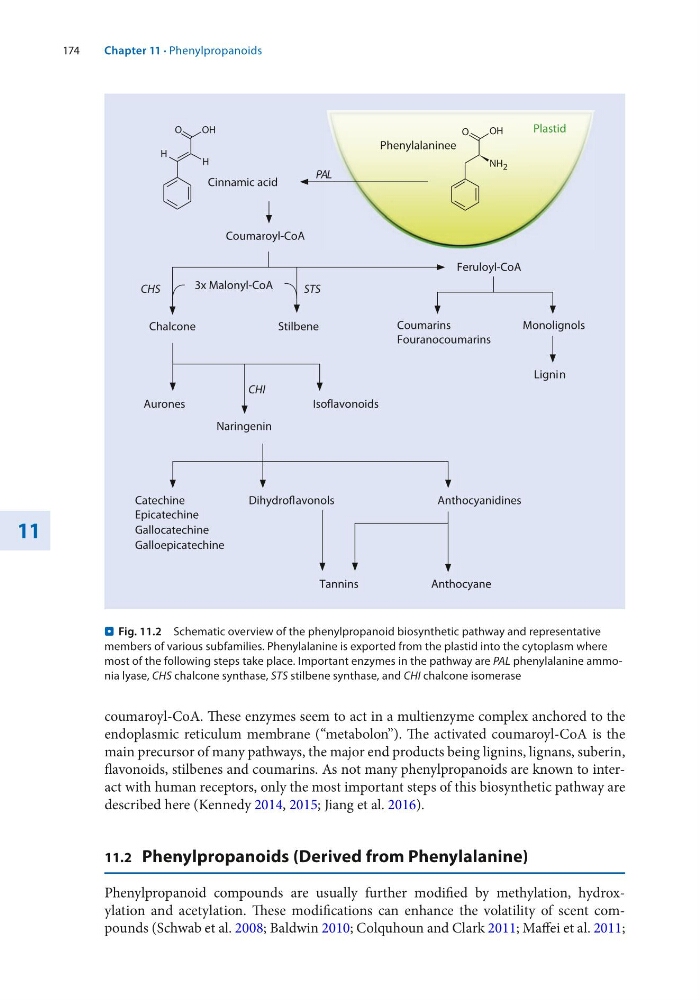
. Fig. 11.2 Schematic overview of the phenylpropanoid biosynthetic pathway and representative
members of various subfamilies. Phenylalanine is exported from the plastid into the cytoplasm where
most of the following steps take place. Important enzymes in the pathway are PAL phenylalanine ammonia lyase, CHS chalcone synthase, STS stilbene synthase, and CHI chalcone isomerase
Chapter 11 · Phenylpropanoids
11
coumaroyl-CoA. These enzymes seem to act in a multienzyme complex anchored to the
endoplasmic reticulum membrane (“metabolon”). The activated coumaroyl-CoA is the
main precursor of many pathways, the major end products being lignins, lignans, suberin,
flavonoids, stilbenes and coumarins. As not many phenylpropanoids are known to interact with human receptors, only the most important steps of this biosynthetic pathway are
described here (Kennedy 2014, 2015; Jiang et al. 2016).
11.2 Phenylpropanoids (Derived from Phenylalanine)
Phenylpropanoid compounds are usually further modified by methylation, hydroxylation and acetylation. These modifications can enhance the volatility of scent compounds (Schwab et al. 2008; Baldwin 2010; Colquhoun and Clark 2011; Maffei et al. 2011;
Cinnamic acid
Aurones
Isoflavonoids
Naringenin
Coumaroyl-CoA
Catechine
Anthocyanidines
Anthocyane
Tannins
Plastid
Chalcone
Stilbene
Coumarins
Fouranocoumarins
3x Malonyl-CoA
Epicatechine
Gallocatechine
Galloepicatechine
CHS
STS
Dihydroflavonols
CHI
Feruloyl-CoA
Monolignols
Lignin
PAL
H
H
OH
OH
O
NH 2
O
Phenylalaninee
. Fig. 11.2 Schematic overview of the phenylpropanoid biosynthetic pathway and representative
members of various subfamilies. Phenylalanine is exported from the plastid into the cytoplasm where
most of the following steps take place. Important enzymes in the pathway are PAL phenylalanine ammonia lyase, CHS chalcone synthase, STS stilbene synthase, and CHI chalcone isomerase
Chapter 11 · Phenylpropanoids