

173
11
phenylalanine ammonia lyase (PAL) that releases the ammonium group (which is reassimilated) leading to trans-cinnamic acid (Zhang and Liu 2015). This enzyme is found
to be associated with the ER membrane. PAL activity has been found in higher plants, in
some fungi and a few bacteria, but not in animals. Cinnamic acid is a precursor of benzoic
acid, another pathway leading to the synthesis of salicylic acid. Cinnamic acid is catalysed
by cinnamate 4-hydroxylase, a microsomal monooxygenase containing a heme cofactor,
into p-coumaric acid and with the help of the 4-coumarate:CoA ligase (4CL) further to
Erythrose 4-P + PEP
DAHP
Shikimate
Chorismate
Ubiquinone
Phylloquinone
Tetrahydrofolate
Anthranilate
Tryptophane
Tryptamine
Auxin
Glucosinolate
Indole Alkaloids
Prephenate
Hydroxyphenylpyruvate
Phenylpyruvate
Arogenat e
Tyrosine
P henylalanine
Tocopherole
Plastoquinone
Tyramine
Suberine
Isoquinoline Alkaloids
Phenylethylamine
Plastid
Cytoplasm
Phenethylamine Alkaloids
Phenylpropanoids
HO
O
OH
O
O
OH
COOH
NH 2
N
H
OH
OH
HO
HO
O
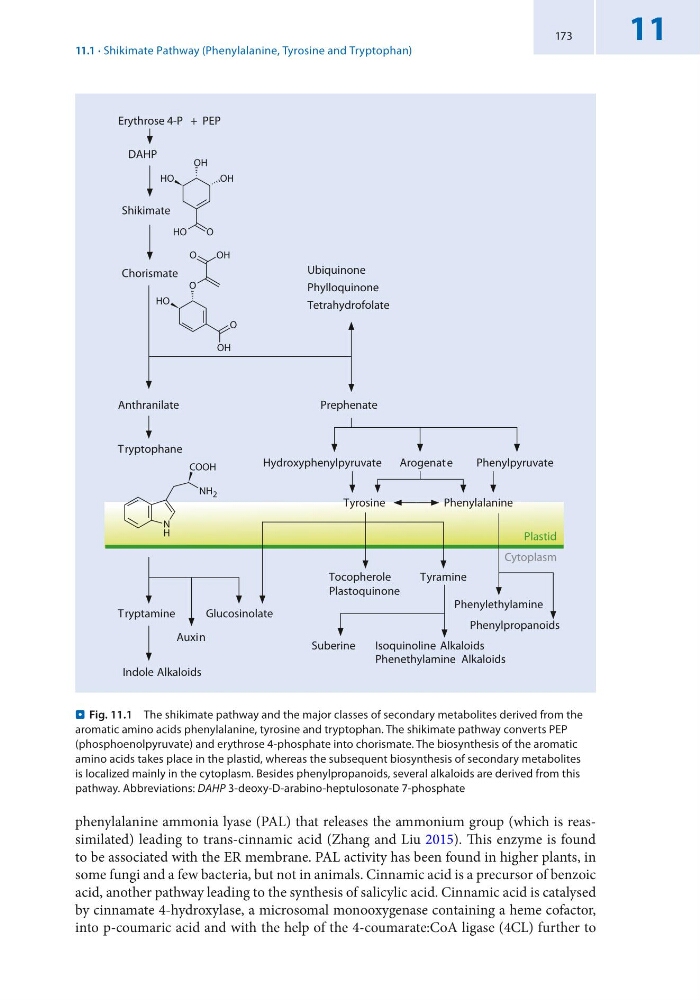
. Fig. 11.1 The shikimate pathway and the major classes of secondary metabolites derived from the
aromatic amino acids phenylalanine, tyrosine and tryptophan. The shikimate pathway converts PEP
(phosphoenolpyruvate) and erythrose 4-phosphate into chorismate. The biosynthesis of the aromatic
amino acids takes place in the plastid, whereas the subsequent biosynthesis of secondary metabolites
is localized mainly in the cytoplasm. Besides phenylpropanoids, several alkaloids are derived from this
pathway. Abbreviations: DAHP 3-deoxy-D-arabino-heptulosonate 7-phosphate
11.1 · Shikimate Pathway (Phenylalanine, Tyrosine and Tryptophan)
11
phenylalanine ammonia lyase (PAL) that releases the ammonium group (which is reassimilated) leading to trans-cinnamic acid (Zhang and Liu 2015). This enzyme is found
to be associated with the ER membrane. PAL activity has been found in higher plants, in
some fungi and a few bacteria, but not in animals. Cinnamic acid is a precursor of benzoic
acid, another pathway leading to the synthesis of salicylic acid. Cinnamic acid is catalysed
by cinnamate 4-hydroxylase, a microsomal monooxygenase containing a heme cofactor,
into p-coumaric acid and with the help of the 4-coumarate:CoA ligase (4CL) further to
Erythrose 4-P + PEP
DAHP
Shikimate
Chorismate
Ubiquinone
Phylloquinone
Tetrahydrofolate
Anthranilate
Tryptophane
Tryptamine
Auxin
Glucosinolate
Indole Alkaloids
Prephenate
Hydroxyphenylpyruvate
Phenylpyruvate
Arogenat e
Tyrosine
P henylalanine
Tocopherole
Plastoquinone
Tyramine
Suberine
Isoquinoline Alkaloids
Phenylethylamine
Plastid
Cytoplasm
Phenethylamine Alkaloids
Phenylpropanoids
HO
O
OH
O
O
OH
COOH
NH 2
N
H
OH
OH
HO
HO
O
. Fig. 11.1 The shikimate pathway and the major classes of secondary metabolites derived from the
aromatic amino acids phenylalanine, tyrosine and tryptophan. The shikimate pathway converts PEP
(phosphoenolpyruvate) and erythrose 4-phosphate into chorismate. The biosynthesis of the aromatic
amino acids takes place in the plastid, whereas the subsequent biosynthesis of secondary metabolites
is localized mainly in the cytoplasm. Besides phenylpropanoids, several alkaloids are derived from this
pathway. Abbreviations: DAHP 3-deoxy-D-arabino-heptulosonate 7-phosphate
11.1 · Shikimate Pathway (Phenylalanine, Tyrosine and Tryptophan)