

7
1
metabolites is far from cheap, and the gain of these compounds for the plant must outweigh the costs. Remarkably, despite their long history of medicinal and recreational use,
very little is known about the concrete function of many of these metabolites for the
plants. Nevertheless, for many compounds their cellular targets in animals are known, and
therefore their effect on animals or pathogens can be deduced. Also, in some rare cases,
the function of a specific compound for the plant is well studied. Based on this knowledge,
a wide range of functions for secondary metabolites can be conceived that cover different
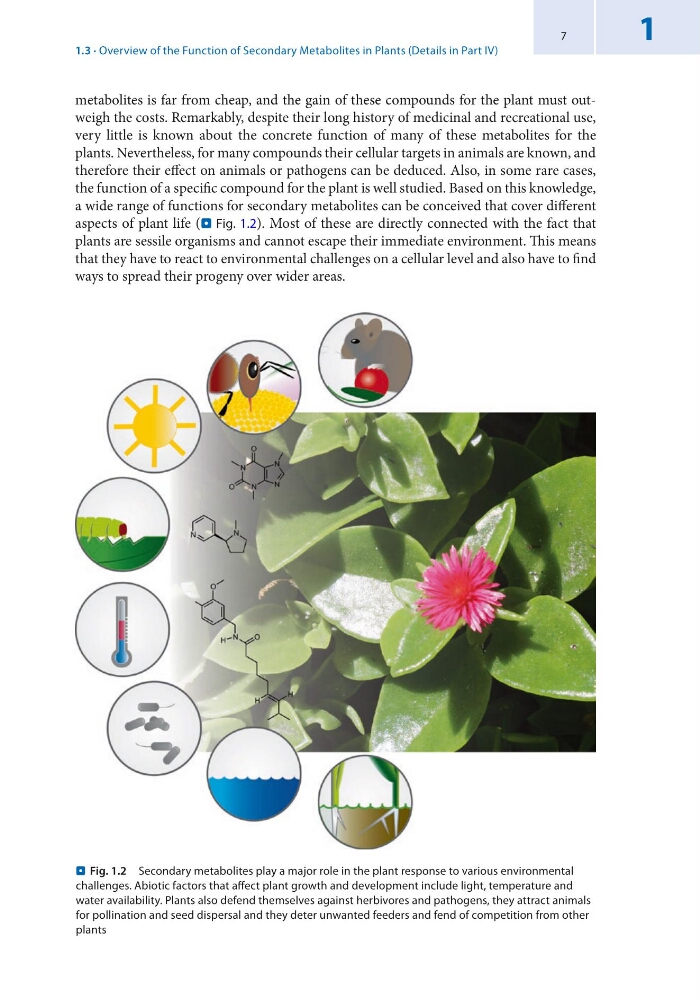
aspects of plant life (. Fig. 1.2). Most of these are directly connected with the fact that
plants are sessile organisms and cannot escape their immediate environment. This means
that they have to react to environmental challenges on a cellular level and also have to find
ways to spread their progeny over wider areas.
. Fig. 1.2 Secondary metabolites play a major role in the plant response to various environmental
challenges. Abiotic factors that affect plant growth and development include light, temperature and
water availability. Plants also defend themselves against herbivores and pathogens, they attract animals
for pollination and seed dispersal and they deter unwanted feeders and fend of competition from other
plants
1.3 · Overview of the Function of Secondary Metabolites in Plants (Details in Part IV)
1
metabolites is far from cheap, and the gain of these compounds for the plant must outweigh the costs. Remarkably, despite their long history of medicinal and recreational use,
very little is known about the concrete function of many of these metabolites for the
plants. Nevertheless, for many compounds their cellular targets in animals are known, and
therefore their effect on animals or pathogens can be deduced. Also, in some rare cases,
the function of a specific compound for the plant is well studied. Based on this knowledge,
a wide range of functions for secondary metabolites can be conceived that cover different
aspects of plant life (. Fig. 1.2). Most of these are directly connected with the fact that
plants are sessile organisms and cannot escape their immediate environment. This means
that they have to react to environmental challenges on a cellular level and also have to find
ways to spread their progeny over wider areas.
. Fig. 1.2 Secondary metabolites play a major role in the plant response to various environmental
challenges. Abiotic factors that affect plant growth and development include light, temperature and
water availability. Plants also defend themselves against herbivores and pathogens, they attract animals
for pollination and seed dispersal and they deter unwanted feeders and fend of competition from other
plants
1.3 · Overview of the Function of Secondary Metabolites in Plants (Details in Part IV)