

6
1
2003; Dahlgren 1980; Zhu et al. 2011). In a large meta-analysis of the distribution of drugs
in different kingdoms, Zhu et al. (2011) showed that only 66 out of 740 families of the
Viridiplantae contained drug-type secondary metabolites, 61 of which clustered within
only 11 groups, orders or clades. A comparison of the Selaginella genome with that of seed
plants also clearly showed that three gene families closely tied to secondary metabolism
underwent a significant expansion in the lycophyte and angiosperm lineages. Two genes
known to be involved in the biosynthesis of volatile odorants seemed to be only present in
seed plants (Banks et al. 2011), which is in line with the major role of these volatiles in
fertilization and seed dispersion.
1.3 Overview of the Function of Secondary Metabolites in Plants
(Details in Part IV)
Most secondary metabolites have very complex structures. To synthesize these compounds requires significant resources and elaborate, high-energy-dependent biochemical
pathways including many specific enzymes. Therefore, the possession of secondary
Photosynthesis
Alkylamides
Polyketides
Terpenoids
Quinones
Phenylpropanoids
Cyanogenic
glycosides
Alkaloids
Glycosinolates
Fatty acids
Carbon metabolism
Nitrogen / Nitrates
Sulfur
Acyl CoA
MEP / MVA
pathway
TCA
Glutamate
Ornithine
Methionine
Shikimate pathway /
Aromatic amino acids
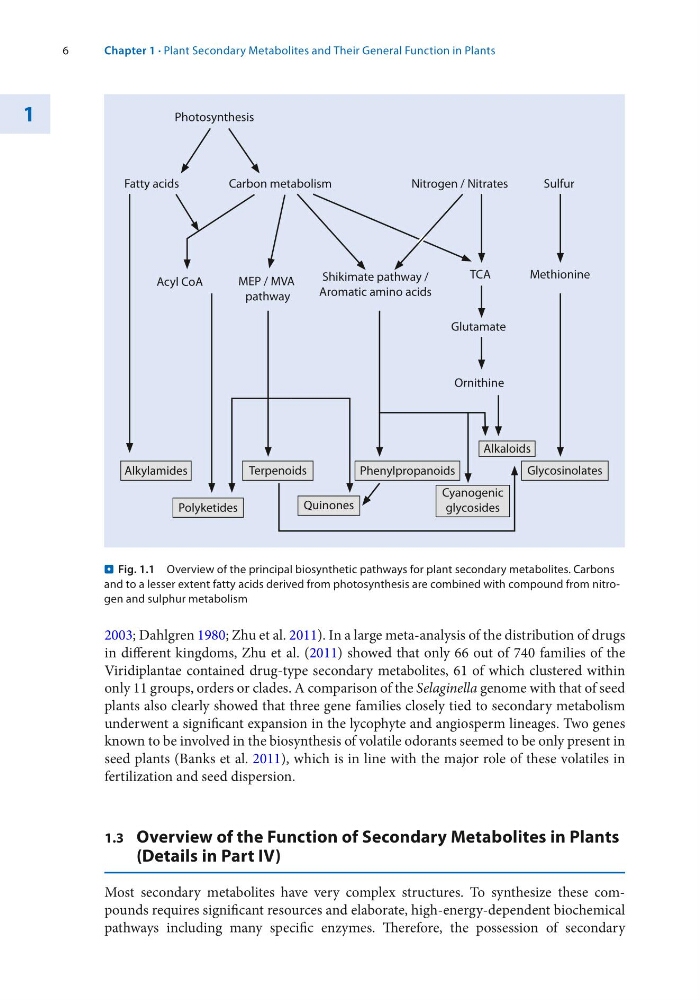
. Fig. 1.1 Overview of the principal biosynthetic pathways for plant secondary metabolites. Carbons
and to a lesser extent fatty acids derived from photosynthesis are combined with compound from nitrogen and sulphur metabolism
Chapter 1 · Plant Secondary Metabolites and Their General Function in Plants
1
2003; Dahlgren 1980; Zhu et al. 2011). In a large meta-analysis of the distribution of drugs
in different kingdoms, Zhu et al. (2011) showed that only 66 out of 740 families of the
Viridiplantae contained drug-type secondary metabolites, 61 of which clustered within
only 11 groups, orders or clades. A comparison of the Selaginella genome with that of seed
plants also clearly showed that three gene families closely tied to secondary metabolism
underwent a significant expansion in the lycophyte and angiosperm lineages. Two genes
known to be involved in the biosynthesis of volatile odorants seemed to be only present in
seed plants (Banks et al. 2011), which is in line with the major role of these volatiles in
fertilization and seed dispersion.
1.3 Overview of the Function of Secondary Metabolites in Plants
(Details in Part IV)
Most secondary metabolites have very complex structures. To synthesize these compounds requires significant resources and elaborate, high-energy-dependent biochemical
pathways including many specific enzymes. Therefore, the possession of secondary
Photosynthesis
Alkylamides
Polyketides
Terpenoids
Quinones
Phenylpropanoids
Cyanogenic
glycosides
Alkaloids
Glycosinolates
Fatty acids
Carbon metabolism
Nitrogen / Nitrates
Sulfur
Acyl CoA
MEP / MVA
pathway
TCA
Glutamate
Ornithine
Methionine
Shikimate pathway /
Aromatic amino acids
. Fig. 1.1 Overview of the principal biosynthetic pathways for plant secondary metabolites. Carbons
and to a lesser extent fatty acids derived from photosynthesis are combined with compound from nitrogen and sulphur metabolism
Chapter 1 · Plant Secondary Metabolites and Their General Function in Plants