

156
10
Mitochondria
Plastid
MVA pathway
MEP pathway
Cytoplasm
ER
IPP
Ubiquinones
Mevalonate
2x Acetyl-CoA
FPP (C15)
C30
Sesquiterpenes
Brassinosteroids
Sterol
Triterpenes
Polyterpenes
G3P + Pyruvate
DXP
HMBPP
IPP
DMAPP
IDI
GPP (C10)
GGPP (C20)
Tetraterpenes (C40)
Tocopherols
Plasoquinone
Phylloquinone
Carotenoids
Xanthophyll
Vacuole
MEP
Monoterpenes
Diterpenes
Acetoacetyl-CoA
Acetyl-CoA
HMG-CoA
IPP
DMAPP
IDI
Sesquiterpenes
Storage
Modifications
DMAPP
IDI
FPP
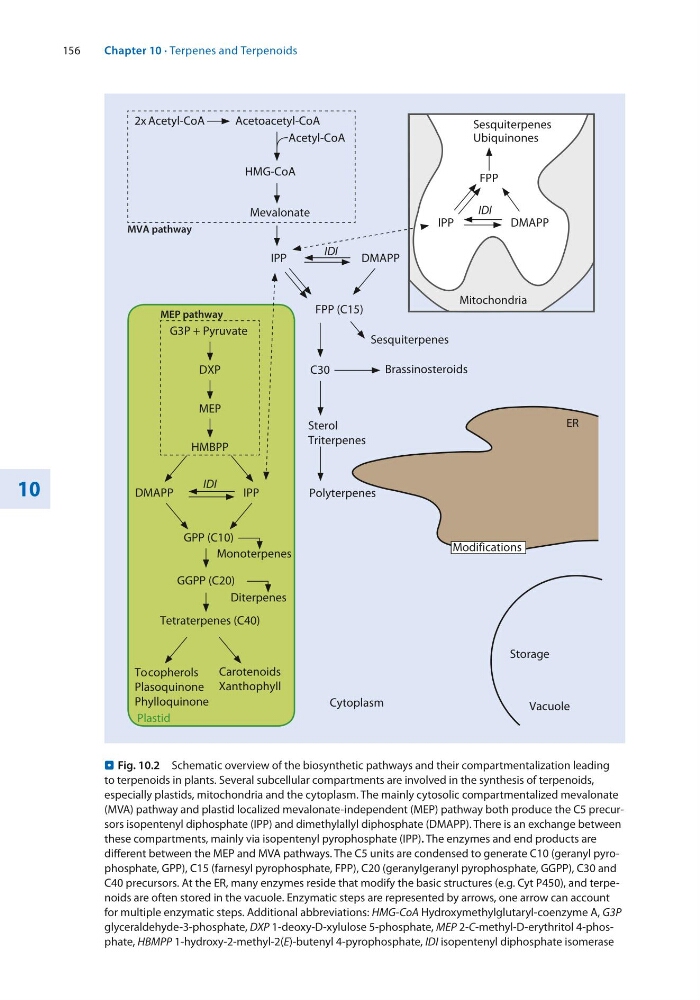
. Fig. 10.2 Schematic overview of the biosynthetic pathways and their compartmentalization leading
to terpenoids in plants. Several subcellular compartments are involved in the synthesis of terpenoids,
especially plastids, mitochondria and the cytoplasm. The mainly cytosolic compartmentalized mevalonate
(MVA) pathway and plastid localized mevalonate-independent (MEP) pathway both produce the C5 precursors isopentenyl diphosphate (IPP) and dimethylallyl diphosphate (DMAPP). There is an exchange between
these compartments, mainly via isopentenyl pyrophosphate (IPP). The enzymes and end products are
different between the MEP and MVA pathways. The C5 units are condensed to generate C10 (geranyl pyrophosphate, GPP), C15 (farnesyl pyrophosphate, FPP), C20 (geranylgeranyl pyrophosphate, GGPP), C30 and
C40 precursors. At the ER, many enzymes reside that modify the basic structures (e.g. Cyt P450), and terpenoids are often stored in the vacuole. Enzymatic steps are represented by arrows, one arrow can account
for multiple enzymatic steps. Additional abbreviations: HMG-CoA Hydroxymethylglutaryl-coenzyme A, G3P
glyceraldehyde-3-phosphate, DXP 1-deoxy-D-xylulose 5-phosphate, MEP 2-C-methyl-D-erythritol 4-phosphate, HBMPP 1-hydroxy-2-methyl-2(E)-butenyl 4-pyrophosphate, IDI isopentenyl diphosphate isomerase
Chapter 10 · Terpenes and Terpenoids
10
Mitochondria
Plastid
MVA pathway
MEP pathway
Cytoplasm
ER
IPP
Ubiquinones
Mevalonate
2x Acetyl-CoA
FPP (C15)
C30
Sesquiterpenes
Brassinosteroids
Sterol
Triterpenes
Polyterpenes
G3P + Pyruvate
DXP
HMBPP
IPP
DMAPP
IDI
GPP (C10)
GGPP (C20)
Tetraterpenes (C40)
Tocopherols
Plasoquinone
Phylloquinone
Carotenoids
Xanthophyll
Vacuole
MEP
Monoterpenes
Diterpenes
Acetoacetyl-CoA
Acetyl-CoA
HMG-CoA
IPP
DMAPP
IDI
Sesquiterpenes
Storage
Modifications
DMAPP
IDI
FPP
. Fig. 10.2 Schematic overview of the biosynthetic pathways and their compartmentalization leading
to terpenoids in plants. Several subcellular compartments are involved in the synthesis of terpenoids,
especially plastids, mitochondria and the cytoplasm. The mainly cytosolic compartmentalized mevalonate
(MVA) pathway and plastid localized mevalonate-independent (MEP) pathway both produce the C5 precursors isopentenyl diphosphate (IPP) and dimethylallyl diphosphate (DMAPP). There is an exchange between
these compartments, mainly via isopentenyl pyrophosphate (IPP). The enzymes and end products are
different between the MEP and MVA pathways. The C5 units are condensed to generate C10 (geranyl pyrophosphate, GPP), C15 (farnesyl pyrophosphate, FPP), C20 (geranylgeranyl pyrophosphate, GGPP), C30 and
C40 precursors. At the ER, many enzymes reside that modify the basic structures (e.g. Cyt P450), and terpenoids are often stored in the vacuole. Enzymatic steps are represented by arrows, one arrow can account
for multiple enzymatic steps. Additional abbreviations: HMG-CoA Hydroxymethylglutaryl-coenzyme A, G3P
glyceraldehyde-3-phosphate, DXP 1-deoxy-D-xylulose 5-phosphate, MEP 2-C-methyl-D-erythritol 4-phosphate, HBMPP 1-hydroxy-2-methyl-2(E)-butenyl 4-pyrophosphate, IDI isopentenyl diphosphate isomerase
Chapter 10 · Terpenes and Terpenoids