

155
10
The MEP pathway needs seven enzymes to produce IPP, starting from glyceraldehyde 3-phosphate and pyruvate (. Fig. 10.2). The first step is mediated by 1-deoxy-Dxylulose 5-phosphate synthase (DXS) and leads to the formation of 1-deoxy-D-xylulose
5- phosphate (DXP), followed by the 1-deoxy-D-xylulose 5-phosphate reductoisomerase
(DXR) step yielding 2-C-methyl-D-erythritol 4-phosphate (MEP). Four additional steps
are needed to produce 1-hydroxy-2-methyl-2-(E)-butenyl 4-pyrophosphate (HMBPP),
IPP
head-to-tail (1-4 link)
DMAPP
a
head
1
2
4
3
5
OH
O
O
O
P
P OH
O
OH
tail
b
most natural
occuring
head-to-head (1-1 link)
tail-to-tail (4-4 link)
irregular
terpenes
c
IPP
FPP (C15)
sesquiterpenes
triterpenes
DMAPP
GPP (C10)
monoterpenes
diterpenes
tetraterpenes
OH
O
O
O
P
P OH
O
OH
OH
O
O
O
P
P OH
O
OH
OH
O
O
O
P
P OH
O
OH
OH
O
O
O
P
P OH
O
OH
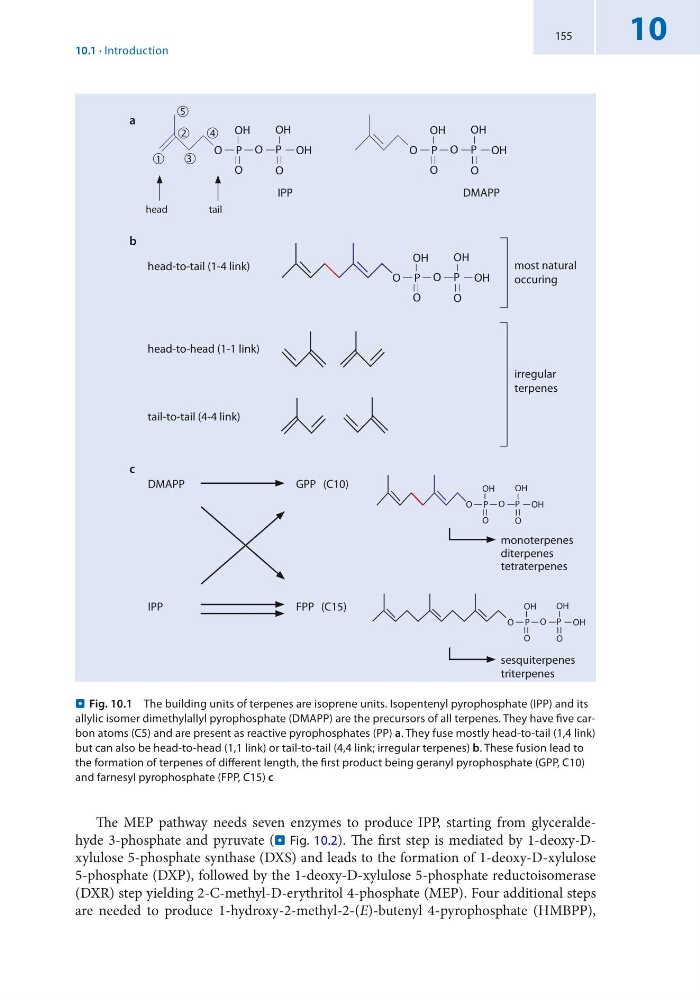
. Fig. 10.1 The building units of terpenes are isoprene units. Isopentenyl pyrophosphate (IPP) and its
allylic isomer dimethylallyl pyrophosphate (DMAPP) are the precursors of all terpenes. They have five carbon atoms (C5) and are present as reactive pyrophosphates (PP) a. They fuse mostly head-to-tail (1,4 link)
but can also be head-to-head (1,1 link) or tail-to-tail (4,4 link; irregular terpenes) b. These fusion lead to
the formation of terpenes of different length, the first product being geranyl pyrophosphate (GPP, C10)
and farnesyl pyrophosphate (FPP, C15) c
10.1 · Introduction
10
The MEP pathway needs seven enzymes to produce IPP, starting from glyceraldehyde 3-phosphate and pyruvate (. Fig. 10.2). The first step is mediated by 1-deoxy-Dxylulose 5-phosphate synthase (DXS) and leads to the formation of 1-deoxy-D-xylulose
5- phosphate (DXP), followed by the 1-deoxy-D-xylulose 5-phosphate reductoisomerase
(DXR) step yielding 2-C-methyl-D-erythritol 4-phosphate (MEP). Four additional steps
are needed to produce 1-hydroxy-2-methyl-2-(E)-butenyl 4-pyrophosphate (HMBPP),
IPP
head-to-tail (1-4 link)
DMAPP
a
head
1
2
4
3
5
OH
O
O
O
P
P OH
O
OH
tail
b
most natural
occuring
head-to-head (1-1 link)
tail-to-tail (4-4 link)
irregular
terpenes
c
IPP
FPP (C15)
sesquiterpenes
triterpenes
DMAPP
GPP (C10)
monoterpenes
diterpenes
tetraterpenes
OH
O
O
O
P
P OH
O
OH
OH
O
O
O
P
P OH
O
OH
OH
O
O
O
P
P OH
O
OH
OH
O
O
O
P
P OH
O
OH
. Fig. 10.1 The building units of terpenes are isoprene units. Isopentenyl pyrophosphate (IPP) and its
allylic isomer dimethylallyl pyrophosphate (DMAPP) are the precursors of all terpenes. They have five carbon atoms (C5) and are present as reactive pyrophosphates (PP) a. They fuse mostly head-to-tail (1,4 link)
but can also be head-to-head (1,1 link) or tail-to-tail (4,4 link; irregular terpenes) b. These fusion lead to
the formation of terpenes of different length, the first product being geranyl pyrophosphate (GPP, C10)
and farnesyl pyrophosphate (FPP, C15) c
10.1 · Introduction