

149
9
pathway’s efficiency. Here the anchoring of Cyt P450 enzymes to the ER membrane can
serve as a clustering point (Bassard et al. 2017). Such multienzyme complexes allow the
direct transfer of an intermediate from one enzyme to another and reduce the dissipation
of intermediates into the cytoplasm thus avoiding possible toxic effects.
In the last modification steps, groups can be added to the compounds (acylation,
methylation, prenylation) that derive from different pathways, but also reductions and the
removal of carbon (decarboxylation), nitrogen and oxygen units are possible (. Fig. 9.2a).
These modifications are most important for the complexity of these compounds and are
often very specific for species or tissues. Furthermore, they can affect the solubility of
compounds and therefore the localization of the end product in the cell. Lipophilic compounds will accumulate in membranes, vesicles or dead cells, whereas hydrophilic compounds are often stored in the vacuole. The addition of sugar moieties to the compounds
(glycosylation of the aglycon) changes their solubility, stability and biological activity.
Especially the solubility of the compound in water is enhanced by glycosylation (e.g. saponins), which can lead to the storage of a compound in its inactive stage in the vacuole.
Additionally, the addition of sugar can modulate the toxicity allowing the plant to store a
less toxic compound. To combine a sugar with a compound, the sugar moiety is usually
activated by UTP to form a uridine diphosphosugar (UDP-sugar). This facilitates a nucleophilic attack, as the nucleotidyl group acts as a leaving group. Finally, most biosynthetic
reactions are catalysed by enzymes that can distinguish between the steric properties of
their substrates. This also results in different stereoisomers, allowing that (S) and (R) versions of a compound exist. These isomers can have completely different binding affinities
for the effector proteins or the receptors they bind to.
Most secondary metabolites can be classified into the three major groups, terpenoids,
phenylpropanoids and alkaloids, but also some additional smaller groups exist. Many of
these compounds are present in plants that we use for drugs or for teas or consume as
food. Several of them or their intermediates can act as phytotoxins or neurotoxins
(. Table 9.1) (Rietjens et al. 2005). Details are discussed below.
a
b
RH
ROH
2-oxoglutarate
succinate
RH
ROH
R
Fe IV
O
S
H
O 2
NADPH
H 2 O
H 2 O
HO 2 C
H O 2 C
CO 2 H
CO 2 H
H 2 O
O 2
O
CO 2
NADP +
2OGD
Cyt P450
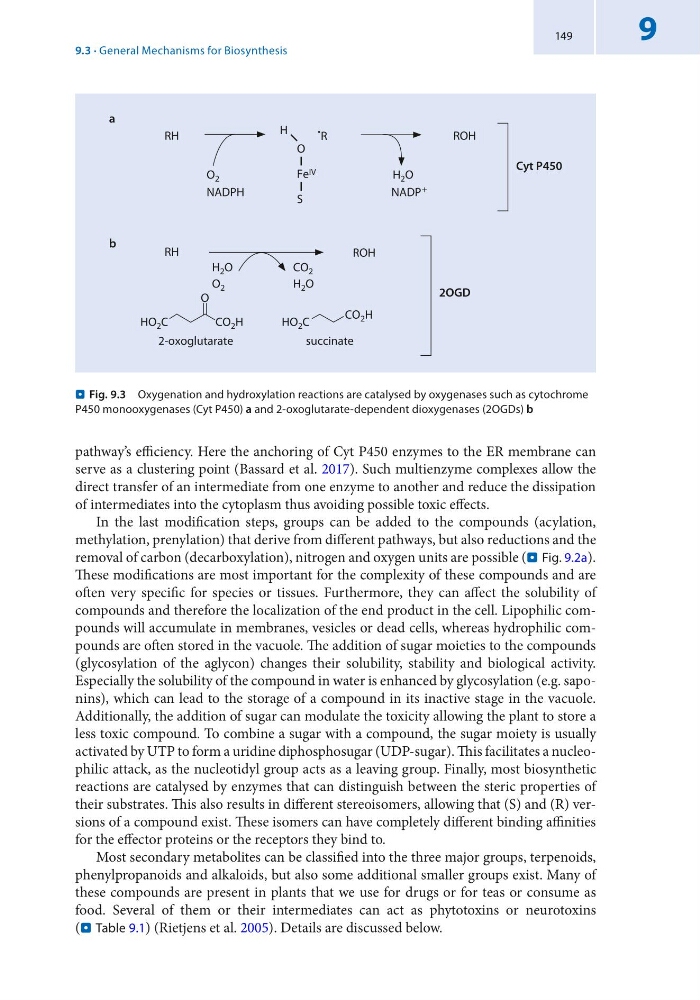
. Fig. 9.3 Oxygenation and hydroxylation reactions are catalysed by oxygenases such as cytochrome
P450 monooxygenases (Cyt P450) a and 2-oxoglutarate-dependent dioxygenases (2OGDs) b
9.3 · General Mechanisms for Biosynthesis
9
pathway’s efficiency. Here the anchoring of Cyt P450 enzymes to the ER membrane can
serve as a clustering point (Bassard et al. 2017). Such multienzyme complexes allow the
direct transfer of an intermediate from one enzyme to another and reduce the dissipation
of intermediates into the cytoplasm thus avoiding possible toxic effects.
In the last modification steps, groups can be added to the compounds (acylation,
methylation, prenylation) that derive from different pathways, but also reductions and the
removal of carbon (decarboxylation), nitrogen and oxygen units are possible (. Fig. 9.2a).
These modifications are most important for the complexity of these compounds and are
often very specific for species or tissues. Furthermore, they can affect the solubility of
compounds and therefore the localization of the end product in the cell. Lipophilic compounds will accumulate in membranes, vesicles or dead cells, whereas hydrophilic compounds are often stored in the vacuole. The addition of sugar moieties to the compounds
(glycosylation of the aglycon) changes their solubility, stability and biological activity.
Especially the solubility of the compound in water is enhanced by glycosylation (e.g. saponins), which can lead to the storage of a compound in its inactive stage in the vacuole.
Additionally, the addition of sugar can modulate the toxicity allowing the plant to store a
less toxic compound. To combine a sugar with a compound, the sugar moiety is usually
activated by UTP to form a uridine diphosphosugar (UDP-sugar). This facilitates a nucleophilic attack, as the nucleotidyl group acts as a leaving group. Finally, most biosynthetic
reactions are catalysed by enzymes that can distinguish between the steric properties of
their substrates. This also results in different stereoisomers, allowing that (S) and (R) versions of a compound exist. These isomers can have completely different binding affinities
for the effector proteins or the receptors they bind to.
Most secondary metabolites can be classified into the three major groups, terpenoids,
phenylpropanoids and alkaloids, but also some additional smaller groups exist. Many of
these compounds are present in plants that we use for drugs or for teas or consume as
food. Several of them or their intermediates can act as phytotoxins or neurotoxins
(. Table 9.1) (Rietjens et al. 2005). Details are discussed below.
a
b
RH
ROH
2-oxoglutarate
succinate
RH
ROH
R
Fe IV
O
S
H
O 2
NADPH
H 2 O
H 2 O
HO 2 C
H O 2 C
CO 2 H
CO 2 H
H 2 O
O 2
O
CO 2
NADP +
2OGD
Cyt P450
. Fig. 9.3 Oxygenation and hydroxylation reactions are catalysed by oxygenases such as cytochrome
P450 monooxygenases (Cyt P450) a and 2-oxoglutarate-dependent dioxygenases (2OGDs) b
9.3 · General Mechanisms for Biosynthesis