

148
9
been identified so far. In plants up to 1% of all genes probably code for Cyt P450 enzymes,
indicating the variation of modifications that can be performed (Mizutani and Ohta 2010;
Nelson and Werck-Reichhart 2011). Metabolons, an “assembly line” of enzymes, where
enzymes cluster together working like a conveyor belt, have been suggested to increase a
a
primary
metabolites
Cyclisation
Acylation
Methylation
Prenylation
Oxidation
Reduction
Glycosylation
diversity
b Aldol reaction
c Claisen condensation
d Mannich reaction
+
+
e Diels-Alder reaction
+
f Pictet-Spengler reaction
+
+
secondary metabolites
enol
keton
amine
keton
keton
alken
dien
olefi n
amine
keton
enol
ester
ester
R 1
R 1
H
N
R 1
R 2
R 2
R 4
R 5
R 6
R 6
R 5
R 2
R 2
R 2
R 2
R 2
R 2
R 1
R 1
H H
HOR
OR
OR
OR
OR
OR
OR
H
R 1
R 1
R 1
R 1
R 1
H
OR
H
R 3 R 4
N
O
O
O
O
O
O
O
O
OH
O
O H
O
O
O
OR
R 2
R 3
R 3
R 3
O
NH 2
NH
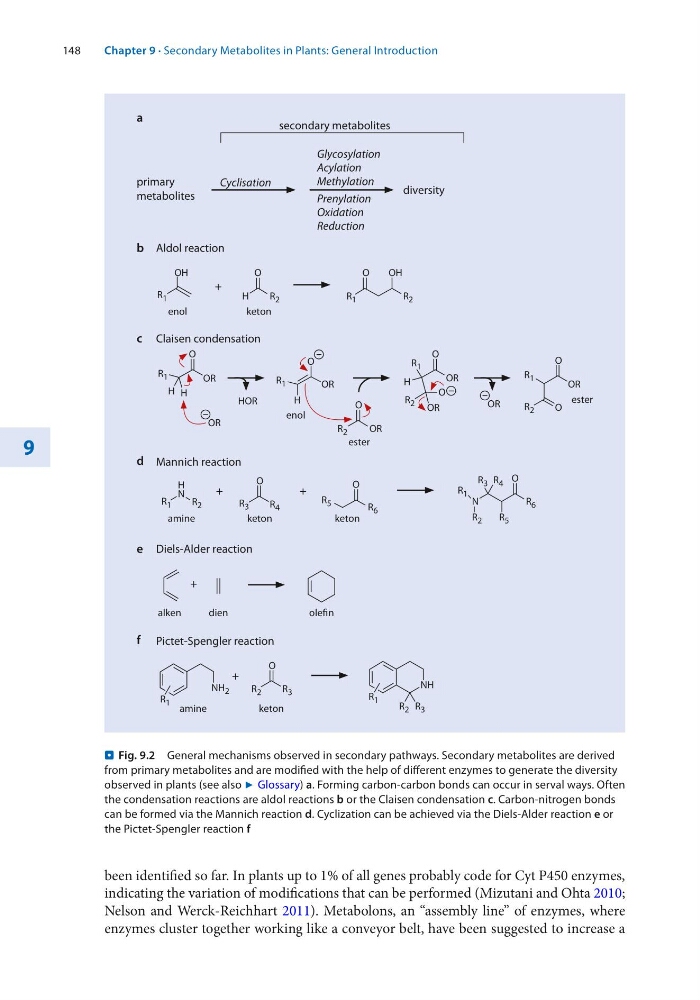
. Fig. 9.2 General mechanisms observed in secondary pathways. Secondary metabolites are derived
from primary metabolites and are modified with the help of different enzymes to generate the diversity
observed in plants (see also 7 Glossary) a. Forming carbon-carbon bonds can occur in serval ways. Often
the condensation reactions are aldol reactions b or the Claisen condensation c. Carbon-nitrogen bonds
can be formed via the Mannich reaction d. Cyclization can be achieved via the Diels-Alder reaction e or
the Pictet-Spengler reaction f
Chapter 9 · Secondary Metabolites in Plants: General Introduction
9
been identified so far. In plants up to 1% of all genes probably code for Cyt P450 enzymes,
indicating the variation of modifications that can be performed (Mizutani and Ohta 2010;
Nelson and Werck-Reichhart 2011). Metabolons, an “assembly line” of enzymes, where
enzymes cluster together working like a conveyor belt, have been suggested to increase a
a
primary
metabolites
Cyclisation
Acylation
Methylation
Prenylation
Oxidation
Reduction
Glycosylation
diversity
b Aldol reaction
c Claisen condensation
d Mannich reaction
+
+
e Diels-Alder reaction
+
f Pictet-Spengler reaction
+
+
secondary metabolites
enol
keton
amine
keton
keton
alken
dien
olefi n
amine
keton
enol
ester
ester
R 1
R 1
H
N
R 1
R 2
R 2
R 4
R 5
R 6
R 6
R 5
R 2
R 2
R 2
R 2
R 2
R 2
R 1
R 1
H H
HOR
OR
OR
OR
OR
OR
OR
H
R 1
R 1
R 1
R 1
R 1
H
OR
H
R 3 R 4
N
O
O
O
O
O
O
O
O
OH
O
O H
O
O
O
OR
R 2
R 3
R 3
R 3
O
NH 2
NH
. Fig. 9.2 General mechanisms observed in secondary pathways. Secondary metabolites are derived
from primary metabolites and are modified with the help of different enzymes to generate the diversity
observed in plants (see also 7 Glossary) a. Forming carbon-carbon bonds can occur in serval ways. Often
the condensation reactions are aldol reactions b or the Claisen condensation c. Carbon-nitrogen bonds
can be formed via the Mannich reaction d. Cyclization can be achieved via the Diels-Alder reaction e or
the Pictet-Spengler reaction f
Chapter 9 · Secondary Metabolites in Plants: General Introduction