

125
8
Box 8.1 Nicotine and the onset of modern forensics
In 1851, Hippolyte Visart de Bocarmé allegedly poisoned his brother-in-law, Gustave Fougnies,
with an extract of tobacco leaves that he mixed into Fougnies’ dinner. The toxic properties of
nicotine were already known, and Visart de Bocarmé had tested his concoction on cats and birds.
He then used the extract for the murder believing that the substance could not be detected in
human tissue. However, the Belgian chemist Jean Stas proofed that Fougnies was poisoned by
developing a method to extract the alkaloid from the tissue (Wennig 2009) so that it could be
identified. While improved, fundamentally the same analytical method to extract nicotine and
other alkaloids from biological specimen is still employed today
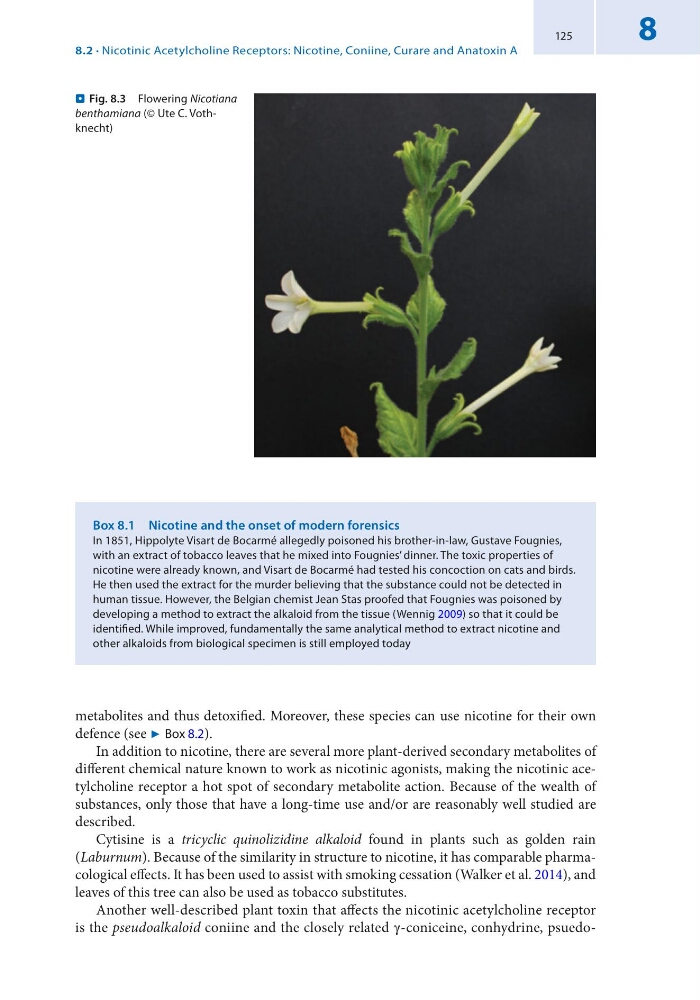
. Fig. 8.3 Flowering Nicotiana
benthamiana (© Ute C. Vothknecht)
metabolites and thus detoxified. Moreover, these species can use nicotine for their own
defence (see 7 Box 8.2).
In addition to nicotine, there are several more plant-derived secondary metabolites of
different chemical nature known to work as nicotinic agonists, making the nicotinic acetylcholine receptor a hot spot of secondary metabolite action. Because of the wealth of
substances, only those that have a long-time use and/or are reasonably well studied are
described.
Cytisine is a tricyclic quinolizidine alkaloid found in plants such as golden rain
(Laburnum). Because of the similarity in structure to nicotine, it has comparable pharmacological effects. It has been used to assist with smoking cessation (Walker et al. 2014), and
leaves of this tree can also be used as tobacco substitutes.
Another well-described plant toxin that affects the nicotinic acetylcholine receptor
is the pseudoalkaloid coniine and the closely related γ-coniceine, conhydrine, psuedo8.2 · Nicotinic Acetylcholine Receptors: Nicotine, Coniine, Curare and Anatoxin A
8
Box 8.1 Nicotine and the onset of modern forensics
In 1851, Hippolyte Visart de Bocarmé allegedly poisoned his brother-in-law, Gustave Fougnies,
with an extract of tobacco leaves that he mixed into Fougnies’ dinner. The toxic properties of
nicotine were already known, and Visart de Bocarmé had tested his concoction on cats and birds.
He then used the extract for the murder believing that the substance could not be detected in
human tissue. However, the Belgian chemist Jean Stas proofed that Fougnies was poisoned by
developing a method to extract the alkaloid from the tissue (Wennig 2009) so that it could be
identified. While improved, fundamentally the same analytical method to extract nicotine and
other alkaloids from biological specimen is still employed today
. Fig. 8.3 Flowering Nicotiana
benthamiana (© Ute C. Vothknecht)
metabolites and thus detoxified. Moreover, these species can use nicotine for their own
defence (see 7 Box 8.2).
In addition to nicotine, there are several more plant-derived secondary metabolites of
different chemical nature known to work as nicotinic agonists, making the nicotinic acetylcholine receptor a hot spot of secondary metabolite action. Because of the wealth of
substances, only those that have a long-time use and/or are reasonably well studied are
described.
Cytisine is a tricyclic quinolizidine alkaloid found in plants such as golden rain
(Laburnum). Because of the similarity in structure to nicotine, it has comparable pharmacological effects. It has been used to assist with smoking cessation (Walker et al. 2014), and
leaves of this tree can also be used as tobacco substitutes.
Another well-described plant toxin that affects the nicotinic acetylcholine receptor
is the pseudoalkaloid coniine and the closely related γ-coniceine, conhydrine, psuedo8.2 · Nicotinic Acetylcholine Receptors: Nicotine, Coniine, Curare and Anatoxin A