

124
8
nicotine itself is no longer a pesticide of choice, nicotine analogues such as imidacloprid
are currently widely used for these purposes. N. rustica, known in South America as
mapacho and in Vietnam as thuoc lao (thuốc lào), is an even more potent variety of
tobacco that contains several times more nicotine than N. tabacum and is thus used to
produce organic pesticides.
Interestingly, nicotine is synthesized in the roots and then gets transported to the
aerial parts of the tobacco plant where it accumulates in leave tissue. While it is present to
a certain extent at all times, wild species of tobacco increase the synthesis of nicotine after
leaf wounding (Baldwin 1988). It acts as an herbicide leading pests, such as caterpillars, to
abandon wounded leaves.
However, in the ongoing arms race between plants and their enemies, several tobaccoadapted species have become insensitive to nicotine, e.g. Manduca sexta, the tobacco
hornworm (Wink and Theile 2002). It was shown that insensitivity is not caused by a
change in the nicotine binding site on the nicotinic acetylcholine receptor. Moreover,
these species are also insensitive to alkaloids affecting other receptors. Thus, it is believed
that in these caterpillars toxic alkaloids are quickly excreted and/or convert to harmless
Nicotine
+
Coniine
–
Anatoxin A
+
Arecoline
–
Turbocurarine
–
Cytisine
+
Lobeline
+
Nicotinic acetylcholine
receptor
Acetylcholine
ENDOGENOUS:
H
N
O
O
O
N
N
H
H
N
O
O
N
H
N
N
NH
H
OH
H
O
H
H
N
O
OH
O
O
HO
H
N
+
+
N
O
O
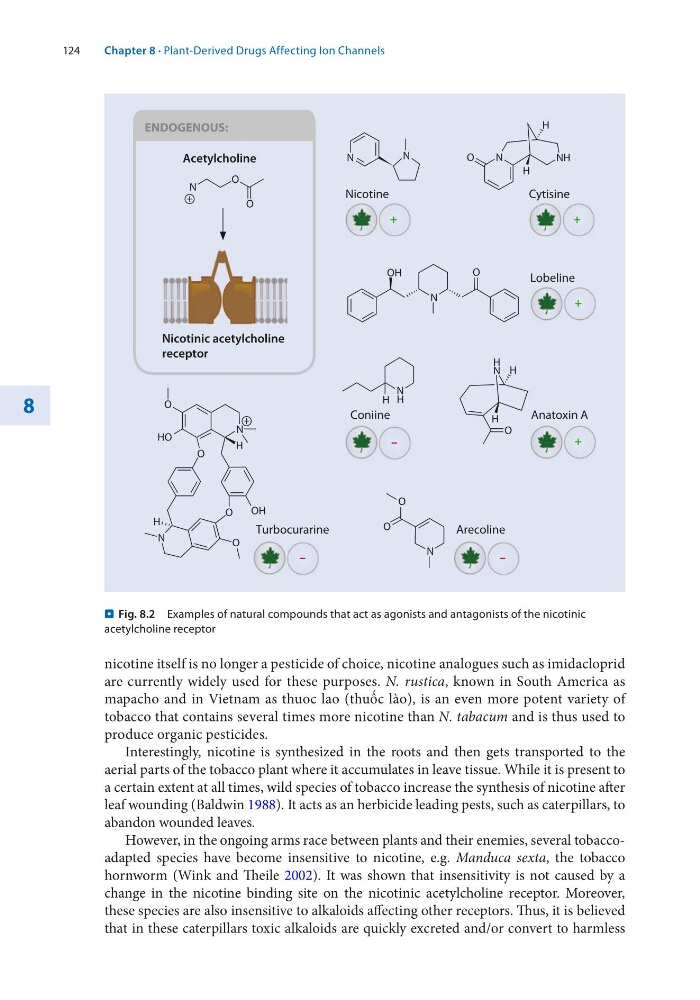
. Fig. 8.2 Examples of natural compounds that act as agonists and antagonists of the nicotinic
acetylcholine receptor
Chapter 8 · Plant-Derived Drugs Affecting Ion Channels
8
nicotine itself is no longer a pesticide of choice, nicotine analogues such as imidacloprid
are currently widely used for these purposes. N. rustica, known in South America as
mapacho and in Vietnam as thuoc lao (thuốc lào), is an even more potent variety of
tobacco that contains several times more nicotine than N. tabacum and is thus used to
produce organic pesticides.
Interestingly, nicotine is synthesized in the roots and then gets transported to the
aerial parts of the tobacco plant where it accumulates in leave tissue. While it is present to
a certain extent at all times, wild species of tobacco increase the synthesis of nicotine after
leaf wounding (Baldwin 1988). It acts as an herbicide leading pests, such as caterpillars, to
abandon wounded leaves.
However, in the ongoing arms race between plants and their enemies, several tobaccoadapted species have become insensitive to nicotine, e.g. Manduca sexta, the tobacco
hornworm (Wink and Theile 2002). It was shown that insensitivity is not caused by a
change in the nicotine binding site on the nicotinic acetylcholine receptor. Moreover,
these species are also insensitive to alkaloids affecting other receptors. Thus, it is believed
that in these caterpillars toxic alkaloids are quickly excreted and/or convert to harmless
Nicotine
+
Coniine
–
Anatoxin A
+
Arecoline
–
Turbocurarine
–
Cytisine
+
Lobeline
+
Nicotinic acetylcholine
receptor
Acetylcholine
ENDOGENOUS:
H
N
O
O
O
N
N
H
H
N
O
O
N
H
N
N
NH
H
OH
H
O
H
H
N
O
OH
O
O
HO
H
N
+
+
N
O
O
. Fig. 8.2 Examples of natural compounds that act as agonists and antagonists of the nicotinic
acetylcholine receptor
Chapter 8 · Plant-Derived Drugs Affecting Ion Channels