

108
7
The use of these plant-derived compounds to affect the human mind has a long history. Already the Atharvaveda, an old sacred Indian text, and the first Chinese pharmaceutical book describe the medical powers of Cannabis (Li 1973). A description by
Herodotus (500 BC) of the habit of central Eurasian Scythians to take cannabis steam
baths and recent findings of hemp seed pots in a Scythian burial site support the idea that
the nomadic tribe brought psychoactive Cannabis strains to Europe where its usage is
known throughout the classical Greek and Roman time. By contrast, hemp – a strain of
Cannabis (Cannabis sativa L.) that has low THC content and therefore little to none psychoactivity – has been used for fibre production since over 10,000 years in Europe (see
7 Box 7.2). Impressions of plant fibre cordage were found in clay fragment at a burial site
in Czechoslovakia dating back to 26,900 BC, making it one of the oldest human artefacts
(Pringle 1997; Fleming and Clarke 1998).
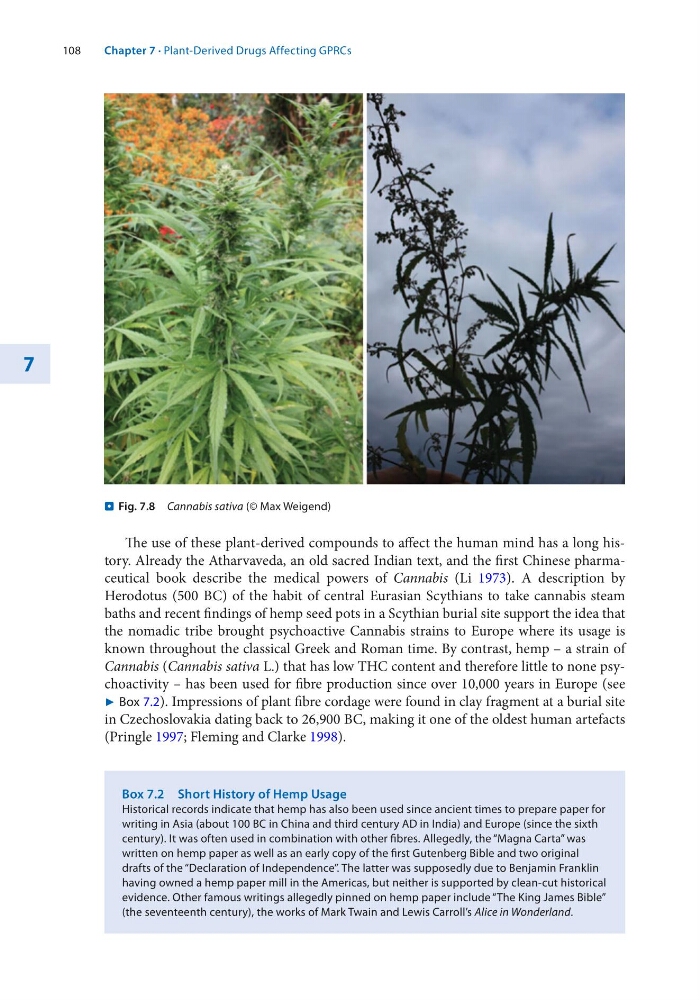
. Fig. 7.8 Cannabis sativa (© Max Weigend)
Box 7.2 Short History of Hemp Usage
Historical records indicate that hemp has also been used since ancient times to prepare paper for
writing in Asia (about 100 BC in China and third century AD in India) and Europe (since the sixth
century). It was often used in combination with other fibres. Allegedly, the “Magna Carta” was
written on hemp paper as well as an early copy of the first Gutenberg Bible and two original
drafts of the “Declaration of Independence”. The latter was supposedly due to Benjamin Franklin
having owned a hemp paper mill in the Americas, but neither is supported by clean-cut historical
evidence. Other famous writings allegedly pinned on hemp paper include “The King James Bible”
(the seventeenth century), the works of Mark Twain and Lewis Carroll’s Alice in Wonderland.
Chapter 7 · Plant-Derived Drugs Affecting GPRCs
7
The use of these plant-derived compounds to affect the human mind has a long history. Already the Atharvaveda, an old sacred Indian text, and the first Chinese pharmaceutical book describe the medical powers of Cannabis (Li 1973). A description by
Herodotus (500 BC) of the habit of central Eurasian Scythians to take cannabis steam
baths and recent findings of hemp seed pots in a Scythian burial site support the idea that
the nomadic tribe brought psychoactive Cannabis strains to Europe where its usage is
known throughout the classical Greek and Roman time. By contrast, hemp – a strain of
Cannabis (Cannabis sativa L.) that has low THC content and therefore little to none psychoactivity – has been used for fibre production since over 10,000 years in Europe (see
7 Box 7.2). Impressions of plant fibre cordage were found in clay fragment at a burial site
in Czechoslovakia dating back to 26,900 BC, making it one of the oldest human artefacts
(Pringle 1997; Fleming and Clarke 1998).
. Fig. 7.8 Cannabis sativa (© Max Weigend)
Box 7.2 Short History of Hemp Usage
Historical records indicate that hemp has also been used since ancient times to prepare paper for
writing in Asia (about 100 BC in China and third century AD in India) and Europe (since the sixth
century). It was often used in combination with other fibres. Allegedly, the “Magna Carta” was
written on hemp paper as well as an early copy of the first Gutenberg Bible and two original
drafts of the “Declaration of Independence”. The latter was supposedly due to Benjamin Franklin
having owned a hemp paper mill in the Americas, but neither is supported by clean-cut historical
evidence. Other famous writings allegedly pinned on hemp paper include “The King James Bible”
(the seventeenth century), the works of Mark Twain and Lewis Carroll’s Alice in Wonderland.
Chapter 7 · Plant-Derived Drugs Affecting GPRCs