

107
7
7.4 Cannabinoid Receptors: Phytocannabinoids
Cannabinoid receptors (CB1 and CB2) are regulated in animals by a group of lipid-based
ligands called endocannabinoids. However, plant-derived ligands for these receptors were
known well before endocannabinoids were identified and even provided the name for this
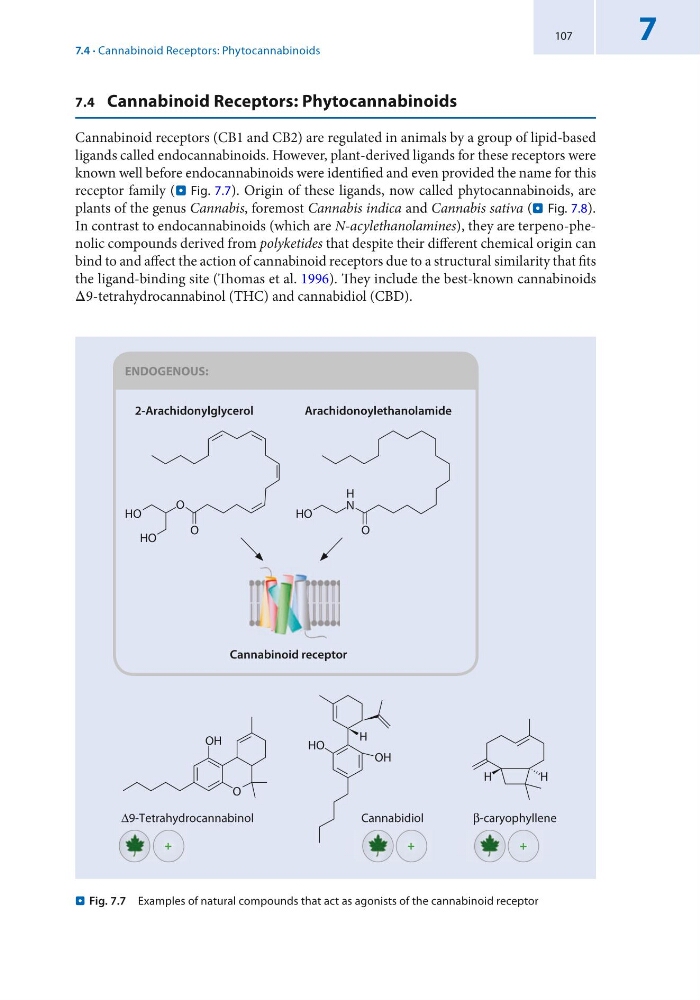
receptor family (. Fig. 7.7). Origin of these ligands, now called phytocannabinoids, are
plants of the genus Cannabis, foremost Cannabis indica and Cannabis sativa (. Fig. 7.8).
In contrast to endocannabinoids (which are N-acylethanolamines), they are terpeno-phenolic compounds derived from polyketides that despite their different chemical origin can
bind to and affect the action of cannabinoid receptors due to a structural similarity that fits
the ligand- binding site (Thomas et al. 1996). They include the best-known cannabinoids
Δ9-tetrahydrocannabinol (THC) and cannabidiol (CBD).
+
Cannabinoid receptor
2-Arachidonylglycerol
Cannabidiol
+
+
∆9-Tetrahydrocannabinol
Arachidonoylethanolamide
ENDOGENOUS:
β-caryophyllene
HO
OH
OH
HO
H
H
H
O
HO
H
N
HO
O
O
O
. Fig. 7.7 Examples of natural compounds that act as agonists of the cannabinoid receptor
7.4 · Cannabinoid Receptors: Phytocannabinoids
7
7.4 Cannabinoid Receptors: Phytocannabinoids
Cannabinoid receptors (CB1 and CB2) are regulated in animals by a group of lipid-based
ligands called endocannabinoids. However, plant-derived ligands for these receptors were
known well before endocannabinoids were identified and even provided the name for this
receptor family (. Fig. 7.7). Origin of these ligands, now called phytocannabinoids, are
plants of the genus Cannabis, foremost Cannabis indica and Cannabis sativa (. Fig. 7.8).
In contrast to endocannabinoids (which are N-acylethanolamines), they are terpeno-phenolic compounds derived from polyketides that despite their different chemical origin can
bind to and affect the action of cannabinoid receptors due to a structural similarity that fits
the ligand- binding site (Thomas et al. 1996). They include the best-known cannabinoids
Δ9-tetrahydrocannabinol (THC) and cannabidiol (CBD).
+
Cannabinoid receptor
2-Arachidonylglycerol
Cannabidiol
+
+
∆9-Tetrahydrocannabinol
Arachidonoylethanolamide
ENDOGENOUS:
β-caryophyllene
HO
OH
OH
HO
H
H
H
O
HO
H
N
HO
O
O
O
. Fig. 7.7 Examples of natural compounds that act as agonists of the cannabinoid receptor
7.4 · Cannabinoid Receptors: Phytocannabinoids