

100
7
What You Will Learn in This Chapter
The presence of GPRCs in plants is still a question of debate. While G-protein coupled signalling exists, the signalling cycle is typically not activated by seven transmembrane-spanning
receptors. By contrast, many plant secondary metabolites are known to affect human
GPRCs. Some are very specific for a single type of receptor; however, many others act on
more than one type, albeit with often strongly different affinities.
7.1 Muscarinic Acetylcholine Receptors: Atropine, Muscarine
and Scopolamine
In case of the muscarinic acetylcholine receptor, the name-giving compound is derived
from some poisonous mushrooms, especially of the Inocybe and Citcybe species, such as
the ivory funnel (Malone et al. 1962; Lurie et al. 2009). Muscarine, a quaternary amine,
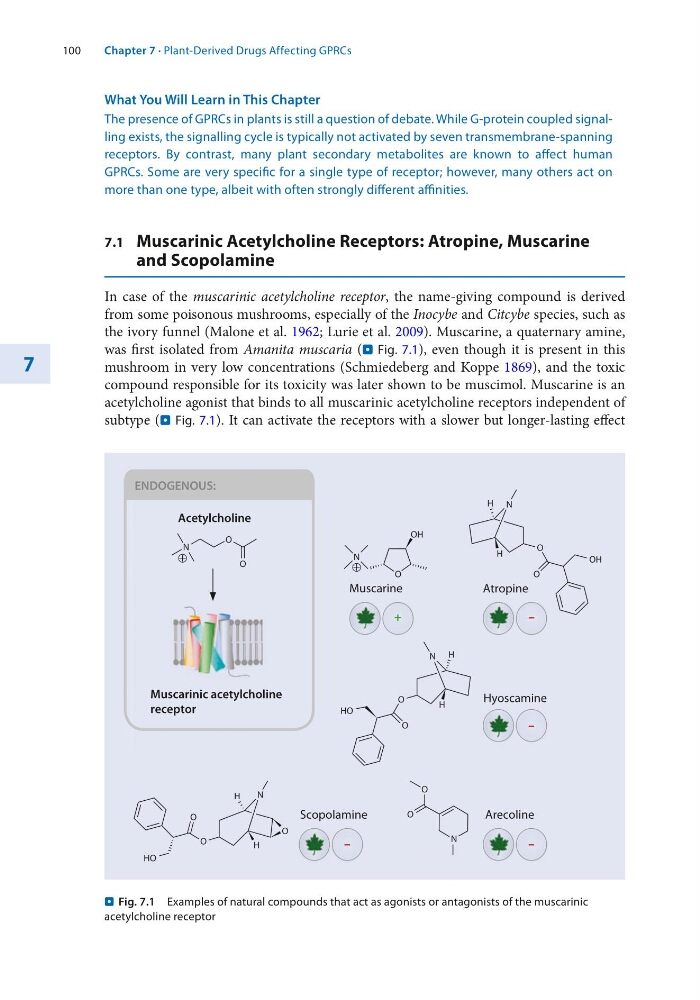
was first isolated from Amanita muscaria (. Fig. 7.1), even though it is present in this
mushroom in very low concentrations (Schmiedeberg and Koppe 1869), and the toxic
compound responsible for its toxicity was later shown to be muscimol. Muscarine is an
acetylcholine agonist that binds to all muscarinic acetylcholine receptors independent of
subtype (. Fig. 7.1). It can activate the receptors with a slower but longer-lasting effect
Muscarinic acetylcholine
receptor
Acetylcholine
ENDOGENOUS:
Muscarine
+
Scopolamine
–
Hyoscamine
–
Atropine
–
Arecoline
–
O
O
O
O
O
O
O
HO
HO
O
O
H
N
H
O
H
H
N
O
O
H
H
OH
OH
N
N
N
N
. Fig. 7.1 Examples of natural compounds that act as agonists or antagonists of the muscarinic
acetylcholine receptor
Chapter 7 · Plant-Derived Drugs Affecting GPRCs
7
What You Will Learn in This Chapter
The presence of GPRCs in plants is still a question of debate. While G-protein coupled signalling exists, the signalling cycle is typically not activated by seven transmembrane-spanning
receptors. By contrast, many plant secondary metabolites are known to affect human
GPRCs. Some are very specific for a single type of receptor; however, many others act on
more than one type, albeit with often strongly different affinities.
7.1 Muscarinic Acetylcholine Receptors: Atropine, Muscarine
and Scopolamine
In case of the muscarinic acetylcholine receptor, the name-giving compound is derived
from some poisonous mushrooms, especially of the Inocybe and Citcybe species, such as
the ivory funnel (Malone et al. 1962; Lurie et al. 2009). Muscarine, a quaternary amine,
was first isolated from Amanita muscaria (. Fig. 7.1), even though it is present in this
mushroom in very low concentrations (Schmiedeberg and Koppe 1869), and the toxic
compound responsible for its toxicity was later shown to be muscimol. Muscarine is an
acetylcholine agonist that binds to all muscarinic acetylcholine receptors independent of
subtype (. Fig. 7.1). It can activate the receptors with a slower but longer-lasting effect
Muscarinic acetylcholine
receptor
Acetylcholine
ENDOGENOUS:
Muscarine
+
Scopolamine
–
Hyoscamine
–
Atropine
–
Arecoline
–
O
O
O
O
O
O
O
HO
HO
O
O
H
N
H
O
H
H
N
O
O
H
H
OH
OH
N
N
N
N
. Fig. 7.1 Examples of natural compounds that act as agonists or antagonists of the muscarinic
acetylcholine receptor
Chapter 7 · Plant-Derived Drugs Affecting GPRCs