

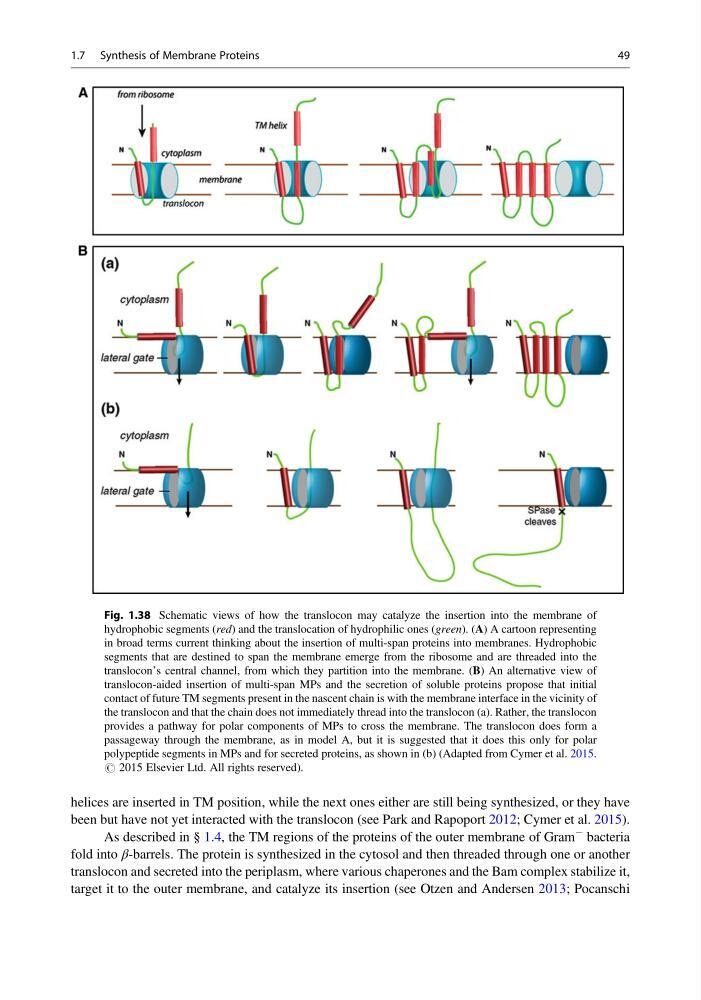
helices are inserted in TM position, while the next ones either are still being synthesized, or they have
been but have not yet interacted with the translocon (see Park and Rapoport 2012; Cymer et al. 2015).
As described in § 1.4, the TM regions of the proteins of the outer membrane of Gram
À bacteria
fold into β-barrels. The protein is synthesized in the cytosol and then threaded through one or another
translocon and secreted into the periplasm, where various chaperones and the Bam complex stabilize it,
target it to the outer membrane, and catalyze its insertion (see Otzen and Andersen 2013; Pocanschi
Fig. 1.38 Schematic views of how the translocon may catalyze the insertion into the membrane of
hydrophobic segments (red) and the translocation of hydrophilic ones (green). (A) A cartoon representing
in broad terms current thinking about the insertion of multi-span proteins into membranes. Hydrophobic
segments that are destined to span the membrane emerge from the ribosome and are threaded into the
translocon’s central channel, from which they partition into the membrane. (B) An alternative view of
translocon-aided insertion of multi-span MPs and the secretion of soluble proteins propose that initial
contact of future TM segments present in the nascent chain is with the membrane interface in the vicinity of
the translocon and that the chain does not immediately thread into the translocon (a). Rather, the translocon
provides a pathway for polar components of MPs to cross the membrane. The translocon does form a
passageway through the membrane, as in model A, but it is suggested that it does this only for polar
polypeptide segments in MPs and for secreted proteins, as shown in (b) (Adapted from Cymer et al. 2015.
# 2015 Elsevier Ltd. All rights reserved).
1.7 Synthesis of Membrane Proteins
49
been but have not yet interacted with the translocon (see Park and Rapoport 2012; Cymer et al. 2015).
As described in § 1.4, the TM regions of the proteins of the outer membrane of Gram
À bacteria
fold into β-barrels. The protein is synthesized in the cytosol and then threaded through one or another
translocon and secreted into the periplasm, where various chaperones and the Bam complex stabilize it,
target it to the outer membrane, and catalyze its insertion (see Otzen and Andersen 2013; Pocanschi
Fig. 1.38 Schematic views of how the translocon may catalyze the insertion into the membrane of
hydrophobic segments (red) and the translocation of hydrophilic ones (green). (A) A cartoon representing
in broad terms current thinking about the insertion of multi-span proteins into membranes. Hydrophobic
segments that are destined to span the membrane emerge from the ribosome and are threaded into the
translocon’s central channel, from which they partition into the membrane. (B) An alternative view of
translocon-aided insertion of multi-span MPs and the secretion of soluble proteins propose that initial
contact of future TM segments present in the nascent chain is with the membrane interface in the vicinity of
the translocon and that the chain does not immediately thread into the translocon (a). Rather, the translocon
provides a pathway for polar components of MPs to cross the membrane. The translocon does form a
passageway through the membrane, as in model A, but it is suggested that it does this only for polar
polypeptide segments in MPs and for secreted proteins, as shown in (b) (Adapted from Cymer et al. 2015.
# 2015 Elsevier Ltd. All rights reserved).
1.7 Synthesis of Membrane Proteins
49