

In Study 15.4, the feasibility of eliciting protection against a vaginal challenge with Chlamydia
was examined using the mouse/C. muridarum system, and the immune mechanisms involved in
protection were characterized, using in parallel nMOMP/A8-35 and nMOMP/Z3-14 preparations.
The vaccine formulated with nMOMP/A8-35 complexes was found to induce a very robust protection
against a vaginal infection and to preserve fertility. The protection is dependent on CD4
+ T cells and
may result from the increased accessibility to the immune system of epitopes in the nMOMP/A8-35
formulation as compared to the nMOMP/Z3-14 one. The latter is suggested by two observations: first,
more MOMP peptides are recognized by circulating antibodies in the first case than in the second;
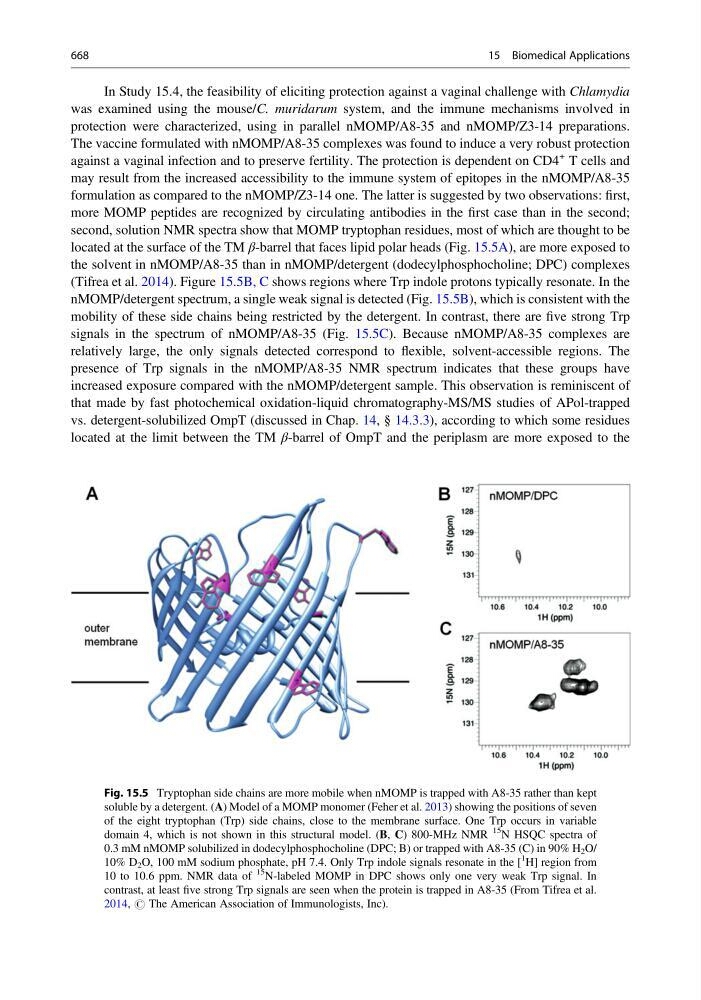
second, solution NMR spectra show that MOMP tryptophan residues, most of which are thought to be
located at the surface of the TM β-barrel that faces lipid polar heads (Fig. 15.5A), are more exposed to
the solvent in nMOMP/A8-35 than in nMOMP/detergent (dodecylphosphocholine; DPC) complexes
(Tifrea et al. 2014). Figure 15.5B, C shows regions where Trp indole protons typically resonate. In the
nMOMP/detergent spectrum, a single weak signal is detected (Fig. 15.5B), which is consistent with the
mobility of these side chains being restricted by the detergent. In contrast, there are five strong Trp
signals in the spectrum of nMOMP/A8-35 (Fig. 15.5C). Because nMOMP/A8-35 complexes are
relatively large, the only signals detected correspond to flexible, solvent-accessible regions. The
presence of Trp signals in the nMOMP/A8-35 NMR spectrum indicates that these groups have
increased exposure compared with the nMOMP/detergent sample. This observation is reminiscent of
that made by fast photochemical oxidation-liquid chromatography-MS/MS studies of APol-trapped
vs. detergent-solubilized OmpT (discussed in Chap. 14, § 14.3.3), according to which some residues
located at the limit between the TM β-barrel of OmpT and the periplasm are more exposed to the
Fig. 15.5 Tryptophan side chains are more mobile when nMOMP is trapped with A8-35 rather than kept
soluble by a detergent. (A) Model of a MOMP monomer (Feher et al. 2013) showing the positions of seven
of the eight tryptophan (Trp) side chains, close to the membrane surface. One Trp occurs in variable
domain 4, which is not shown in this structural model. (B, C) 800-MHz NMR
15
N HSQC spectra of
0.3 mM nMOMP solubilized in dodecylphosphocholine (DPC; B) or trapped with A8-35 (C) in 90% H 2 O/
10% D 2 O, 100 mM sodium phosphate, pH 7.4. Only Trp indole signals resonate in the [
1
H] region from
10 to 10.6 ppm. NMR data of
15
N-labeled MOMP in DPC shows only one very weak Trp signal. In
contrast, at least five strong Trp signals are seen when the protein is trapped in A8-35 (From Tifrea et al.
2014, # The American Association of Immunologists, Inc).
668
15 Biomedical Applications